



In this complete guide, you will learn what USDC is, how it keeps its value, which blockchains support it, how people use it, and what risks you should understand before you buy or hold it. Whether you are a complete beginner or an experienced trader, this article will help you understand USDC clearly.
What Is USD Coin (USDC)?
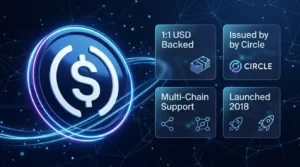
USD Coin (USDC) is a dollar-backed stablecoin, a type of cryptocurrency designed to always be worth about 1 US dollar. It is issued by Circle, a financial technology company, and it lives on public blockchains, which means anyone with an internet connection and a compatible wallet can send, receive, and hold it.
Unlike Bitcoin or Ethereum, whose prices depend on market demand and speculation, USDC is built for stability. One USDC is meant to equal one dollar, so its price should stay very close to $1.00 at all times. This makes it useful for trading, payments, saving, and moving money across borders without the volatility that affects most other digital assets.
A Brief History of USDC
USDC was launched in 2018 as a joint effort between Circle and Coinbase, one of the largest cryptocurrency exchanges in the world. The two companies created a consortium to manage the token and promote open, transparent standards for dollar-based digital currency.
In its early years, USDC grew steadily as more exchanges, wallets, and decentralized finance (DeFi) applications added support for it. Over time, Circle took a larger role in managing the token, and USDC became one of the top stablecoins by market size. Today it is used by individuals, businesses, and financial institutions around the world, and it is supported on many major blockchain networks.
How Does USDC Maintain Its $1 Value?
The key to USDC’s stability is its 1:1 reserve backing. For every USDC token in circulation, the issuer is meant to hold the equivalent of one US dollar in reserve assets. These reserves are mainly held in cash and short-term US government securities, which are considered low-risk assets.
The process works through minting and redeeming:
- Minting: A user or institution deposits US dollars with Circle or an authorized partner. The same amount of USDC is then created on the blockchain.
- Circulation: The new USDC can be sent, traded, or used in applications like any other digital token.
- Redeeming: When a user wants to exchange USDC back into dollars, the tokens are sent back to the issuer, destroyed (burned), and the equivalent dollars are returned.
This mint-and-redeem system helps keep the market price close to $1. If USDC ever trades slightly below a dollar, approved participants can buy it cheaply and redeem it for a full dollar, which pushes the price back up. If it trades above a dollar, more USDC can be minted and sold, which brings the price down.
Understanding USDC Reserves and Transparency
Trust is the most important factor for any stablecoin. Because USDC’s value depends on the reserves behind it, users want to know that the money is really there. Circle publishes information about the composition of its reserves and makes regular attestation reports available to the public. You can review these details on the Circle transparency page.
This level of disclosure is one of the main reasons why many businesses and institutions prefer USDC. However, transparency reports are a snapshot in time, so it is always wise to check the latest information rather than rely on old data.
Which Blockchains Support USDC?
USDC is not limited to a single blockchain. It is available on multiple networks, including Ethereum, Solana, Base, Avalanche, Polygon, and others. Each network has different transaction speeds and fees, so you can choose the one that suits your needs.
For example, Ethereum offers the largest ecosystem of applications, while other networks may offer faster confirmations and lower fees. You can learn more about how stablecoins work on smart-contract platforms in this Ethereum.org stablecoin guide.
The important thing to remember is that USDC on one network is not automatically usable on another. Always confirm that the sender and receiver are using the same network before you transfer funds.
Main Uses of USDC
USDC has many practical uses in the digital economy:
- Trading and hedging: Traders often move into USDC during volatile markets to protect their profits without leaving the crypto ecosystem. It also serves as a common trading pair on exchanges.
- Cross-border payments: Sending money internationally through banks can be slow and expensive. USDC transfers can settle within seconds or minutes, at any time of day, often at a much lower cost.
- Decentralized finance (DeFi): USDC is widely used in lending platforms, liquidity pools, and other DeFi applications where a stable asset is needed.
- Saving in a stable asset: In countries where local currencies lose value quickly, many people use dollar stablecoins as a way to preserve purchasing power.
- Business payments: Companies use USDC for payroll, supplier invoices, freelancer payments, and international settlements.
- Online commerce: A growing number of merchants and platforms accept stablecoin payments, making them useful for digital services and remote work.
Benefits of Using USDC
- Price stability: USDC is far less volatile than most cryptocurrencies, which makes it easier to plan, budget, and price goods.
- Speed: Blockchain transfers can be completed in seconds or minutes, 24 hours a day, 7 days a week, including weekends and holidays.
- Low cost: Fees are often much lower than traditional international wire transfers.
- Accessibility: Anyone with a smartphone and internet access can hold USDC without needing a traditional bank account.
- Transparency: Regular reserve reporting gives users more visibility than many other digital assets.
- Programmability: As a blockchain token, USDC can be integrated into apps, smart contracts, and automated payment systems.
Risks You Should Know Before Using USDC
No financial asset is completely risk-free, and it is important to understand the downsides.
De-peg risk. In March 2023, USDC briefly fell well below $1 after the collapse of Silicon Valley Bank, where a portion of its cash reserves was held. The token recovered once the situation was resolved, but the event showed that even well-regarded stablecoins can be affected by problems in the traditional banking system.
Issuer and reserve risk. When you hold USDC, you rely on the issuer to manage reserves responsibly and to honor redemptions. If that trust is damaged, the value can be affected.
Regulatory changes. Governments around the world are still developing rules for stablecoins. New laws can change how USDC is issued, who can use it, and where it is available.
Technical and user-error risk. Sending USDC to the wrong address or the wrong network can result in permanent loss. Blockchain transactions cannot be reversed. Wallet hacks and phishing scams are also common threats.
Platform risk. If you keep USDC on an exchange or a yield platform, you are exposed to the risks of that platform as well, including hacks, withdrawal limits, or insolvency.
USDC vs. USDT: What Is the Difference?
The two most popular dollar-pegged stablecoins are USDC and USDT (Tether). Both aim to hold a value of $1, but there are differences.
USDT has historically had a larger market share and very deep liquidity on exchanges worldwide. USDC is often preferred by users who value regular reserve disclosures and a compliance-focused approach. The right choice depends on your region, the platforms you use, and your personal comfort level with each issuer’s practices.
Many traders keep both, using whichever offers better liquidity or lower fees on a particular exchange.

How to Buy and Use USDC Safely
If you are new to stablecoins, follow these steps:
- Choose a reputable exchange. Pick a well-known, regulated platform that is available in your country.
- Complete verification. Most exchanges require identity verification (KYC) before you can buy.
- Buy USDC. Use a supported payment method, such as a bank transfer or card.
- Consider a personal wallet. For long-term holding, moving your USDC to a self-custody wallet gives you full control.
- Check the network. Always double-check whether you are using Ethereum, Solana, or another network before sending.
- Send a small test amount first. This is a simple way to confirm that the address and network are correct.
- Protect your account. Enable two-factor authentication, use strong passwords, and never share your seed phrase with anyone.
Frequently Asked Questions
Is USDC safe?
USDC is considered one of the more transparent stablecoins, but it is not risk-free. Reserve, regulatory, technical, and platform risks still apply.
Is USDC the same as the US dollar?
No. It is a digital token designed to track the value of the dollar. It is not legal tender itself.
Can USDC lose its peg?
Yes. Temporary de-pegging can happen during periods of market stress, as seen in March 2023.
Does USDC earn interest?
The token itself does not pay interest. Some platforms offer yield or rewards programs, but these come with their own risks, so read the terms carefully.
Can I convert USDC back to cash?
Yes. You can sell USDC on an exchange or redeem it through eligible channels and withdraw the funds to your bank account, depending on your location and platform.
Final Thoughts
USDC has become a key building block of the crypto economy by combining the speed of blockchain technology with the stability of the US dollar. It makes trading easier, payments faster, and cross-border transfers cheaper. At the same time, it is important to remember that stablecoins carry risks, and no token is guaranteed to hold its value under all conditions.
Before using USDC, take time to learn how it works, choose trusted platforms, and protect your accounts carefully. With the right knowledge, USDC can be a useful tool for anyone exploring digital finance
