


Crypto cycle has its repeat characters: the meme coins that steal headlines, the layer-1s that promise to rebuild finance, and the legacy altcoins that refuse to fade away. XRP sits in that last category—but “legacy” doesn’t mean irrelevant. In fact, XRP often becomes most interesting when the broader market starts rotating away from pure speculation and back toward liquidity, real-world payment narratives, and coins with deep exchange support. That’s exactly why XRP is attracting fresh attention now.
The discussion isn’t just about price candles or hype. It’s increasingly about who is accumulating and why. XRP whales—large holders capable of moving markets—have historically played an outsized role in XRP’s volatility. At the same time, institutional interest in crypto has matured, with firms looking beyond Bitcoin and Ethereum for assets that can fit into specific strategies: cross-border payments, liquidity provisioning, custody-friendly tokens, and regulated access routes. When whales and institutions show signs of positioning, markets tend to listen.
Another reason XRP keeps returning to center stage is its reputation for sudden, powerful breakouts after long periods of consolidation. In crypto, compressed price action can act like a spring. If the right catalysts align—improving sentiment, rising liquidity, favorable regulatory clarity, and renewed demand—a new ATH becomes more than a meme. It becomes a plausible scenario traders and long-term holders start preparing for.
This article explores how XRP whales, institutions, on-chain behavior, market structure, and macro conditions may be building the case for XRP to challenge its previous peak. You’ll also see the risks that could delay or derail the next rally—because no narrative is complete without the fine print.
The XRP Story in 2026: More Than a Chart
XRP has always been a coin people love to debate. Some see it as a payments-focused asset with strong infrastructure, while others argue the market has moved on to newer networks. Yet despite the noise, XRP remains one of the most liquid altcoins globally. Liquidity matters because it attracts sophisticated participants—market makers, high-volume traders, and, increasingly, institutional desks that need reliable execution.
When analysts discuss XRP, they often frame it around utility: cross-border transfers, settlement efficiency, and a long-running vision of bridging traditional finance and crypto rails. Whether someone believes every part of that vision or not, the market still treats XRP as a “major,” which means it can benefit disproportionately when capital rotates into large-cap altcoins. That rotation phase is often where the “new ATH” conversations begin.
The most important takeaway is that XRP doesn’t need to be the newest tech to rally. It needs liquidity, attention, and a credible catalyst mix—particularly if broader crypto sentiment shifts bullish. In these moments, XRP whales and institutions can amplify momentum quickly, creating the kind of squeeze that turns a quiet market into a vertical move.
XRP Whales—What Their Moves Can Signal
Who Counts as a Whale in XRP?
In simple terms, XRP whales are addresses or entities holding large amounts of XRP relative to the average participant. Their influence comes from scale: when large holders accumulate, distribution tightens; when they sell aggressively, liquidity gets tested. This dynamic can matter even more for XRP because it is widely held across exchanges, long-term wallets, and entities tied to liquidity operations.
Because whale activity can overlap with exchange flows, custody movements, and large OTC transfers, it’s essential to interpret signals carefully. Not every big transfer is “bullish” or “bearish.” But patterns—like consistent net accumulation during dips or reduced exchange balances—can point to positioning ahead of a bigger move.
Why Whale Accumulation Often Precedes Breakouts
Crypto markets tend to reward patience. Large holders often build positions during low-volatility phases because it’s easier to buy without pushing price up. If XRP whales are accumulating, it can create a supply squeeze, especially when retail demand returns. In many historical runs, the strongest moves happen when price breaks a long-standing range and forces sidelined buyers to chase.
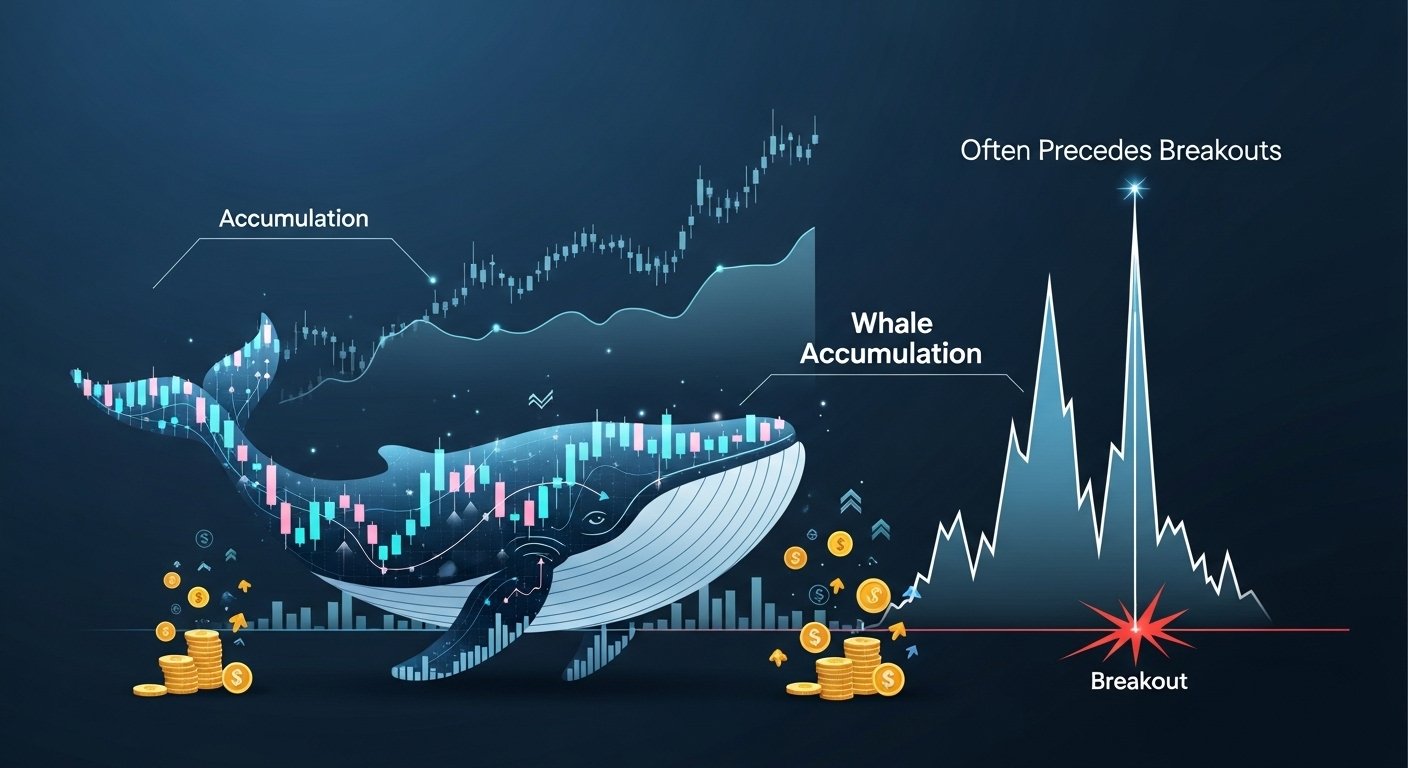
For XRP, whale accumulation can matter for another reason: the market watches it closely. Whale narratives can become self-fulfilling in the short term because they attract attention, and attention attracts liquidity. Once liquidity rises, breakouts become easier to sustain, and talk of XRP new ATH starts feeling less like a fantasy and more like a roadmap.
Distribution vs. Healthy Rotation
It’s also possible for whale activity to be misread. Whales may sell into strength, which is normal market behavior. The key is distinguishing between distribution that caps rallies and profit-taking that simply resets momentum. If XRP whales are selling while volume is increasing and price holds key levels, that can still be constructive—a market can absorb supply without collapsing, which often signals strength.
Institutions and XRP—Why the Narrative Is Changing
Institutional Crypto Has Evolved
Institutional participation in crypto has grown more sophisticated. Early on, “institutions” often meant a few hedge funds buying Bitcoin exposure. Today, institutional flows can include market-making firms, structured product desks, custody providers, and payment-linked entities exploring blockchain settlement. In this environment, XRP becomes relevant because it sits at an intersection of liquidity and payments narrative.
When institutions look at an altcoin, they often ask practical questions: Can it be custodied easily? Is there deep liquidity? Are derivatives available? Is the regulatory picture improving? XRP has historically checked several of these boxes, and when the market senses reduced uncertainty, institutional curiosity tends to rise.
Why Institutions Care About Liquidity and Settlement
One of the most important concepts in institutional trading is execution quality. Slippage is expensive. That’s why liquid, widely listed assets—like XRP—can draw more professional activity than smaller altcoins with thin order books. The XRP price can also react strongly when institutions shift from “watching” to “allocating,” because even modest portfolio exposure across multiple desks can create sustained demand.
Additionally, the ongoing focus on cross-border payments, faster settlement, and blockchain-based rails keeps the broader XRP narrative alive. Institutions don’t need to fully endorse every aspect of a project to trade it. They need a market thesis, liquidity, and catalysts.
Derivatives, ETPs, and the “Access” Factor
Institutions often prefer regulated or structured access when possible. That includes exchange-traded products, custody solutions, and derivatives. As crypto infrastructure matures, XRP can benefit from being a recognizable name with existing market depth. More access routes often translate into more capital participation, and that can feed the conditions needed for a new ATH attempt.
Why a New XRP ATH Could Be Next
Macro Cycle and Liquidity Waves
Crypto bull markets are usually liquidity-driven. When liquidity expands—through improving risk appetite, easing financial conditions, or simply renewed speculation—capital tends to flow from Bitcoin into large-cap altcoins. XRP often performs best during that rotation phase, when traders seek assets with strong liquidity and big upside potential relative to market cap.
If the broader market enters a sustained “risk-on” period, XRP can ride that wave, especially if narratives around whales and institutions remain supportive. A macro-driven alt season doesn’t guarantee a new ATH, but it can provide the fuel needed for one.
Market Structure—Long Consolidations Can Explode
Many traders watch for extended consolidation ranges because they store energy. When XRP compresses for long periods, it can set up the conditions for an outsized move once resistance breaks. This doesn’t mean the rally is guaranteed, but it explains why XRP predictions often spike during calm periods. Traders are essentially waiting for confirmation that the spring has released.
If XRP breaks major resistance and holds above it, momentum strategies can kick in. At that point, the conversation shifts from “can it rally?” to “how high can it go?” and the phrase XRP all-time high starts appearing everywhere again.
Psychology, Media, and the Reflexive Loop
Markets are not purely rational. If price begins trending strongly, media coverage increases. That coverage attracts retail traders, who add volume. More volume encourages market makers and institutions to allocate more resources, which improves liquidity further. This reflexive loop is how many altcoins make their biggest moves.
Because XRP is already widely known, it can enter this loop faster than smaller projects. Once XRP becomes a headline asset again, the probability of an aggressive run toward a new ATH rises—simply because attention accelerates capital flow.
On-Chain and Exchange Signals to Watch for XRP
Exchange Reserves and Net Flows
One of the most watched signals in crypto is whether coins are moving onto exchanges or off them. Rising exchange balances can suggest potential selling pressure, while declining balances can suggest holders are moving into cold storage. For XRP, these flows can be especially important because exchange liquidity is where most price discovery happens.
If net flows show more XRP leaving exchanges during dips, it often aligns with accumulation behavior. When combined with signs of whale positioning, that can strengthen the bullish case for XRP.
Wallet Growth and Network Activity
While XRP is often discussed as a market asset, network usage and wallet growth still matter for long-term conviction. Rising address activity can support the idea that interest is broadening beyond a small group of traders. Even if usage isn’t the only driver of price, sustained activity can help maintain demand during volatile phases.
Liquidity Depth and Order Book Strength
Beyond on-chain data, liquidity depth is an underrated indicator. When order books thicken and spreads tighten, it becomes easier for large participants to trade XRP without huge price impact. Institutions tend to prefer that environment. A strengthening liquidity profile can quietly set the stage for a larger rally—sometimes before retail notices.
Key Catalysts That Could Push XRP Higher
Regulatory Clarity and Market Confidence
Few factors move large-cap crypto narratives like regulatory clarity. When markets perceive less legal uncertainty, risk premiums drop, and capital becomes more willing to enter. For XRP, shifts in perceived regulatory outlook have historically influenced sentiment strongly.
Even incremental improvements—clearer exchange policies, better compliance pathways, and increased comfort among custodians—can create a more supportive environment. That doesn’t automatically mean XRP hits a new ATH, but it can remove a major psychological ceiling.
Institutional Adoption and Payment Rails
If institutional use cases around settlement or payment connectivity gain traction, XRP can benefit from renewed narrative strength. Markets price narratives quickly. When “payments utility” becomes convincing again—especially alongside strong liquidity conditions—it can catalyze a run that looks bigger than fundamentals alone might suggest.
Crypto Market Rotation Into Large-Cap Alts
Altcoin rallies often begin with large caps before moving to mid and small caps. XRP is positioned to capture that early rotation because it’s liquid, widely listed, and heavily tracked. When traders rotate out of Bitcoin dominance, XRP can become a primary target. If that rotation happens while whales continue accumulating, a push toward XRP all-time high territory becomes more realistic.
Risks and Headwinds—What Could Delay a New ATH
Broader Market Downturns
No altcoin is immune to macro shocks. If risk assets broadly sell off, XRP can decline even if its internal narrative looks strong. Liquidity is the tide that lifts crypto boats, and when the tide goes out, correlations rise.
Whale-Driven Volatility
The same XRP whales that can help accelerate a rally can also increase volatility. Large sell walls, sudden transfers, or aggressive profit-taking can create fakeouts—moves that look like breakouts but reverse quickly. Traders watching XRP price should respect the possibility of sharp swings.
Narrative Fatigue and Competition
Crypto is crowded with new stories: modular chains, real-world assets, AI tokens, restaking ecosystems, and more. If attention stays locked on other sectors, XRP may struggle to sustain momentum. In that case, the path to a new ATH could take longer, even if the long-term setup remains intact.
What a Sustainable XRP Rally Would Likely Look Like
A sustainable XRP rally usually has three ingredients: rising volume, improving liquidity, and a sequence of higher highs and higher lows that holds key support levels. When rallies are purely hype-driven, they often spike and fade. When they’re supported by deeper participation—including institutions and strong market-making—pullbacks tend to be absorbed rather than cascading.
In a healthier bull structure, XRP would break major resistance, retest it successfully, and then continue trending upward with expanding participation. This “break and hold” behavior is what many traders look for before committing to the idea that XRP new ATH is not just possible, but increasingly probable.
Conclusion
XRP sits at a compelling crossroads where whales, institutions, and renewed market liquidity can combine into a powerful narrative. A new all-time high is never guaranteed, but the ingredients that typically precede major moves—accumulation behavior, improved access, strong liquidity, and rotation into large-cap altcoins—are exactly the areas where XRP can shine. If broader crypto sentiment remains constructive and catalysts continue stacking, the idea that XRP could challenge its previous peak becomes increasingly plausible. The smartest approach is to stay grounded: watch flows, respect volatility, and remember that the strongest rallies often begin when the market stops arguing and starts bidding.
FAQs
Q: What does it mean when XRP whales are accumulating?
When XRP whales accumulate, it often suggests large holders are building positions during low-volatility periods. This can tighten supply and increase the potential for a sharp move if demand rises.
Q: Can institutions realistically move the XRP price?
Yes. Because XRP is liquid and widely traded, even moderate institutional positioning across multiple desks can add sustained demand and strengthen the conditions for trend continuation.
Q: Is a new XRP ATH guaranteed in the next bull cycle?
No. A new ATH depends on market liquidity, risk appetite, and sustained demand. XRP can be well-positioned without a guarantee that it will exceed its prior peak.
Q: Which signals matter most for tracking XRP momentum?
Traders often watch exchange flows, liquidity depth, volume trends, and whether XRP price holds key support after breaking resistance. These factors help separate real breakouts from short-lived spikes.
Q: What are the biggest risks to an XRP rally?
The biggest risks include broader market downturns, whale-driven volatility, and shifting narratives that keep capital focused on other sectors instead of large-cap altcoins like XRP.
Also Read: XRP Slips Below $1.90 as Fed Jitters Eclipse DXC Deal
