



The cryptocurrency market has once again demonstrated its remarkable resilience in the face of mounting geopolitical uncertainty. Bitcoin (BTC) is holding firm at the $75,000 level, a psychologically critical price point, even as global markets reel from renewed anxiety surrounding the Strait of Hormuz — one of the world’s most strategically vital oil shipping lanes. While traditional risk assets like equities and commodities have wobbled under the weight of this geopolitical pressure, Bitcoin’s ability to maintain its ground is being driven largely by an unexpected but powerful force: sustained institutional inflows through Bitcoin spot ETFs.
This latest episode in Bitcoin’s price story underscores a maturing dynamic that veteran crypto analysts have long anticipated — the growing influence of Wall Street capital flows on BTC’s short-term price trajectory. As tensions in the Middle East ebb and flow, it is increasingly clear that the digital asset market is no longer operating in isolation. Instead, it is finding its rhythm at the intersection of macro risk sentiment, institutional demand, and on-chain fundamentals. In this detailed Bitcoin price forecast, we break down the forces at play, what $75,000 means for BTC’s medium-term outlook, and how traders and long-term investors should interpret the current market setup.
The $75,000 Support Level: Why It Matters for Bitcoin
The $75,000 price zone is not just a round number — it represents a convergence of several technical and psychological factors that make it a particularly meaningful area on the BTC/USD chart. After Bitcoin surged past its previous all-time highs earlier in the cycle, the $75,000 region became a key battleground between buyers and sellers. On-chain data reveals that a significant volume of Bitcoin changed hands in this zone during the rally, meaning a large cohort of holders has a cost basis near this price. This creates a natural floor of support, as these market participants are unlikely to panic sell unless conditions deteriorate dramatically.
From a technical analysis perspective, the $75,000 level also aligns with Bitcoin’s 50-day moving average, a widely watched indicator that institutional traders use to gauge medium-term trend direction. As long as BTC holds above this level on a weekly closing basis, the broader bullish market structure remains intact. The Relative Strength Index (RSI) on the daily chart is hovering in the mid-range, suggesting neither overbought conditions that would invite a sharp correction nor oversold readings that would signal distress. This “neutral zone” on momentum indicators actually supports the case for a period of price consolidation before the next directional move.
Key Technical Indicators Supporting the $75,000 Floor
Several technical signals are converging to reinforce Bitcoin’s hold at current levels. The 200-week moving average, historically one of the most reliable long-term trend indicators for BTC, remains well below the current price, offering a reminder of how far Bitcoin has traveled since its bear market lows. Meanwhile, the MVRV Z-Score — a metric that compares Bitcoin’s market value to its realized value — sits in a zone that has historically preceded further upside rather than a cycle top, though analysts caution that past performance is never a guarantee of future results.
Volume profile analysis shows that the $75,000 area has seen the heaviest point of control in recent months, meaning more trading volume has occurred here than at any other price level in this recent range. In market structure terms, this high-volume node acts as a magnet that keeps prices gravitating back toward it during periods of uncertainty. Combined with the broader macro backdrop, this technical picture paints a nuanced but cautiously optimistic portrait of Bitcoin’s immediate prospects.
Bitcoin Spot ETF Inflows: The Institutional Force Keeping BTC Afloat
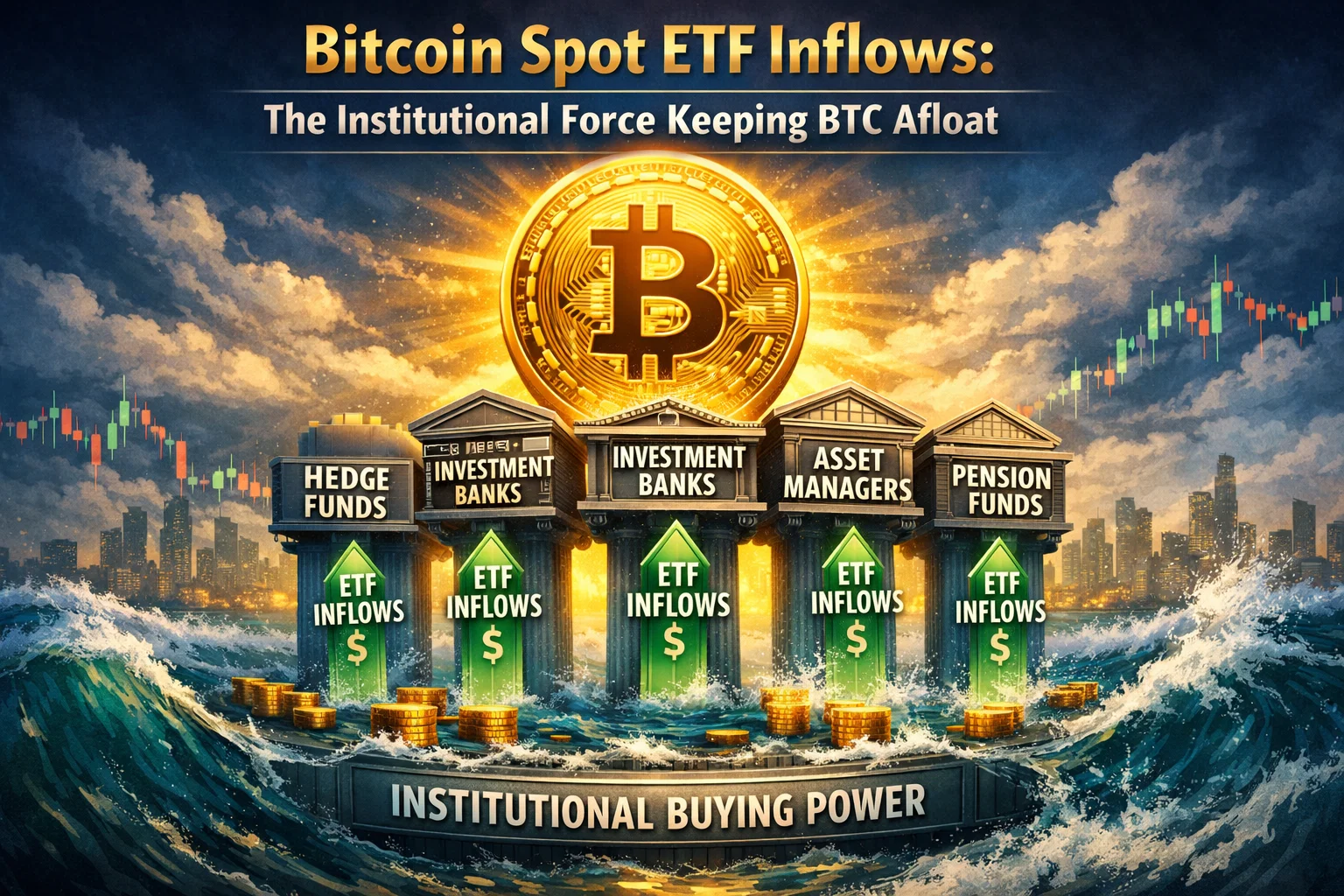
Perhaps the single most important story in the Bitcoin market right now is the extraordinary pace at which institutional capital continues to flow into spot Bitcoin ETFs. Since their approval, these exchange-traded funds have fundamentally altered the demand dynamics for BTC. Unlike the retail-driven cycles of the past, institutional buyers acquiring Bitcoin through ETF wrappers tend to be less reactive to short-term news events, providing a stabilizing effect on price during periods of volatility.
Recent data from ETF flow tracking platforms reveals that net inflows into Bitcoin spot ETFs have remained strongly positive even as the Hormuz situation created uncertainty in oil markets and triggered risk-off behavior in equities. This is a remarkable divergence. In a traditional risk-off environment, one might expect institutional money to flee speculative assets like Bitcoin. Instead, portfolio managers and hedge funds appear to be treating BTC as a separate asset class — one that may actually benefit from the same macroeconomic anxieties that are unsettling conventional markets.
Which ETFs Are Driving the Inflows?
The landscape of Bitcoin ETF products has grown increasingly competitive, with several major asset managers vying for investor capital. The largest funds — operated by asset management giants — continue to dominate in terms of assets under management and daily inflow figures. On multiple recent trading sessions, combined net inflows across the major Bitcoin ETF issuers have exceeded several hundred million dollars in a single day, more than absorbing the selling pressure that geopolitical headlines have generated.
This dynamic creates what analysts call a supply shock narrative: as ETF providers continuously purchase BTC from the open market to back newly issued shares, and as Bitcoin’s fixed supply of 21 million coins remains immutable, even modest increases in institutional demand can have an outsized effect on price. The mathematics of this supply-demand equation are particularly favorable given that a meaningful percentage of existing Bitcoin supply is considered illiquid — held by long-term investors with no intention of selling at current prices.
The Hormuz Factor: Geopolitical Risk and Its Ripple Effect on Crypto Markets
The Strait of Hormuz is the narrow waterway between Iran and Oman through which roughly 20% of the world’s oil supply transits each day. Any genuine threat to the free flow of shipping through this chokepoint carries enormous implications for global energy prices, inflation expectations, and broader financial market stability. In recent weeks, renewed geopolitical tensions in the region have stoked fears of supply disruptions, sending oil prices higher and putting pressure on risk assets worldwide.
For Bitcoin, the relationship with geopolitical risk is complex and has evolved considerably over time. In the early days of cryptocurrency, BTC was often positioned as “digital gold” — a safe haven asset immune to the machinations of nation-states and central banks. While that narrative has never been fully validated, there is growing evidence that Bitcoin does exhibit some safe-haven characteristics during periods of acute geopolitical stress, particularly when the source of that stress raises questions about fiat currency stability or capital controls.
How Oil Price Shocks Indirectly Affect Bitcoin Sentiment
The connection between crude oil price spikes and Bitcoin market sentiment operates through several indirect channels. First, a sharp rise in oil prices feeds directly into inflation expectations, which in turn shapes the outlook for central bank monetary policy. If energy-driven inflation forces the Federal Reserve and other major central banks to keep interest rates elevated for longer — or even consider raising them further — this creates headwinds for all risk assets, including crypto.
Second, oil price volatility tends to generate macro uncertainty that can cause institutional investors to rebalance portfolios, sometimes triggering correlated sell-offs across asset classes. However, the fact that Bitcoin has held $75,000 despite these pressures suggests that the ETF-driven structural demand is currently powerful enough to absorb this macro turbulence. This is a meaningful signal about the changing nature of Bitcoin’s investor base and the long-term implications of having regulated, accessible investment vehicles in the market.
Bitcoin’s Macro Positioning: Digital Gold Narrative in Focus

The broader macroeconomic context in which Bitcoin finds itself today is arguably more favorable than any previous cycle. Global debt levels continue to rise across major economies, currency debasement remains a persistent concern among institutional investors, and the geopolitical order that has underpinned financial globalization for decades is showing signs of stress. Against this backdrop, Bitcoin’s core value proposition — a decentralized, scarce, censorship-resistant store of value — resonates more powerfully than ever.
The digital gold narrative has gained particular traction among sovereign wealth funds, endowments, and family offices that have historically been the most conservative institutional participants in financial markets. For these entities, allocating even a small percentage of a multi-billion-dollar portfolio to Bitcoin provides meaningful exposure to an asymmetric return profile while hedging against tail risks that are difficult to quantify using traditional models.
On-Chain Data Supports Long-Term Accumulation
Beyond the ETF narrative, on-chain metrics paint a picture of a market in which long-term conviction remains strong. Wallet addresses holding Bitcoin for more than one year now control a historically high percentage of the total supply, a metric known as long-term holder supply. Meanwhile, the exchange reserves of Bitcoin — the amount of BTC sitting on centralized trading platforms available for immediate sale — continue to trend downward, suggesting that sellers are not rushing to unload their holdings at $75,000.
The network’s hash rate, a measure of the total computational power being dedicated to securing the Bitcoin blockchain, recently hit new all-time highs. This is a meaningful long-term signal because miners — the entities responsible for maintaining network security — only invest in expensive hardware when they believe Bitcoin’s price will remain elevated or increase over time. A record hash rate, in this context, represents a vote of confidence in Bitcoin’s future by some of the most economically incentivized participants in the ecosystem.
Short-Term Price Outlook: What Could Move BTC Above or Below $75,000?
Looking at the near-term horizon, several catalysts could either propel Bitcoin above the $75,000 level toward the next major resistance zone or trigger a pullback that tests lower support areas. On the bullish side, a resolution or de-escalation of Hormuz-related tensions would likely prompt a broad risk-on rally that lifts Bitcoin alongside equities and other growth assets. Additionally, any positive developments in U.S. regulatory clarity around cryptocurrency legislation could unleash a wave of new institutional demand.
On the cautionary side, if geopolitical tensions escalate into a genuine military confrontation affecting oil supply, the resulting spike in global inflation and market volatility could briefly overwhelm even the positive ETF flow dynamics. A sudden surge in Bitcoin exchange inflows from large holders — a pattern often associated with impending sell pressure — would also warrant close attention from traders monitoring the $75,000 support zone.
What the Options Market Is Signaling
The Bitcoin derivatives market offers additional insight into how sophisticated traders are positioning themselves. Currently, the options market shows a relatively balanced put-to-call ratio, suggesting that professional traders are not overwhelmingly positioned for either a sharp rally or a severe drawdown from current levels. Implied volatility in BTC options has remained subdued compared to historical norms, which paradoxically can precede significant price moves when the calm finally breaks.
Conclusion
The story of Bitcoin holding at $75,000 amid Hormuz-related geopolitical anxiety and sustained ETF inflows is ultimately a story about the maturation of the cryptocurrency asset class. What would once have been sufficient to trigger a 20–30% Bitcoin correction — global oil supply fears, macro uncertainty, risk-off sentiment — is being absorbed and offset by the structural demand created by regulated institutional investment vehicles. This does not mean Bitcoin is immune to downside risk; no asset is. But it does suggest that the market’s fundamental character is changing in ways that are broadly constructive for long-term investors.
For those watching the BTC price forecast closely, the $75,000 level is one to watch with great care. A sustained hold above it — especially on weekly and monthly closing candles — would add meaningful weight to the argument that Bitcoin’s next major leg higher is a matter of when, not if. As always, prudent risk management, diversification, and a clear understanding of one’s own investment time horizon remain essential guides in navigating this volatile but historically rewarding market.
Also Read: Bitcoin Surges Past $73K as Inflation Cools
