


The cryptocurrency market has once again demonstrated its remarkable ability to process geopolitical chaos and emerge with surprising resilience. Bitcoin surged to $74,929 — nearly touching the psychologically critical $75,000 level — on April 13, 2026, as traders collectively decided that President Donald Trump’s aggressive posturing toward Iran was more bark than bite. The move marked a dramatic reversal from the weekend’s sell-off, when BTC prices tumbled below $71,000 following the collapse of peace talks in Pakistan and Trump’s announcement of a U.S. Navy blockade of the Strait of Hormuz.
The backdrop to this rally is a war that began in late February 2026, when the United States and Israel launched airstrikes against Iran, triggering the largest disruption to the global oil market in modern history. Since then, the cryptocurrency market has been trading in an uneasy range, caught between hopes for de-escalation and fears of a wider conflict. Bitcoin rose from its weekend lows not because the geopolitical risk disappeared — it hasn’t — but because traders began to interpret the Trump administration’s increasingly aggressive rhetoric as a negotiating tactic rather than a genuine military threat.
The Strait of Hormuz Crisis and Its Impact on Bitcoin
To understand why Bitcoin jumped to $74,000, it is essential to understand the geopolitical pressure cooker that formed over the weekend of April 11–12, 2026. U.S. and Iranian negotiators had engaged in 21 hours of face-to-face talks in Islamabad, Pakistan, attempting to hammer out an extended ceasefire agreement. The talks broke down on Saturday night over the single most contentious issue: Iran’s nuclear program. Vice President J.D. Vance announced the failure late that evening, and by Sunday morning, President Trump had posted on Truth Social that the U.S. Navy would blockade “all ships” entering or leaving the Strait of Hormuz.
The Strait of Hormuz is the world’s most critical oil chokepoint, and its disruption has sent oil prices soaring to above $100 per barrel at various points during this conflict. When CENTCOM confirmed the blockade would take effect on Monday, April 13, at 10 a.m. ET, crypto markets reacted sharply. Bitcoin, which had been trading comfortably above $73,000 for most of Saturday, dropped to around $70,600 at its lowest point on some exchanges. Ethereum fell below $2,200, and XRP tumbled to $1.32. Over $530 million in leveraged positions were liquidated across the crypto market in 24 hours, with short sellers initially dominating as panic set in.
Why Traders Are Calling Trump’s Bluff
The central narrative driving the Bitcoin rally to $74,000 is trader skepticism about Trump’s willingness to escalate the Iran conflict beyond its current form. Digital asset trading firm QCP Capital published a note to investors on April 13 explaining the market’s reasoning with particular clarity. Analysts at the firm argued that while White House rhetoric had become increasingly aggressive, the actual policy stance had softened considerably beneath the surface. The United States, they noted, is highly unlikely to intercept Chinese vessels transiting the strait, as doing so would risk triggering a global economic escalation that would dwarf the current crisis.
This is a calculated read on geopolitical risk that experienced traders have been refining over the course of the Trump administration. The president has a well-documented pattern of issuing extreme threats — at one point stating that “a whole civilization will die tonight” unless Iran reopened the strait — only to step back from the brink when the consequences of follow-through become clear. Critics and financial commentators have taken to calling this pattern “TACO,” shorthand for “Trump Always Chickens Out,” and it has become a key framework through which cryptocurrency investors are interpreting U.S.-Iran dynamics. When Trump announced a conditional two-week ceasefire with Iran in early April, the market spiked, and when talks collapsed again, the sell-off was quickly absorbed.
The Mechanics of the Short Squeeze That Drove Bitcoin Higher
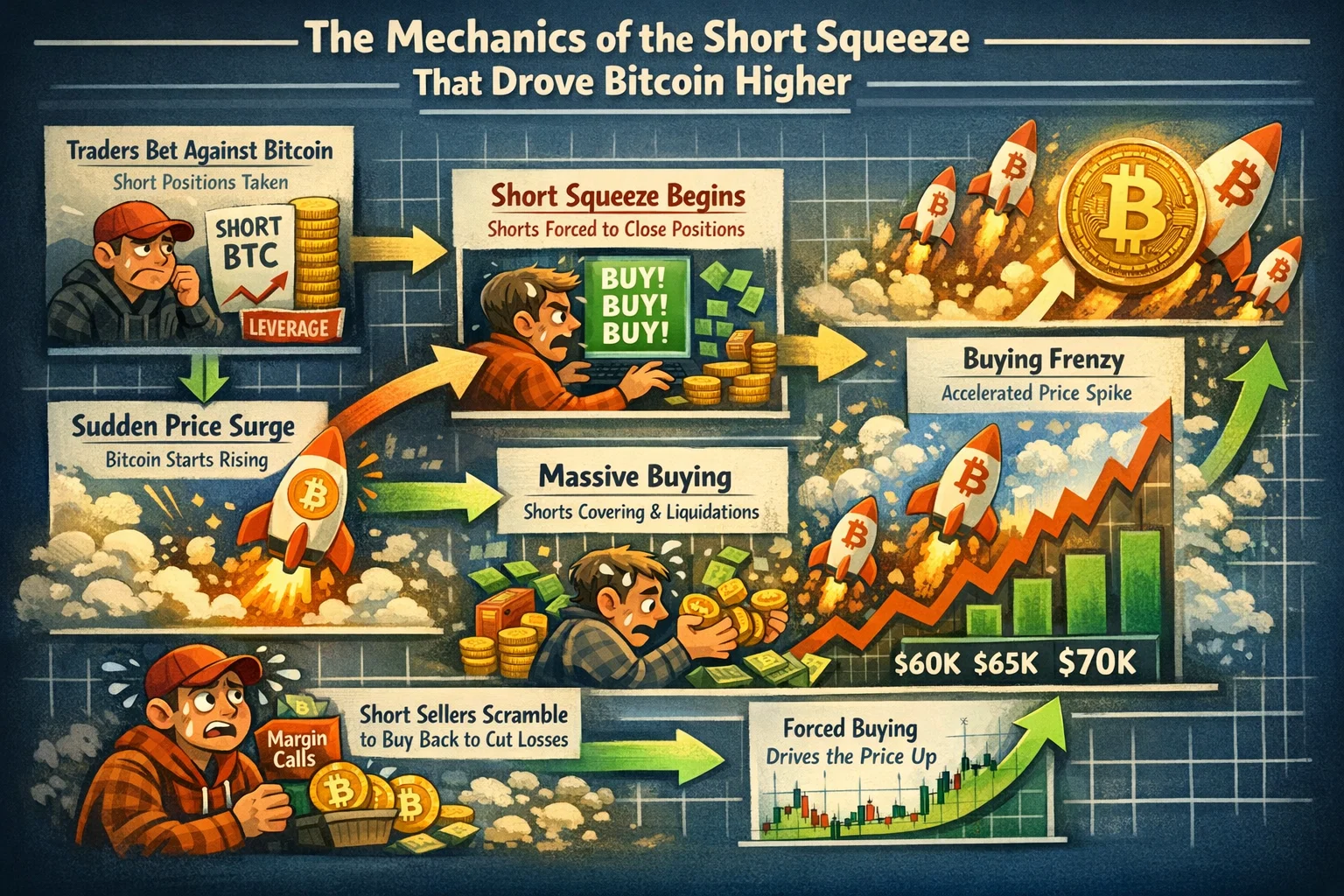
One of the most important technical factors behind Bitcoin’s rise to $74,000 was the structure of the derivatives market heading into the weekend. In the days before the blockade announcement, funding rates — a measure of sentiment in the perpetual futures market — had turned negative. Negative funding rates are a reliable signal that bearish bets have grown crowded. When too many traders are positioned on the same side of a trade, the potential for a violent reversal increases dramatically.
When buyers stepped in near the $70,000 support level after Trump’s Iran overtures, they did so against a market heavily loaded with short positions. As Bitcoin’s price began to rise, those short sellers faced margin calls that forced them to buy back their positions, adding fuel to a fire they had bet against. This is the classical mechanics of a short squeeze, and it is a phenomenon that has accelerated several of Bitcoin’s most dramatic single-day moves over the past few years. According to Coinglass data, over $530 million in positions were liquidated across the cryptocurrency market in a 24-hour window, with short sellers absorbing the majority of those losses.
Bitcoin ETF Flows and Institutional Demand
The existence of deep institutional buying through ETF vehicles is one reason why the $68,000 to $70,000 support zone has held across multiple retests since the war began. Large asset managers, pension funds, and corporate treasury programs that access Bitcoin through regulated ETF structures tend to be longer-term holders with higher conviction than retail traders. Their buying during dips absorbs sell pressure that would otherwise push prices lower. Strategy Inc., the largest corporate Bitcoin holder, continued to add to its treasury this week, acquiring 13,927 additional BTC and bringing its total holdings to approximately 780,897 BTC.
It is worth noting that the start of the week brought some caution back to the ETF market, with Bitcoin ETFs seeing $291 million in outflows as the blockade news set in. Blockchain analytics firm CryptoQuant reported that Bitcoin inflows to Binance had dropped to a more than six-year low, roughly three times below the normal rate. The firm interpreted this as evidence that investors are not looking to sell, preferring instead to hold their BTC off exchanges — a posture that mechanically reduces short-term selling pressure and supports higher prices.
Whale Accumulation and On-Chain Signals
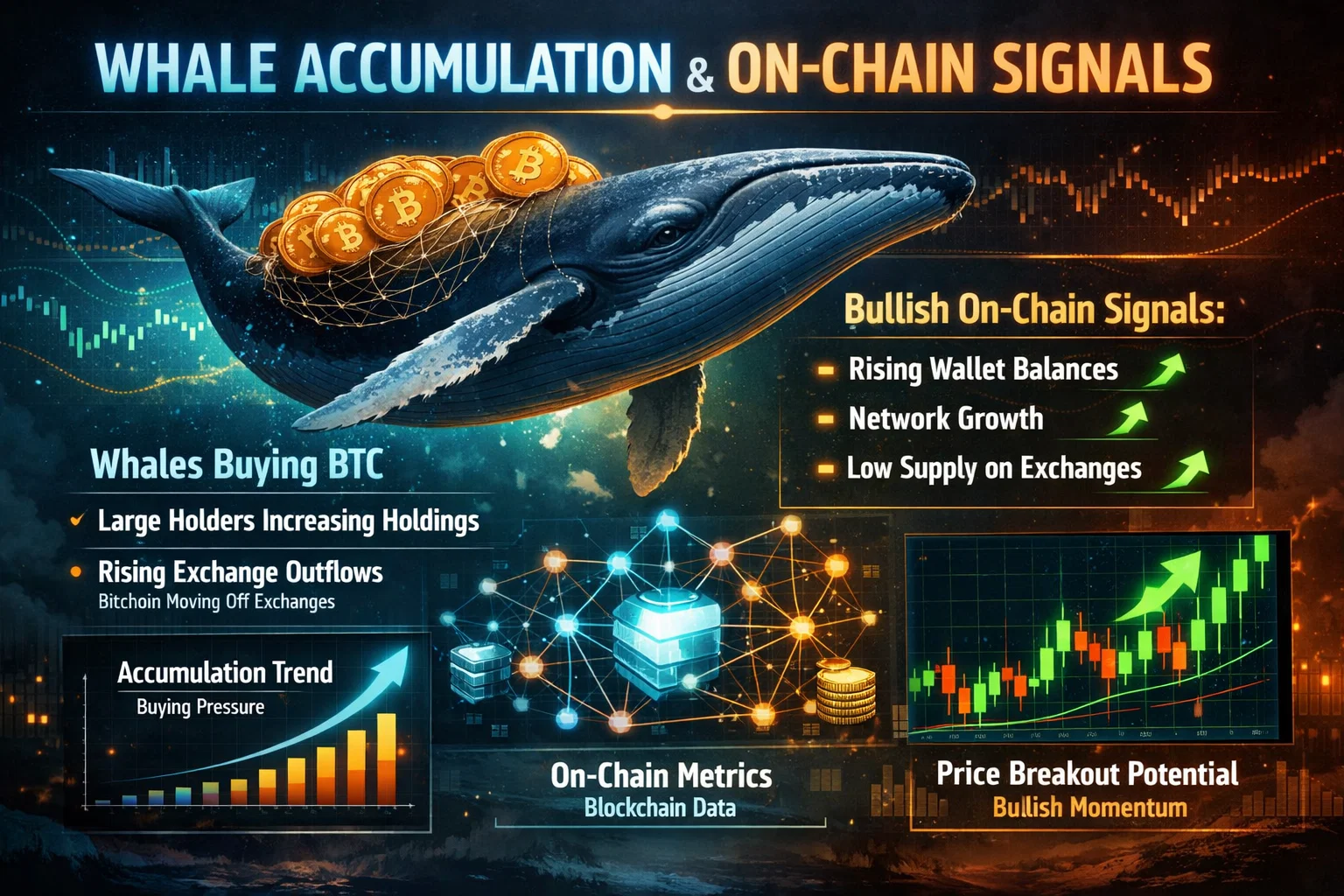
Large holders accumulating during periods of geopolitical uncertainty is a historically bullish signal, as it suggests that sophisticated market participants view current prices as an attractive entry point.
The holding behavior extends beyond just the whale cohort. The drop in exchange inflows across the board suggests that retail holders are also choosing to sit on their positions rather than rush to lock in profits or cut losses. This “HODL” mentality — a cornerstone of long-term Bitcoin investment culture — has historically preceded significant price appreciation when combined with improving macro conditions. Whether those macro conditions are on the horizon depends heavily on the Federal Reserve’s next moves.
Broader Market Context and Correlated Assets
Bitcoin’s rise to $74,000 did not happen in isolation. Equity markets also staged a notable recovery alongside the crypto rally, with the S&P 500 rising 1% over the past 24 hours and more than 4% over the five-day period. The Nasdaq gained 1% in a single day and nearly 6% over the week. Oil prices also retreated from their most extreme levels, with West Texas Intermediate crude falling roughly 2.36% from its highs as Iran signaled willingness to negotiate and the ceasefire framework remained at least partially intact.
Gold, often treated as the ultimate safe-haven asset, was trading above $4,700 an ounce during the same period, up about 0.5%. The fact that both Bitcoin and gold were rising simultaneously reflects the complicated nature of investor sentiment at this moment. Some buyers are treating Bitcoin as a digital haven — a hedge against geopolitical disruption and currency debasement — while others are buying it as a risk-on speculative asset alongside tech stocks and growth equities. This dual identity makes Bitcoin’s price action difficult to predict in a purely mechanical sense, but it also means that the asset benefits from demand across a wide spectrum of investor profiles.
Risks That Could Send Bitcoin Back Toward Support
No honest assessment of Bitcoin’s current price level would be complete without acknowledging the meaningful risks that remain on the table. The most immediate concern is the potential failure of the next round of U.S.-Iran negotiations. If talks planned for April 15 collapse again without a framework for reopening the Strait of Hormuz, oil prices could surge back toward $110 or higher, reigniting inflation fears and triggering another sell-off across risk assets, including Bitcoin.
Tax-season selling ahead of the April 15 U.S. deadline represents another near-term headwind. American retail investors who realized cryptocurrency gains during Bitcoin’s all-time high run above $126,000 in October 2025 face significant tax bills this month, and some of that selling pressure is likely to manifest in reduced spot demand. A failure to hold above the $72,000 to $73,000 support zone could pull prices back toward $68,000 relatively quickly, given the technical structure of the current trading range.
Conclusion
Bitcoin’s surge to $74,000 on April 13, 2026, is a fascinating case study in how digital asset markets process geopolitical risk in real time. Traders assessed Trump’s aggressive blockade rhetoric against the broader backdrop of a president with a documented pattern of escalating threats without follow-through, decided that the risk of full-scale military conflict remained manageable, and moved decisively to cover short positions and accumulate spot BTC. The resulting short squeeze, amplified by strong institutional ETF demand and whale accumulation on-chain, pushed prices to within a whisker of the psychologically significant $75,000 level.
The structural case for Bitcoin remains intact, supported by institutional ETF inflows, corporate treasury accumulation, and on-chain data showing reduced exchange deposits and a preference for long-term holding. But the near-term outlook is clouded by geopolitical uncertainty, tax-season selling pressure, and the ever-present possibility that the Iran situation deteriorates rather than improves. Traders calling Trump’s bluff have been rewarded handsomely so far — but the next round of talks, the next Fed meeting, and the next Truth Social post could each change the calculus dramatically.
Also More: Crypto News Today Bitcoin Below $93K, DeFi Slumps
