


The TRON OFAC sanctions have placed one of the busiest blockchains in the world under the regulatory microscope once again. US authorities have added TRX addresses to their sanctions lists, sending a clear message to the crypto industry. TRON is known for fast, cheap transfers, which attract both honest users and bad actors. This article explains what happened, why it matters, and how exchanges, wallet providers, and ordinary holders may be affected. For more updates like this, keep following Crypto Fy Lab.
What Are the TRON OFAC Sanctions?
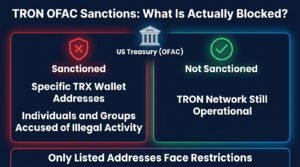
The TRON OFAC sanctions are actions in which the US Treasury lists specific TRX and TRON-based wallet addresses as blocked property. These addresses are tied to individuals or groups accused of illegal activity. Once an address is listed, US persons and companies are generally barred from dealing with it. The blockchain itself is not banned, and TRON as a network remains operational. Only the named wallet addresses and their controllers face restrictions. This difference is important because many headlines wrongly suggest the entire network is sanctioned.
Understanding OFAC and Its Role
OFAC stands for the Office of Foreign Assets Control, a department inside the US Treasury. Its job is to enforce economic and trade sanctions against targeted countries, organization,s and individuals. In recent years, OFAC has started publishing crypto wallet addresses alongside names and aliases. You can view the official list on the OFAC sanctions list page. Because the US dollar system is so influential, these listings affect businesses worldwide. Even companies outside America often follow OFAC rules to protect their banking relationships and avoid heavy penalties.
Why TRON OFAC Sanctions Target TRX Addresses
TRX addresses are being targeted because the TRON network handles enormous transaction volume every day. A large share of this activity involves stablecoin transfers, especially USDT. Low fees and quick confirmation make TRON attractive for moving value across borders. Unfortunately, the same qualities appeal to sanctioned entities and criminal networks seeking to move funds quietly. Investigators trace these flows using on-chain data and then recommend listings. Targeting addresses lets regulators cut off specific actors without shutting down a legitimate network used by millions of people.
How TRON Became a Hub for Stablecoin Transfers
TRON, founded by Justin Sun, grew rapidly by focusing on low-cost payments and smart contract support. Over ti,me it became one of the main networks for USDT circulation, especially in emerging markets. Traders, remittance us,ers and businesses prefer it because sending funds costs very little. You can learn more about the project on the official TRON website. This popularity is a double-edged sword. High usage brings more attention from regulators, and every large network eventually faces questions about how its activity is monitored and controlled.
Impact of TRON OFAC Sanctions on Exchanges and Wallets
Exchanges and wallet providers are the first to feel the effect of the TRON OFAC sanctions. Platforms serving US customers must screen deposits and withdrawals against the sanctions list. If a listed address sends funds to a user, the platform may need to freeze the account and report it. Many exchanges already use automated screening tools to catch such transfers. Smaller platforms with weaker controls face higher risk. Compliance costs are rising, and some services may restrict certain regions or transaction types to avoid legal trouble and protect their licenses.
What TRON OFAC Sanctions Mean for Everyday TRX Holders
For most ordinary TRX holders, the sanctions do not change daily life. If you hold your own coins and never interact with listed addresses, you have nothing to worry about. The risk appears when funds pass through mixers, unknown peer-to-peer sellers, or suspicious wallets. Receiving coins that were once linked to a sanctioned address can lead to frozen withdrawals on an exchange. That is why careful users check where their funds come from. Understanding the TRON OFAC sanctions helps you avoid accidental exposure and keeps your account safe.
Effect of TRON OFAC Sanctions on TRX Price
Sanctions news can create short-term fear in the market, and TRX is no exception. When headlines appear, some traders sell quickly because they expect tougher enforcement. However, past events show that price reactions are usually temporary unless the action affects major exchanges or core network operations. The long-term trend depends more on adoption, stablecoin volume, and overall market conditions. Investors should avoid panic decisions based only on a single headline. Watching on-chain activity and official announcements gives a clearer picture than social media speculation and rumor.
Compliance Tools and Blockchain Analytics
Blockchain analytics companies play a major role in this space. They track wallet clusters, label risky addresse,s and give exchanges real-time alerts. Because TRON is a public ledger, every transfer can be traced back through its history. This transparency is a strong tool for investigators and a reminder that crypto is not fully anonymous. Compliance teams use these services to screen users before they onboard them. As sanctions expand, demand for such tools will likely grow, and the industry will move toward stricter standards for monitoring and reporting.
Stablecoin Issuers and Address Freezes
Stablecoin issuers are another important part of the story. Tether, for example, has the technical ability to freeze USDT held at certain addresses when authorities request it. Since so much USDT moves on TRON, these freezes can have a real impact on sanctioned wallets. Frozen funds become unusable until the issue is resolved. This shows that centralized control still exists within parts of the crypto ecosystem. Users should understand that holding a stablecoin means accepting the possibility of such actions if their address becomes linked to illegal activity.
How to Stay Safe and Compliant
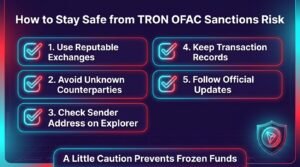
Staying safe starts with good habits. Use reputable exchanges and avoid trading with unknown counterparties who cannot prove their identity. Before accepting a large payment, check the sender address on a blockchain explorer for suspicious history. Keep records of your transactions in case an exchange asks for proof of source. Follow trusted news sources and official updates so you notice new listings early. You can also read more guides in the Crypto Fy Lab news section. A little caution today prevents frozen funds tomorrow.
Final Thoughts on TRON OFAC Sanctions
The TRON OFAC sanctions highlight how closely regulators now watch public blockchains. TRON itself continues to operate, but wallet-level enforcement is becoming a normal part of the crypto landscape. For exchanges, compliance is no longer optional, and for users, awareness is the best protection. Stay informed, verify your transaction sources and treat every headline with calm judgment. As rules evolve, the networks that balance speed, openness, and compliance will be best positioned for long-term growth. We will keep tracking this story and share updates as they develop.
