


Solana’s latest upgrades are changing what people expect from a Layer-1 blockchain. For years, Solana was known as the fast chain that sometimes stumbled, with outages and congestion hurting its reputation. Now two major projects, Alpenglow and Firedancer, target those exact weaknesses. One speeds up consensus, while the other makes the network sturdier by adding a second independent validator client. Together they push Solana toward the standard needed for serious financial settlement. In this guide, we break down what is changing, why it matters for developers and SOL holders, and which risks remain before the full rollout is complete.
Why Solana’s Latest Upgrades Matter Now
Layer-1 competition is no longer only about who has the lowest fees. Traders, payment firms, and institutions now ask harder questions about finality, uptime, and resilience. A chain that is fast but occasionally halts cannot easily host serious financial products. Solana’s roadmap answers this directly by redesigning both how validators agree on blocks and how validator software is built. This shift moves the conversation from raw speed to reliability and trust. That is why these changes are being treated as a new playbook rather than a routine software patch. If you follow market trends, our crypto market analysis shows how infrastructure quality increasingly drives long-term interest.
Alpenglow: The Biggest Consensus Overhaul in Solana’s History
Alpenglow is the most ambitious change Solana has ever attempted at the protocol level. It replaces the older consensus combination of Proof of History and Tower BFT with a leaner design. The goal is simple but bold: make transaction finality feel almost instant. According to Alchemy’s breakdown of Alpenglow, the upgrade is formalized as SIMD-0326 and is expected to reach mainnet after community testing and security audits. Reports on exact timing differ, so it is wise to watch official Solana channels for the final date. Still, the direction is clear, and the network is preparing for a major leap.
Votor and Rotor: How Finality Gets Faster
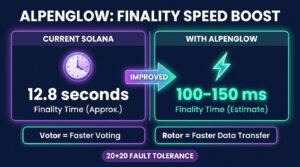
Alpenglow is built around two new components called Votor and Rotor. Votor handles voting and moves that process off-chain, which removes a lot of the overhead that slows the current system. Rotor focuses on how block data travels across the network, helping validators receive information more efficiently. The practical result is a dramatic drop in finality time. Current finality is around 12.8 seconds, and Alpenglow aims to bring it down to roughly 100 to 150 milliseconds. For users, that means trades, payments, and swaps that feel closer to a centralized exchange. One analysis reports that stakers approved the proposal with about 98 percent support, which signals strong community backing.
The 20+20 Resilience Model
Speed means little without safety, so Alpenglow also rewrites Solana’s security assumptions. It introduces a “20+20” fault tolerance framework. In simple terms, the network can keep working even if up to 20 percent of stake behaves maliciously and another 20 percent is simply offline or crashed. This is a practical improvement because real networks suffer more from outages than from deliberate attacks. By planning for both situations at once, Solana becomes more robust against the kind of failures that damaged its image in the past. It is a quiet change, but it may matter more to institutions than any headline speed figure.
Firedancer: A Second Engine for the Network
If Alpenglow is the new transmission, Firedancer is the new engine. Built by Jump Crypto over roughly three years, it is a completely independent validator client written in C and C++. Full Firedancer reached Solana mainnet in December 2025 after long testnet runs without major incidents. Before this, most of the network depended on a single dominant software implementation, which created a dangerous single point of failure. A bug in that one codebase could, in theory, stop the whole chain. Firedancer changes that picture by giving validators a real alternative, and it follows the same multi-client path that Ethereum took years ago.
Client Diversity and Fewer Single Points of Failure
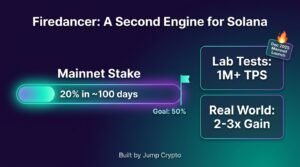
Client diversity is one of the least glamorous but most important ideas in blockchain engineering. When many validators run different software, a flaw in one client cannot easily take down everyone. BlockEden’s report on Firedancer and Alpenglow notes that Firedancer passed 20 percent of mainnet stake within about 100 days. The longer-term goal is to pass 50 percent, a level where Solana could survive a serious bug in the older client without halting. Every validator that switches or adds Firedancer makes the network a little safer. This is why adoption numbers matter as much as the code itself.
Performance Gains and Realistic Expectations
Firedancer splits its work into isolated “tiles,” with separate units handling networking, verification, and block production. This design squeezes far more performance out of ordinary hardware. In lab tests, it has processed over one million transactions per second, which is where the famous 1M TPS headline comes from. However, real-world conditions are different from test environments. Network limits, validator hardware, and application demand all restrict actual throughput, so realistic gains in production are more modest, often described as a two- to three-times improvement. Smart readers should treat the million-TPS number as potential capacity, not as today’s everyday experience.
Beyond Speed: Privacy, Institutions, and Developer Confidence
The upgrade cycle is not only about performance. Solana is also working on Confidential Balances, a privacy feature that uses zero-knowledge proofs to hide token transfer amounts while keeping them verifiable. This matters for businesses that cannot expose every payment on a public ledger. At the same time, institutional interest keeps growing through products like spot Solana ETFs and payment partnerships. Developers benefit too, because a more reliable base layer lowers the risk of building complex apps. You can follow related stories in our latest blockchain news section. Together, these pieces suggest Solana is aiming to be a settlement layer, not just a fast trading venue.
What This Means for the Layer-1 Playbook
For years, the Layer-1 playbook was simple: promise higher throughput and lower fees than the competition. Solana’s latest upgrades suggest a more mature formula. Winning chains will need fast finality, multiple independent clients, strong fault tolerance, and optional privacy. Solana is trying to deliver all four at once, which puts pressure on rivals to match that complete package. Ethereum still leads in decentralization history and developer mindshare, but Solana is narrowing the gap in user experience. The result is a healthier competition where reliability, not marketing claims, decides which networks attract serious capital and long-term builders.
Risks and Challenges to Watch
No major upgrade arrives without risk. Alpenglow replaces core machinery, and any change that deep needs extensive audits and careful validator coordination. Timelines for protocol upgrades also have a habit of slipping, so early target dates should be treated cautiously. Firedancer adoption could stall if validators prefer the familiar client, which would delay the resilience benefits. There is also the market side, because price rarely follows technical progress in a straight line. Anyone interested in SOL should avoid assuming that better technology guarantees higher prices. Following official updates and doing independent research remains the safest approach.
Conclusion About Solana’s Latest Upgrades
Solana’s latest upgrades show a network growing up. Alpenglow targets near-instant finality and stronger fault tolerance, while Firedancer adds client diversity and serious performance headroom. Privacy tools and rising institutional interest add further momentum. Whether every milestone lands on schedule is still uncertain, but the strategic direction is clear: reliability is now as important as speed. For developers, investors, and curious readers, this is a story worth tracking closely as the rollout continues through the rest of 2026.
