


Hyperliquid vs. centralized exchanges has become the biggest debate in crypto derivatives. Hyperliquid runs a fully on-chain order book, and its HYPE token powers the ecosystem. Binance, Bybit, and OKX still control most perpetual futures volume, but traders now question whether they need a middleman at all. DeFi perps offer self-custody, open data, and fast execution. Centralized platforms offer deep liquidity, fiat access, and polished tools. This guide compares both models, weighs the risks, and answers one question: can DeFi perps win the market? Read on to see where each side leads and where it falls short.
What Is Hyperliquid and How Does HYPE Fit In?
Hyperliquid runs its own Layer 1 blockchain and designs it specifically for trading. The chain hosts a fully on-chain order book, so every order, cancel, and fill appears on the ledger. Traders connect a wallet, deposit USDC, and open perpetual positions without creating an account. The HYPE token plays several roles. It rewards stakers who secure the network, and it gives holders a stake in the ecosystem’s growth. The protocol also uses trading revenue to support HYPE through buybacks. The team launched the platform without venture capital funding, and that choice built a loyal community. You can explore the project on the official Hyperliquid website.
How Centralized Exchanges Lead Hyperliquid vs. Centralized Exchanges in Volume
Centralized exchanges still hold the largest share of crypto derivatives volume. Binance, Bybit, OKX, and Bitget serve millions of traders every day. These platforms match orders on private servers, which gives them extreme speed and enormous liquidity. They also offer fiat on-ramps, copy trading, demo accounts, and customer support. Beginners feel comfortable there because the interface hides most technical details. Large funds prefer them because deep order books keep slippage low on big trades. CoinGecko’s derivatives rankings let you compare these venues yourself.
Hyperliquid vs Centralized Exchanges: Core Differences
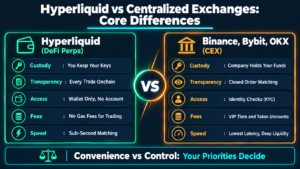
The core difference comes down to trust. On a centralized exchange, you hand your funds to a company and trust it to protect them. On Hyperliquid, you keep your keys, and your wallet signs every action. Centralized platforms run closed systems, so you cannot verify their order matching independently. Hyperliquid publishes every trade on-chain, so anyone can audit activity in real time. Centralized exchanges require identity checks in most regions, while Hyperliquid asks only for a wallet. Each model trades convenience against control, and your priorities decide which one fits you better.
Hyperliquid vs Centralized Exchanges: Speed, Liquidity, and Fees
Hyperliquid matches orders in well under a second and handles high throughput for an onchain system. Centralized exchanges still win on raw latency because their servers sit inside optimized data centers. Liquidity follows a similar pattern. Bitcoin and Ether markets on Hyperliquid now carry serious depth, yet smaller altcoin pairs often move more smoothly on centralized venues. Fees look competitive on both sides. Hyperliquid charges no gas fees for trading and uses tiered maker and taker rates. Centralized exchanges lower their fees through VIP programs and native token discounts. Compare the live fee tables before you commit large capital.
Custody and Transparency: Where DeFi Perps Lead
Self-custody gives DeFi perps their strongest advantage. The collapse of FTX taught traders that customer balances can vanish overnight when a company misuses them. Hyperliquid reduces that risk because users deposit funds into on-chain contracts instead of company wallets. Open data adds another layer of safety. Anyone can track liquidations, open interest, and vault performance on public dashboards. Centralized exchanges publish proof-of-reserves reports, but those reports rarely match the transparency of a public ledger. Traders who value verification over promises increasingly choose onchain venues. You can read more market breakdowns on Crypto Fy Lab.
Risks of Hyperliquid vs Centralized Exchanges Traders Must Weigh
DeFi perps carry real risks, and you should weigh them honestly. Smart contract bugs can drain funds, and validator concentration raises centralization concerns. Manipulation attempts on thinly traded tokens have also prompted the team to adjust its risk settings. High leverage magnifies losses on every platform, so liquidation risk never disappears. Bridge security matters because your deposits travel through a cross-chain path. Regulators may also target DeFi venues more aggressively as volumes grow. Start with small positions, set stop losses, and read our crypto trading guides before you use leverage.

Can DeFi Perps Win the Market?
Hyperliquid vs. centralized exchanges will not end with a total takeover soon, but DeFi will keep gaining share. Hyperliquid already proves that an on-chain order book can compete on speed and cost. Institutions still need compliance, fiat rails, and insurance, and centralized platforms supply all three today. Meanwhile, retail traders who distrust custodians move on-chain after every exchange scandal. Competitors like dYdX, Aster, and Lighter push the whole category forward. You can track the market share shift on DefiLlama. The winner will likely combine DeFi transparency with centralized-grade user experience.
FAQs
Is Hyperliquid safer than a centralized exchange?
Hyperliquid removes custodian risk because you control your wallet, but it adds smart contract and bridge risk. Centralized exchanges protect you from technical mistakes with support teams, yet they expose you to company failure and hacks. Neither option offers complete safety. Spread your funds across platforms and limit your exposure on each one.
What does the HYPE token do?
HYPE rewards stakers, supports network security, and links holders to the ecosystem’s growth. Buybacks funded by protocol revenue add demand for the token. The price still swings sharply, so you should research the tokenomics before you invest. Never put in money you cannot afford to lose.
Do I need KYC to trade on Hyperliquid?
Hyperliquid does not ask for identity verification at the protocol level, so you connect a wallet and start trading. Some regions block access, and local laws still apply to you. Check your country’s rules before you trade. Always use a secure wallet and protect your seed phrase.
Final Thoughts
Hyperliquid .vs. centralized exchanges is not a winner-takes-all contest. Hyperliquid gives traders custody, transparency, and gas-free trading. Centralized platforms give them liquidity, fiat access, and familiar tools. Smart traders will likely use both and match each venue to the job. Watch volume, open interest, and HYPE’s growth to measure the shift. Visit Crypto Fy Lab for daily crypto news and analysis, and trade only with money you can afford to lose. This article does not offer financial advice.
