


Something significant is unfolding in the world of digital finance. Bitcoin has climbed above $73,000, reclaiming a price level that once felt distant after months of macroeconomic turbulence, regulatory uncertainty, and fluctuating investor sentiment. This milestone is not an isolated event — it reflects a meaningful shift in the broader financial landscape, one where cooling inflation data and a revived appetite for risk assets are combining to send the world’s largest cryptocurrency sharply higher.
For anyone who has tracked Bitcoin through its previous cycles, the pattern feels familiar: macro conditions soften, institutional confidence builds, and BTC leads the charge as risk capital pours back into the market. But this time, the rally carries additional weight. The structural foundations underpinning Bitcoin’s rise have matured significantly. Spot Bitcoin ETFs, expanded corporate treasury adoption, and a post-halving supply squeeze are all reinforcing a bullish narrative that goes well beyond short-term speculation.
This article breaks down exactly why Bitcoin is surging above $73,000 right now, what the cooling inflation environment means for crypto markets, how risk appetite is reshaping capital flows, and what investors and analysts are saying about where Bitcoin might head from here. Whether you are a seasoned crypto investor or someone trying to make sense of the headlines, this deep dive will give you the full picture.
What Does “Inflation Cooling” Actually Mean for Bitcoin?
The phrase “inflation cooling” gets thrown around frequently in financial media, but understanding its direct impact on Bitcoin requires unpacking the relationship between monetary policy, investor behavior, and digital asset valuations. When inflation data comes in below expectations — as it has in recent months — it signals that the Federal Reserve may not need to maintain aggressively high interest rates. Lower rates reduce the opportunity cost of holding non-yielding assets like Bitcoin, which makes the cryptocurrency comparatively more attractive.
Softer-than-expected U.S. inflation data has been reducing expectations for further monetary tightening, prompting renewed interest in digital assets. This is a crucial dynamic: when inflation cools, the probability of additional rate hikes drops, and risk assets across the board — from equities to commodities to cryptocurrencies — tend to rally in anticipation of a more accommodating monetary environment.
Bitcoin increasingly trades like a macro-sensitive asset, responding to the same signals that move gold, tech stocks, and emerging market currencies. Low interest rates and high inflation typically boost Bitcoin because they weaken the U.S. dollar and reduce the appeal of traditional savings. The inverse is equally true: as inflation cools from its peak and the Fed signals patience rather than aggression, the narrative of Bitcoin as digital gold and a store of value becomes easier to defend.
There is also a currency dimension at play. The U.S. dollar index fell roughly 7 to 9 percent in 2025 against baskets of major currencies, while the euro gained about 13 percent and the pound around 7 to 8 percent. Historically, sustained dollar weakness has aligned with stronger BTC-USD, because a softer dollar both supports global liquidity and strengthens the narrative of scarce, non-sovereign assets. A weakening dollar, powered by disinflation and anticipated rate cuts, is one of the most reliable tailwinds Bitcoin can receive.
Why Risk Appetite Is Returning to Crypto Markets

Beyond inflation data, a broader shift in investor risk appetite is playing a central role in Bitcoin’s climb above $73,000. Risk appetite refers to the willingness of investors to allocate capital toward higher-risk, potentially higher-reward assets rather than parking money in safer instruments like treasury bonds or cash equivalents. When risk appetite is low, money flows out of crypto. When it rises, Bitcoin tends to be one of the primary beneficiaries.
Rising expectations of future Federal Reserve rate cuts have revived risk appetite across global markets, lifting equities, gold and crypto in tandem. This synchronized rally across asset classes is a classic “risk-on” signal, and Bitcoin is participating forcefully in that rotation. The psychological and narrative component of risk appetite cannot be underestimated — when equity markets are grinding higher and volatility indices are calm, retail and institutional investors alike feel more comfortable reaching for assets like BTC.
Bitcoin sets the tone for the entire crypto market, but macro risk appetite sets the tone for Bitcoin. When fear spikes or equities sell off, BTC is typically the most liquid crypto asset to exit, amplifying both downturns and recoveries. This bidirectional sensitivity means that a genuine, sustained improvement in risk appetite — rather than a brief relief rally — can translate into substantial and durable Bitcoin price appreciation.
What makes the current environment particularly compelling is the combination of macro improvement with structural market changes. Unlike previous cycles, Bitcoin is no longer trading purely as a speculative retail asset. Institutional investors now have access to spot Bitcoin ETFs, which provide a regulated, familiar vehicle for allocating to BTC. As risk appetite returns, these institutional flows are amplifying the move higher in ways that were not possible in earlier bull markets.
The Role of Institutional Adoption in the $73K Rally
It would be incomplete to discuss Bitcoin’s rise above $73,000 without addressing the profound role that institutional adoption has played in reshaping how the asset behaves. The approval of spot Bitcoin ETFs in the United States in January 2024 was a watershed moment that fundamentally changed the investor base for BTC.
The SEC approved spot Bitcoin ETFs on January 10, 2024, in a structural turning point that opened Bitcoin to pension funds, asset managers, and RIAs via traditional brokerage accounts. ETF inflow data has since become one of the most watched real-time price signals in the market. This institutionalization means that when risk appetite returns, there is a well-established, liquid, and regulated pathway for large pools of capital to enter the Bitcoin market quickly and efficiently.
Corporate treasury adoption has been another powerful structural driver. In Q1 of 2025, 12 new public firms added Bitcoin to their balance sheets. This pushed total corporate holdings to 688,000 BTC, a 16% increase now worth an estimated $57 billion. Analysts say this is influencing the way Bitcoin reacts to macroeconomic trends. When publicly traded companies hold BTC on their balance sheets, it creates a baseline of long-term demand that acts as a price floor during periods of uncertainty and a catalyst during periods of optimism.
The combination of ETF-driven institutional flows and expanding corporate adoption has fundamentally altered the supply-demand dynamics of Bitcoin. Fewer coins are available on exchanges as long-term holders and corporate treasuries absorb supply, while demand from newly onboarded institutional investors creates consistent buying pressure. In this environment, even moderate improvements in macro sentiment can produce outsized price moves — which is precisely what we are witnessing as Bitcoin crosses the $73,000 threshold.
Bitcoin’s Post-Halving Supply Dynamics
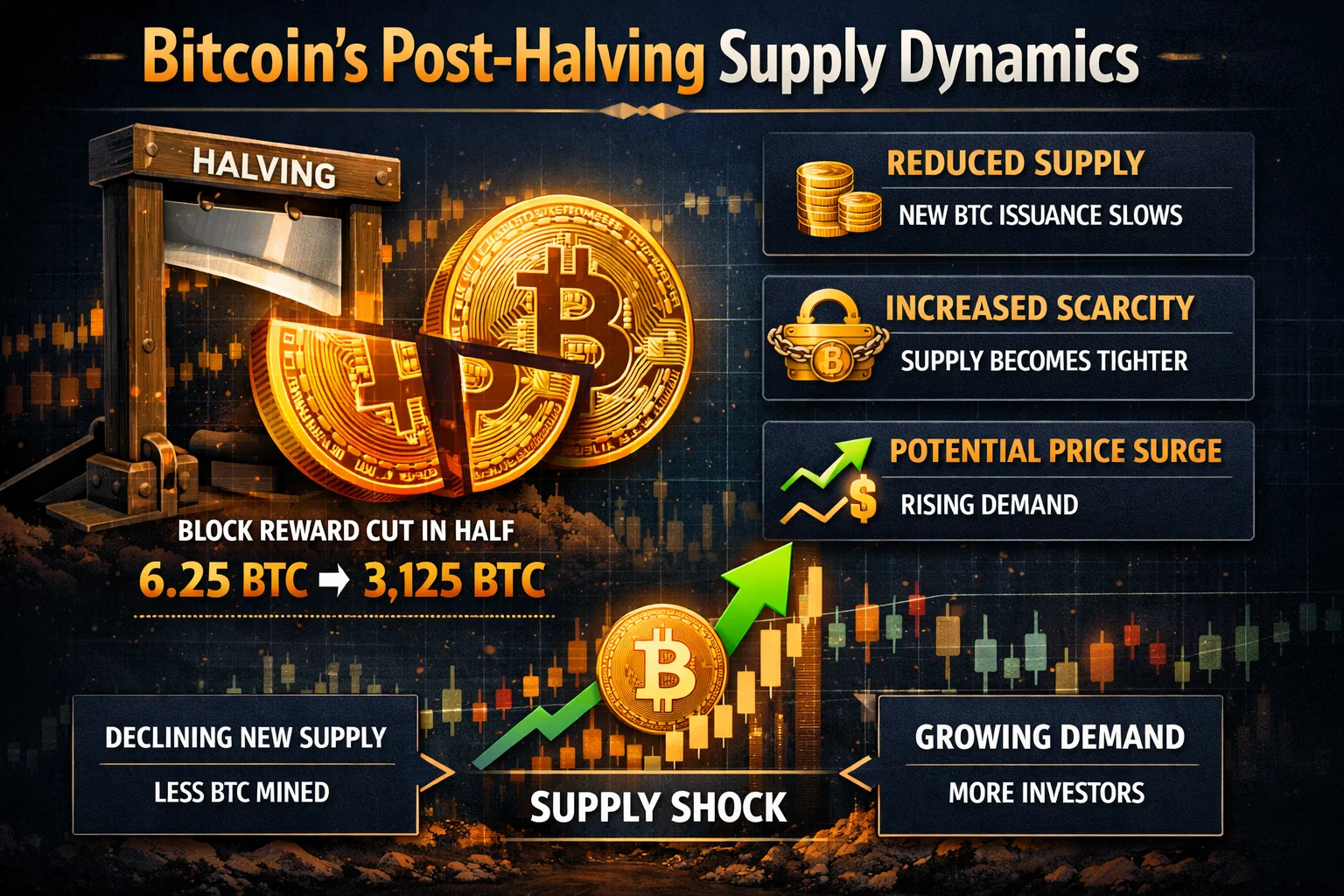
No analysis of the current Bitcoin rally would be complete without addressing the halving cycle — one of the most mathematically predictable and historically significant drivers of BTC price appreciation. Bitcoin’s protocol reduces the block reward paid to miners by half approximately every four years. This event, known as the halving, directly constrains the rate at which new Bitcoin enters circulation, creating a systematic supply shock that has preceded every major bull market in BTC’s history.
The April 2024 halving reduced the block reward to 3.125 BTC. Each halving has historically preceded a significant bull cycle. The effects of a halving typically take six to eighteen months to fully materialize in price, as miners adjust, supply tightens on exchanges, and demand from institutional and retail buyers meets a shrinking flow of newly minted coins.
By 2026, the post-halving supply reduction is well into its price discovery phase. The combination of constrained new supply from the halving and robust demand from spot ETF inflows and corporate buyers creates an asymmetric market structure — one where relatively modest increases in demand can produce significant price appreciation because the available supply is limited. This is the structural bedrock beneath Bitcoin’s climb above $73,000, and it explains why many analysts expect the current rally to have more room to run than a simple macro-driven bounce might suggest.
What Analysts Are Saying About Bitcoin’s Next Move
As Bitcoin reclaims the $73,000 level, market analysts and crypto strategists are weighing in with a range of perspectives on where the price might head next. The consensus is broadly optimistic, though with important caveats tied to macroeconomic conditions and monetary policy trajectories.
A constructive base case clusters around end-2026 spot levels between $120,000 and $170,000, consistent with the bulk of institutional forecasts if ETF inflows remain positive, rate cuts proceed gradually, and no major regulatory shock hits. This base case scenario assumes that inflation continues its cooling trajectory, the Federal Reserve delivers at least one or two rate cuts, and institutional demand through ETFs and corporate treasuries remains robust.
Long-term holders continue to dominate supply, while short-term speculators have largely flushed out during the correction, leaving a more resilient holder base. That configuration typically sets the stage for future price movements skewed to the upside, provided macro conditions do not deteriorate dramatically. A holder base dominated by long-term, conviction-driven investors is historically a bullish signal — it reduces the likelihood of panic selling during minor corrections and supports sustained upward price movement.
However, not all analysts are uniformly bullish in the short term. Some point to the risk of stagflation — a scenario where inflation stays sticky even as growth slows — as a potential headwind. If growth slows while inflation stays sticky, the central bank is boxed in: cutting too fast risks another inflation flare-up, while staying tight risks a deeper downturn. In that setting, Bitcoin can either behave as a high-beta risk asset and sell off with equities, or as a macro hedge if institutional investors decide that fiat policy is structurally impaired. This dual-regime uncertainty is why risk management remains essential even as optimism builds.
How Global Macroeconomic Conditions Are Shaping BTC Demand
Bitcoin does not exist in a vacuum. Its price is increasingly shaped by global macroeconomic conditions, including currency dynamics, geopolitical developments, trade policy, and central bank decisions around the world. Understanding these cross-currents is essential for interpreting why Bitcoin is making significant moves at specific moments in time.
In countries facing rapid inflation or a weakening national currency, Bitcoin becomes a means to preserve purchasing power. Capital controls and restrictions on moving money across borders drive individuals toward Bitcoin’s open, permissionless system. This dynamic adds an international dimension to Bitcoin demand that goes beyond U.S.-centric macro narratives. As currency devaluation accelerates in various emerging economies and geopolitical tensions complicate traditional financial channels, Bitcoin’s utility as a borderless, censorship-resistant asset grows more compelling.
Analysts note that rising tariffs and geopolitical frictions could influence inflation, growth, and investor risk appetite in the months ahead. While these forces introduce uncertainty, they also amplify the narrative case for Bitcoin as a hedge against policy risk and financial system fragility. When traditional financial infrastructure is stressed — whether by trade disputes, sanctions, or sovereign debt concerns — Bitcoin benefits from its decentralized and non-sovereign nature.
The interaction between dollar weakness, global liquidity expansion, and Bitcoin’s fixed supply creates a powerful macro tailwind that goes beyond any single economic data point. When central banks around the world are injecting liquidity or cutting rates in response to slowing growth, the increased money supply searching for real returns tends to find its way into scarce assets — and Bitcoin, with its hard cap of 21 million coins, is increasingly perceived as the scarcest digital asset in existence.
Risks and Challenges to Watch
Even in the midst of a powerful rally, maintaining a balanced perspective requires acknowledging the risks that could interrupt or reverse Bitcoin’s climb above $73,000. Regulatory developments, macro surprises, and technical market dynamics all have the potential to introduce sharp volatility.
A bearish tail, driven by a hard landing, policy error, or a reversal in ETF appetite, runs back through $70,000 and into the $50,000s, with low-probability stress cases in the $25,000 to $10,000 dollar zone if panic or policy crackdown returns. These tail risks are important to keep in mind — not because they are the most likely outcome, but because crypto markets have historically been capable of rapid and severe drawdowns even during broader bull trends.
Bitcoin regularly experiences 50–80% drawdowns. The 2022 cycle saw Bitcoin fall from approximately $69,000 to approximately $16,000, a loss of over 77%. Anyone allocating capital to Bitcoin needs to internalize this historical volatility profile and ensure their position sizing reflects their actual risk tolerance, not just their optimism about the asset’s potential.
Regulatory clarity — or the lack thereof — remains another key variable. Positive regulatory developments generally boost institutional confidence and expand the addressable market for Bitcoin. Negative developments — such as aggressive restrictions on crypto exchanges, stablecoin crackdowns, or unfavorable tax treatment — can rapidly dampen sentiment and trigger significant selling pressure. The current environment in the United States is cautiously constructive, but global regulatory fragmentation remains a source of ongoing uncertainty.
Conclusion
Bitcoin’s climb above $73,000 is the product of multiple powerful forces converging at the same moment: cooling inflation reducing rate hike expectations, a resurgence in risk appetite across global markets, robust institutional demand through spot ETFs and corporate treasuries, the ongoing post-halving supply compression, and a weakening U.S. dollar that enhances Bitcoin’s appeal as a non-sovereign store of value. Each of these factors is meaningful on its own — together, they form a compelling macro and structural case for sustained Bitcoin price appreciation.
The road ahead is not without risk. Stagflation, regulatory surprises, and macro reversals all pose genuine threats to the current rally. But the structural transformation of Bitcoin’s investor base — from a retail-dominated speculative market to an institutionally integrated asset class — means that the foundation beneath this price level is considerably more robust than it was in previous cycles. Whether $73,000 proves to be a stepping stone or a ceiling depends on how macro conditions evolve in the months ahead, but the signals currently support cautious optimism from those with a clear-eyed understanding of both the opportunities and the risks.
Read More: Latest Bitcoin Price News and Analysis: Real-Time Updates Insights
