


The cryptocurrency market faces another major confidence test after the reported Binance security breach on October 29, 2026. The incident affected approximately $6.3 billion worth of digital assets and quickly attracted attention across the global crypto industry. Bitcoin, Ethereum, BNB, and several other cryptocurrencies experienced significant selling pressure as investors reacted to the news.
However, the biggest question now goes beyond the amount involved. Could the Binance hack trigger a wider crypto market crash, or will the market recover after the initial panic? Investors want to understand whether this incident threatens Bitcoin’s long-term position and whether altcoins could face even greater pressure.
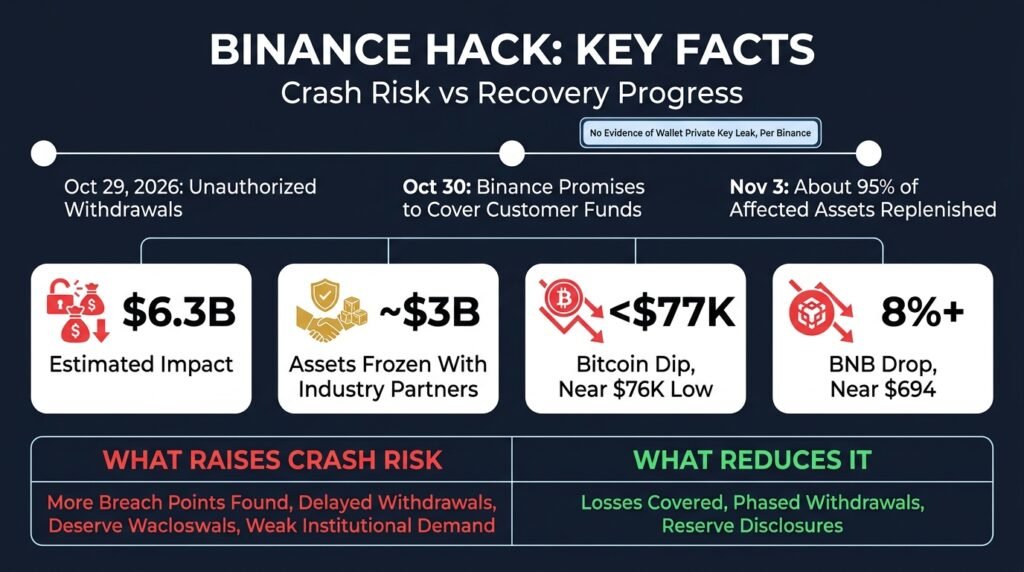
Binance has promised to cover the affected customer funds through its reserves and corporate treasury. The exchange also reported that it had replenished approximately 95% of the affected assets by November 3. These developments have helped reduce some concerns, but market confidence still needs time to recover.
This article examines the Binance hack, crypto market crash risk, Bitcoin’s outlook, potential altcoin losses, and the major developments that could shape the cryptocurrency market in the coming weeks.
1. What Happened During the Binance Hack?
The Binance security incident began on October 29, 2026, when unauthorized transactions moved approximately $6.3 billion worth of digital assets from affected exchange wallets. Binance confirmed the incident and temporarily suspended withdrawals while its security team investigated the breach. The incident quickly became one of the largest security events in cryptocurrency history.
Initial investigations suggested that attackers may have gained access through compromised internal systems. Binance later identified additional points of breach and continued investigating the complete attack sequence. The exchange also stated that investigators had found no evidence that wallet private keys had leaked.
The incident affected multiple digital assets across different blockchain networks. Blockchain analytics companies tracked the movement of the funds and worked with exchanges, law enforcement agencies, and stablecoin issuers. Their cooperation helped freeze approximately $3 billion in affected assets.
According to Binance’s October 30 announcement, the company committed to covering the affected customer funds rather than transferring the financial burden to users. The exchange also started strengthening its security systems and reviewing internal access controls.
Why This Incident Matters
The incident matters because Binance plays a major role in global cryptocurrency trading. Millions of users rely on centralized exchanges to purchase, sell, and store digital assets. A major security failure at such a platform can influence market confidence even when the underlying Bitcoin network continues operating normally.
2. Could the Binance Hack Trigger a Crypto Market Crash?
The Binance hack created conditions for a wider market decline, but it does not automatically guarantee a major crypto crash. Market crashes usually require several negative developments to happen together. These developments can include widespread withdrawals, falling liquidity, institutional selling, regulatory pressure, and declining investor confidence.
The incident initially increased selling pressure because traders feared additional security problems and possible liquidity disruptions. Some investors also moved their assets away from centralized exchanges while they waited for more information.
However, Binance’s decision to cover customer losses reduced the possibility of direct financial damage to ordinary exchange customers. The company also reported progress in replenishing affected assets and restoring withdrawals.
The wider market still faces uncertainty. Another major security incident, delayed withdrawals, or disappointing reserve disclosures could increase selling pressure. Bitcoin could also struggle if traditional financial markets weaken or institutional investors reduce their exposure to risky assets.
A complete market crash therefore requires more than one exchange security incident. Traders and analysts must examine liquidity, market demand, institutional flows, and the overall financial environment before reaching that conclusion.
3. Bitcoin Price: What Could Happen Next?
Bitcoin remains the most important cryptocurrency to watch during this period. Its market position, liquidity, and institutional adoption give it a different risk profile from smaller digital assets. Nevertheless, Bitcoin cannot completely escape the effects of major industry events.
Following the Binance incident, Bitcoin dropped below $77,000 and briefly approached the $76,000 area. The decline reflected market uncertainty, selling pressure, and liquidations across leveraged futures positions.
Market analysts have highlighted the $76,000 to $78,000 region as an important area to monitor during November. This zone matters because buyers need to maintain demand around these levels to support market stability.
A stronger recovery could develop if Binance completes its reimbursement process, publishes convincing reserve information, and maintains normal withdrawal operations. Renewed institutional demand and stronger Bitcoin ETF flows could also improve sentiment.
On the other hand, Bitcoin could face additional pressure if selling accelerates or market liquidity weakens. A sustained move below important support areas could encourage further selling.
Investors should remember that support levels do not guarantee price reversals. Bitcoin can move sharply in either direction, particularly when major news affects the market.
4. Ethereum Could Face Additional Selling Pressure
Ethereum also experienced pressure following the Binance security incident. The second-largest cryptocurrency plays an important role in decentralized finance, stablecoins, tokenization, and blockchain applications. These connections make Ethereum an important part of the wider market.
The reported theft involved several digital assets, including Ethereum-related holdings. Blockchain analysts also tracked attempts to exchange certain stolen assets into ETH, which increased attention on Ethereum’s liquidity and market activity.
Ethereum could face additional pressure if investors reduce exposure to riskier digital assets. Traders often move toward Bitcoin or stablecoins during periods of uncertainty, and this rotation can weaken ETH’s performance against Bitcoin.
However, Ethereum maintains several long-term growth drivers. Layer 2 adoption, decentralized applications, institutional tokenization, and stablecoin activity continue to support its broader ecosystem.
Read our detailed guide on <a href=”https://cryptofylab.com/ethereum-future-scope/“>Ethereum Future Scope: Layer 2 Scaling, Tokenization, and Wall Street Adoption</a> to understand the network’s long-term development.
The next major test for Ethereum will involve market demand, network activity, and institutional interest. Strong ecosystem activity could help ETH recover, while continued market fear could delay that recovery.
5. BNB Faces the Most Direct Exchange-Related Pressure
BNB deserves special attention because the token has a direct connection with the Binance ecosystem. Traders use BNB for transaction fees, blockchain applications, staking, and several exchange-related services.
The Binance hack increased concerns about the exchange’s reputation and its ability to maintain customer confidence. BNB experienced a decline of more than 8% during the initial market reaction and traded near $694, according to reports from the period.
Unlike Bitcoin, BNB faces additional pressure whenever investors question Binance’s business operations. Negative exchange headlines can influence both the token’s market demand and its broader ecosystem.
Nevertheless, Binance’s commitment to cover affected customer funds provides an important source of reassurance. The exchange has also restored withdrawal services in phases and reported progress toward replenishing affected assets.
BNB’s recovery will depend on several factors, including Binance’s financial strength, customer activity, ecosystem growth, and market sentiment.
Read our detailed <a href=”https://cryptofylab.com/bnb-trading-analysis/“>BNB Trading Analysis: Key Levels, Volatility, and Market Reaction to Binance News</a> for additional information about the token’s market performance.
6. Why Could Altcoins Fall Harder Than Bitcoin?
Altcoins generally carry higher market risk than Bitcoin. Many smaller cryptocurrencies have lower trading volumes, thinner liquidity, and greater dependence on investor sentiment. These characteristics can increase their price movements during market uncertainty.
When major negative news appears, investors often reduce exposure to smaller projects first. This behavior can create stronger selling pressure across meme coins, DeFi tokens, gaming cryptocurrencies, and emerging blockchain projects.
The Binance incident could therefore create different outcomes across the altcoin market. Established projects with strong development teams and active ecosystems may attract buyers more quickly than speculative tokens.
Ethereum, Solana, Chainlink, and other established projects have different fundamentals and market structures. Their performance will depend on their individual adoption, liquidity, and broader market conditions.
Smaller tokens could face greater difficulties if trading activity declines. Limited liquidity can increase price volatility and make market recoveries more difficult.
However, investors should not assume that every altcoin will follow the same direction. Strong fundamentals can help individual projects maintain demand even when the wider market experiences uncertainty.
7. Institutional Investors Could Influence Market Recovery
Institutional investors play an increasingly important role in cryptocurrency markets. Asset managers, investment funds, and financial companies now participate through exchange-traded products, regulated custodians, and other investment services.
The Binance incident could encourage these institutions to review their cryptocurrency custody arrangements. They may demand stronger security controls, better reserve disclosures, and clearer protection against exchange-related risks.
Bitcoin ETF flows provide another important signal. Strong inflows could indicate that institutional investors continue to support Bitcoin despite the security incident. Continued outflows, however, could signal that uncertainty still affects investment decisions.
The market also needs to distinguish between exchange risk and blockchain risk. The Binance incident involved exchange infrastructure rather than a confirmed failure of Bitcoin’s underlying protocol.
That distinction matters because institutional investors evaluate each part of the cryptocurrency industry separately. A security problem at one exchange does not automatically invalidate the technology behind every digital asset.
Clear communication and stronger custody standards could help restore institutional confidence over time.
8. Could Investors Move Away From Centralized Exchanges?
The Binance hack has renewed discussions about centralized exchange risks. Centralized platforms offer convenient trading, deep liquidity, and familiar interfaces, but users must trust the company that controls their deposited funds.
Self-custody offers a different approach. Users control their private keys and manage their digital assets through personal wallets. This model reduces dependence on exchange operators, although it introduces responsibility for wallet security and recovery information.
Decentralized exchanges could also attract additional attention. These platforms allow users to interact with blockchain-based trading systems without relying on a traditional centralized exchange for every transaction.
However, decentralized platforms do not eliminate every risk. Smart contract vulnerabilities, bridge failures, liquidity problems, and user mistakes can still cause financial losses.
Our article on <a href=”https://cryptofylab.com/hyperliquid-vs-centralized-exchanges/“>Hyperliquid vs. Centralized Exchanges: Can DeFi Perps Win the Market?</a> explains the differences between these trading models.
The future may bring a combination of centralized convenience and decentralized transparency rather than a complete replacement of one model by another.
9. Stablecoins and Liquidity: An Important Part of the Story
Stablecoins play a central role in cryptocurrency trading because they provide dollar-linked liquidity across exchanges and decentralized applications. USDT and USDC support millions of transactions and help traders move between different digital assets.
The Binance incident demonstrated another important feature of stablecoins. Their issuers can freeze certain tokens when they identify suspicious activity or receive appropriate requests from authorities.
Tether and Circle worked with industry participants to freeze assets connected to the incident. Their actions helped prevent some affected funds from moving freely through the cryptocurrency ecosystem.
This response showed how cooperation between blockchain companies and stablecoin issuers can limit the movement of stolen assets. However, it also raised questions about centralization and the control that issuers maintain over their tokens.
Stablecoin liquidity could influence the market’s recovery. Strong stablecoin supply and healthy trading activity can support market operations, while declining liquidity can increase volatility.
Read our guide on <a href=”https://cryptofylab.com/usdc-regulation/“>USDC Regulation: How New Stablecoin Laws Could Shape the Market</a> for more information about stablecoin oversight and transparency.
10. Three Possible Scenarios for the Crypto Market
The market could follow several different paths after the Binance incident. No single outcome remains certain because investors continue to evaluate new information and changing market conditions.
Bullish Scenario
The bullish scenario requires Binance to complete its reimbursement commitments, maintain normal operations, and provide convincing information about its reserves. Investors could regain confidence as withdrawals stabilize and the exchange demonstrates stronger security controls.
Bitcoin could benefit from renewed demand, while Ethereum and established altcoins could recover alongside improving market sentiment. Institutional inflows could provide another positive signal.
Bearish Scenario
The bearish scenario could develop if investigators discover additional security problems or Binance experiences renewed withdrawal pressure. Weak institutional demand and declining liquidity could increase market-wide selling.
Bitcoin could struggle to maintain important support areas, while smaller altcoins could experience greater volatility. Additional regulatory pressure could also weaken investor confidence.
Sideways Scenario
The sideways scenario could emerge if the market avoids another major shoc,k but investors remain cautious. Bitcoin and major altcoins could trade within broad price ranges while participants wait for stronger economic and industry signals.
This outcome could continue until Binance provides more clarity and institutional demand shows a consistent recovery.
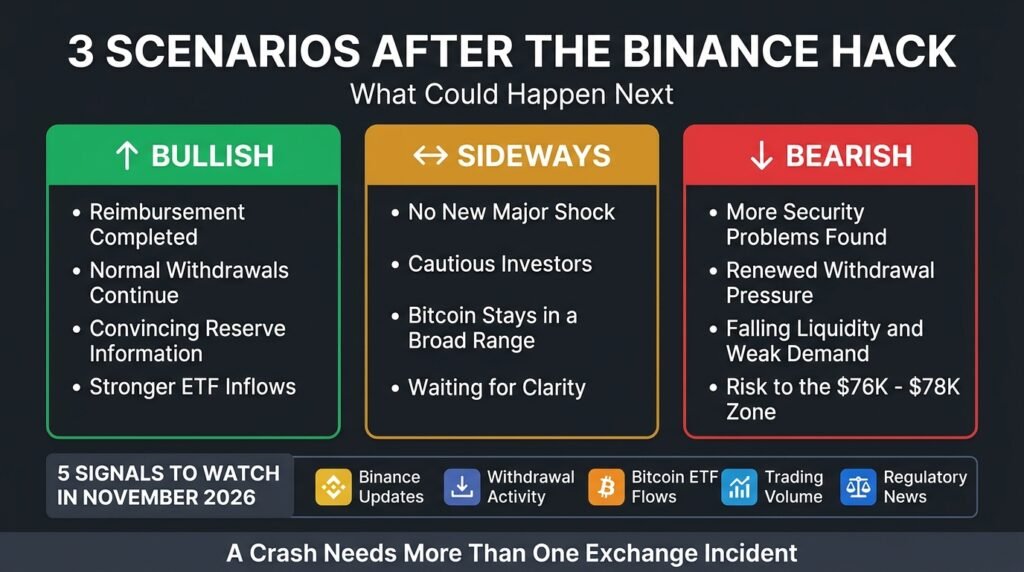
11. Important Market Signals to Watch During November 2026
Investors and market observers should monitor several developments rather than focusing on one headline. Binance’s official security updates remain important because they explain the company’s response and reimbursement progress.
Exchange withdrawals and deposits can reveal changes in customer confidence. A return toward normal activity could reduce concerns about a wider liquidity crisis.
Bitcoin ETF flows provide another useful indicator. Consistent inflows could suggest renewed institutional interest, while continued outflows could indicate caution.
Trading volume also matters. A recovery with healthy market participation may show stronger demand than a short-lived price increase with limited activity.
Regulatory announcements could influence exchange operations and investor expectations. Authorities may demand stronger custody controls, transparent reserves, and improved security procedures.
Finally, the broader financial environment remains important. Interest rates, stock market performance, and global economic uncertainty can influence demand for cryptocurrencies.
Monitoring these signals provides a more complete picture than relying on dramatic crash predictions.
12. What Does the Binance Hack Mean for Crypto’s Future?
The Binance incident highlights the importance of security, transparency, and responsible asset management across the cryptocurrency industry. Exchanges must protect customer funds while maintaining reliable systems and clear communication during emergencies.
The event could encourage stronger internal security controls. Exchanges may review employee permissions, device protection, withdrawal approvals, and the separation of sensitive systems.
Customers may also pay greater attention to proof-of-reserves reports and independent security assessments. Companies that communicate clearly and demonstrate strong financial resources could gain an advantage over competitors.
Blockchain analytics and cooperation between industry participants may also improve. The freezing of affected stablecoins showed that companies can coordinate quickly when they identify suspicious transactions.
However, the incident also reminds investors that cryptocurrency markets still carry serious operational and financial risks. Better technology cannot remove every threat, and no exchange can guarantee complete protection.
The industry’s long-term reputation will depend on how effectively companies learn from this event and improve their security practices.
FAQs about Binance Hack Crypto Market Crash
1. Will the Binance hack cause a crypto market crash?
The Binance hack could increase market volatility and selling pressure, but it does not guarantee a complete market crash. Binance’s reimbursement commitment and progress in restoring affected assets have helped reduce some concerns. Market direction will also depend on liquidity, institutional demand, and broader economic conditions.
2. How much money did attackers take from Binance?
Binance reported an estimated $6.3 billion impact from unauthorized withdrawals on October 29, 2026. The company committed to covering the affected customer funds through its reserves and corporate treasury. Investigators and industry partners also worked to freeze approximately $3 billion in affected assets.
3. Will Bitcoin fall further after the Binance hack?
Bitcoin could face further pressure if investors continue selling or market liquidity weakens. Analysts have highlighted the $76,000 to $78,000 area as an important region to monitor. However, market prices can change quickly, and no support level guarantees a particular outcome.
4. Which cryptocurrencies face the greatest risk?
BNB faces direct exchange-related sentiment risk because of its connection with Binance. Smaller altcoins may also experience greater volatility because they often have lower liquidity. Ethereum and Solana face broader market risks, but their individual ecosystems and adoption levels also influence their performance.
5. Did Binance promise to cover customer losses?
Yes. Binance announced that it would absorb the financial impact of the incident rather than transfer the affected losses to customers. The company also reported that it had replenished approximately 95% of the affected assets by November 3, 2026.
6. Could decentralized exchanges benefit from this incident?
Decentralized exchanges could attract users who prefer greater control over their assets. However, they also carry smart contract, liquidity, and technical risks. The incident may increase interest in self-custody and decentralized trading without eliminating the role of centralized exchanges.
7. What should investors watch after the Binance incident?
Important indicators include Binance’s official updates, withdrawal activity, reserve information, Bitcoin ETF flows, market liquidity, and regulatory developments. These signals can help observers understand whether confidence is returning or whether uncertainty continues to affect the market.
<h2><h2>Final Thoughts On Binance Hack Crypto Market Crash
The Binance hack has created one of the cryptocurrency industry’s biggest security challenges, but a wider crypto market crash does not represent the only possible outcome. The incident increased pressure on Bitcoin, Ethereum, BNB, and altcoins while raising important questions about exchange security and investor confidence.
Binance’s commitment to covering customer losses and its progress toward replenishing affected assets have helped stabilize the situation. However, the exchange must continue demonstrating transparency, financial strength, and reliable operations to rebuild confidence.
Bitcoin’s performance, institutional demand, altcoin liquidity, and broader market conditions will shape the next phase of the cryptocurrency market. The coming weeks could bring further volatility, but they could also create opportunities for stronger projects to demonstrate their long-term value.
Ultimately, this incident highlights one important lesson: cryptocurrency growth requires more than innovation and market demand. It also requires strong security, transparency, and responsible management across the entire industry.
