


Is your crypto safe after the Binance hack? That question filled every trading chat in October 2026, when attackers drained about $6.3 billion from the world’s largest exchange, according to Binance. The Binance hack ranks as the biggest crypto theft in history, and it shook Bitcoin, BNB, and the wider market within hours. Binance promises to cover user losses, and stablecoin issuers froze billions of dollars quickly. Still, the incident raises hard questions about exchange custody. This guide explains what happened, how markets reacted, and which steps protect your coins today. Read on to build a calm plan, because details keep changing.
What Happened in the Binance Hack?
On the evening of October, 2026, crypto started leaving Binance wallets without the exchange’s approval. Binance confirmed that attackers moved about $6.3 billion in digital assets, which makes this the largest theft in crypto history. Early estimates ran lower, and Chainalysis first put the figure near $5.9 billion, so the numbers shifted as the investigation grew. Binance paused withdrawals while its security team reviewed the damage. The company said it would cover every user loss, and co-CEO Yi He repeated that promise publicly. Tether, Circle, and other issuers froze billions in stablecoins tied to the incident within hours. Binance later said partners froze about $3 billion in total. Traders panicked at first, and the crypto market dropped sharply overnight. Reports and figures still change, so check Binance’s official channels for the latest facts. Read our crypto market analysis for daily updates.
How the Binance Hack Happened
Binance shared an initial investigation on October 30. The exchange said attackers reached a DevOps engineer’s laptop, and that foothold gave them a path into sensitive systems. Binance also said its team found additional points of breach, but it did not name them. Early reports describe an internal breach instead of a website attack. Internal tools and keys carry far more power than a public website, so attackers aim there. Social engineering and stolen credentials often open that door, because one tricked employee can expose an entire company. Hot wallets add risk, since they stay connected to the internet so users can withdraw quickly. Large exchanges juggle many wallets, servers, and staff, and that size widens the attack surface. Binance has not released a full technical report yet, so details may change. Treat early explanations with caution, and wait for official findings.
Who Is Behind the Binance Hack?
Blockchain investigators point toward North Korea. TRM Labs, Chainalysis, and the on-chain sleuth ZachXBT tie the attack to TraderTraitor, a hacking group from the Lazarus family. They base that view on laundering patterns and connections to earlier crypto thefts. North Korean hackers have stolen billions from exchanges and DeFi protocols over the past years. US authorities and the United Nations say the regime uses stolen crypto to fund its weapons programs. Attribution still carries uncertainty, because investigators rely on patterns instead of confessions. Law enforcement agencies and blockchain firms now track the stolen funds across chains. Hackers usually swap tokens, bridge assets, and use mixers to hide the trail. Frozen funds make that laundering harder, and quick action by issuers helped. Follow official statements from Binance and law enforcement for confirmed findings, because attribution can shift as new evidence arrives. Read the investigators’ summary on Cointelegraph.
Is Your Crypto Safe After the Binance Hack?
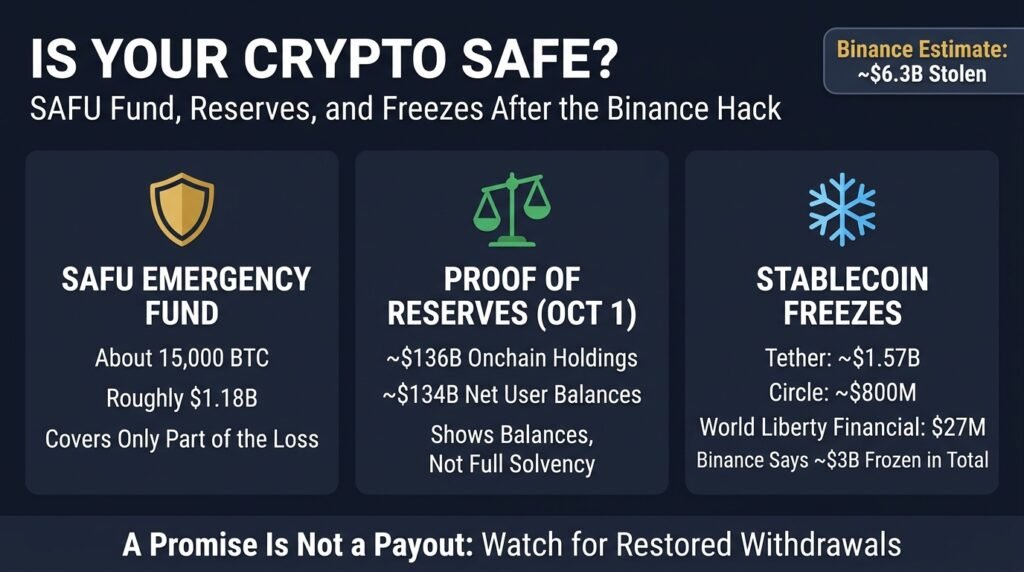
For most users, Binance says yes. Co-CEO Yi He said the exchange will cover all user losses from the hack. Binance holds a SAFU emergency fund of about 15,000 Bitcoin, worth roughly $1.18 billion at recent prices, according to 21Shares. That fund covers only part of the loss, so the company would pay the rest from its own resources. Binance’s October 1 proof of reserves showed about $136 billion inon-chainn holdings against $134 billion in net user balances. Those numbers suggest the exchange can absorb the hit, although proof of reserves shows balances and does not prove full solvency. Analysts like Jeff Ko of ViaBTC also expect Binance to absorb the losses. A promise still differs from a payout, so watch for restored withdrawals and clear updates. Never assume safety based on one statement. Keep only trading funds on any exchange, and move long-term savings into a wallet you control.
How Stablecoin Freezes Limited the Binance Hack
Stablecoin issuers acted within hours, and that speed mattered. Tether froze about $1.57 billion, and Circle froze about $800 million, according to reports. World Liberty Financial froze another $27 million. Centralized stablecoins let issuers block specific addresses, so hackers cannot move those tokens freely. Binance said partners froze roughly $3 billion in total, which cut the net damage sharply. Hackers prefer assets that issuers cannot freeze, such as Bitcoin and Ether, so they likely rushed to swap. This episode shows both sides of centralized stablecoins. Freeze powers protect victims during an attack, but they also prove that issuers control your tokens. Decentralized assets resist freezes, and they also resist recovery. Each design trades one risk for another. Track how much of the stolen amount investigators recover over the coming weeks.
Binance Hack Impact on Bitcoin
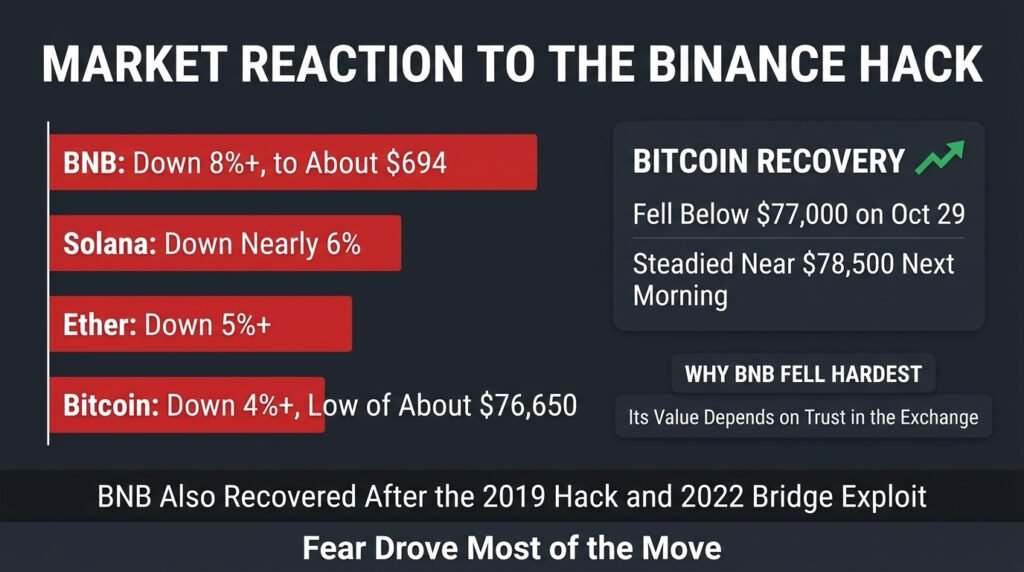
Bitcoin fell below $77,000 late on October 29, and it touched about $76,650 at its low. The price dropped more than four percent within a few hours of the news. Analysts noted that the market already leaned bearish before the hack. The Federal Reserve held rates steady on Wednesday, and several committee members pushed for a hike. A large Deribit options expiry, worth about $11 billion, added pressure on Friday. The stolen Bitcoin represents only a small fraction of total market value, so supply shock stays limited. Fear drove most of the move, not the theft itself. Rick Maeda of Laevitas called the reaction fairly contained for such a record event. Bitcoin then steadied near $78,500 on Friday morning, according to CoinGecko data. Read the full market report on The Block.
Binance Hack Impact on BNB
BNB took the heaviest hit because the token ties directly to the exchange. It dropped more than eight percent within 24 hours and fell to about $694, according to Reuters and CoinGecko data. Analysts said BNB faced the greatest exposure, since its value depends on trust in Binance. Traders use BNB to pay fees and join exchange programs, so any damage to the exchange hits demand. Yet one analyst called the drop quite modest for possibly the largest exchange theft ever. Past incidents show a similar pattern. BNB fell after Binance’s 2019 hack and after the 2022 BNB Chain bridge exploit, and it recovered later in each case. Recovery this time depends on withdrawals reopening and users regaining confidence. Watch exchange outflows, BNB trading volume, and official updates. Check live BNB data on CoinGecko.
Impact on Ethereum, Solana, and the Wider Market
Altcoins fell alongside Bitcoin. Ether dropped more than five percent, and Solana fell nearly six percent within hours of the news. Smaller tokens usually fall harder during panic, because traders sell risky assets first. Liquidations amplified the move, as leveraged long positions closed by force. The total crypto market lost billions in value in a single session. Some traders saw a buying chance, while others waited for clarity. Users of other centralized exchanges also checked their own platforms closely. Analysts said the market recovery hinges on Binance restoring confidence in security and customer funds. Compare moves across assets before you trade, and avoid chasing sudden bounces. Sharp drops often retrace part of the fall, but they can also continue when fear stays high.
Exchange Custody vs Self-Custody After the Binance Hack
The Binance hack revives the old debate about custody. On an exchange, you trust a company to guard your keys, and that company becomes a target. Hackers need to beat one organization to reach millions of balances. Self-custody removes that single point of failure, because you hold the keys. It also shifts all responsibility to you, so a lost seed phrase means lost funds. Hardware wallets offer strong protection for long-term holdings. Exchanges still offer convenience, deep liquidity, and customer support. Most experienced users split funds, with a small trading balance on exchanges and savings in cold storage. Spreading funds across platforms also limits the damage from any one failure. Choose the mix that matches your skill and your risk tolerance. The old rule still applies: not your keys, not your coins.
Steps to Protect Your Crypto After the Binance Hack
Act calmly, because panic leads to mistakes. First, check Binance’s official channels for withdrawal updates, and avoid links from random messages. Enable two-factor authentication with an authenticator app, and replace SMS codes if you still use them. Set an anti-phishing code in your exchange account, so genuine emails carry it. Review your API keys and delete any you do not use. Change your password, and use a unique one stored in a password manager. Move long-term holdings to a hardware wallet once withdrawals reopen. Withdraw in small test batches first, and double-check every address. Avoid panic selling at a sharp low, because forced decisions often cost more than the hack itself. Keep records of your balances and screenshots in case you need them later. Read our crypto trading guides for more safety basics.
How to Spot Scams After the Binance Hack
Scammers love chaos, and they target Binance users right now. Fake support accounts message victims and offer to restore funds for a fee. Phishing emails mimic Binance and ask you to verify your wallet or enter a seed phrase. Fake compensation sites promise payouts if you connect your wallet. Binance will never ask for your password, your seed phrase, or your two-factor codes. Impersonators also fill social media replies with links, so ignore unsolicited messages. Bookmark the official Binance address and open it only from that bookmark. Check the sender’s domain carefully, because tiny spelling changes fool many people. Never install software that a stranger recommends. Report suspicious accounts to the platform. If someone urges you to act within minutes, treat that urgency as a warning sign.
Lessons Traders Should Take From the Binance Hack
Every cycle teaches traders the same lesson in a new form. Counterparty risk exists even at the biggest exchange. Spread your funds across venues, wallets, and assets, so one event cannot wreck your portfolio. Limit leverage, because sudden shocks trigger liquidations within minutes. Hold a stablecoin cash reserve, but remember that issuers can freeze tokens. Keep a written plan with stop losses and position limits. Avoid trading on rumors during a crisis, and wait for official updates. Review your exchange’s proof-of-reserves reports, and understand what they prove and what they miss. Learn from history: Binance recovered from earlier incidents, but exchanges like Mt. Gox never did. Preparation costs little, and panic costs a lot. Follow daily updates on Crypto Fy Lab to stay informed without chasing rumors.
Binance Hack: Bullish and Bearish Outlook
In the bullish case, Binance reopens withdrawals, pays every loss, and investigators recover more stolen funds. Confidence returns, and the market shrugs off the event, as it did after earlier incidents. BNB then recovers as users trust the exchange again. In the bearish case, more breach points surface, withdrawals stay limited, and regulators tighten rules on exchanges. Users could move funds off centralized platforms, and that would drain liquidity. A market that already leans bearish could slide further under that pressure. The base case sits between the two, with Bitcoin following the wider macro mood while BNB trades on trust. Watch withdrawal status, recovered funds, exchange outflows, and regulator statements to see which path unfolds. Nobody can predict the winner, so plan for every scenario. Size your positions so that a bad outcome does not wreck your portfolio.
FAQs
Is my crypto safe after the Binance hack?
Binance says it will cover all user losses, and it holds a SAFU fund and large reserves. Safety still depends on the exchange keeping that promise and restoring withdrawals. Keep only trading funds on exchanges, and store long-term savings in a wallet you control.
How much did the Binance hack steal?
Binance says attackers moved about $6.3 billion, and partners froze about $3 billion of it. Early estimates ranged from $5.7 billion to $5.9 billion. Final numbers may change as the investigation continues.
Did the Binance hack crash Bitcoin?
Bitcoin fell more than four percent and dipped below $77,000, but analysts called the reaction fairly contained. The market already leaned bearish, and options expiry added pressure. Bitcoin steadied near $78,500 the next morning.
Should I withdraw my funds from Binance?
That choice depends on your risk tolerance and your goals. Many users move long-term holdings to a hardware wallet and keep a small balance for trading. Avoid panic decisions, use official links only, and test with small withdrawals first.
Final Thoughts
The Binance hack proves that even the largest exchange faces serious security risk. Binance promises to cover losses, and stablecoin freezes cut the damage, yet trust will take time to rebuild. Bitcoin dipped and recovered some ground, while BNB absorbed the heaviest blow. Protect your coins with strong security habits, split your funds, and ignore scam messages. Visit Crypto Fy Lab for daily crypto news and analysis. This post shares educational information only, so make your own decisions and set your own risk limits.
