


Dogecoin trading for beginners starts with one lesson: hype moves DOGE faster than fundamentals do. A single viral post can send the price soaring, and a single rumor can crush it just as fast. New traders often jump in near the top and sell in panic near the bottom. This guide explains how the market works, how to set up safely, and which simple strategies fit beginners. You will also learn the most common mistakes and the risk rules that protect your money. Read on to build a calm, clear plan before you place your first trade.
What Is Dogecoin and Why Do Beginners Trade It?
Dogecoin began in 2013 as a joke built from Litecoin’s code, and the Shiba Inu meme gave it a friendly face. Billy Markus and Jackson Palmer created it, and they never expected it to grow so large. Today DOGE ranks among the biggest cryptocurrencies by market value. Beginners like it because the price per coin stays low and the community feels welcoming. Exchanges around the world list it, so you can buy it within minutes. The coin runs on proof of work, and its blocks arrive roughly every minute. Fees stay tiny, which makes small payments practical. Celebrity posts, especially from Elon Musk, have fueled several famous rallies. Those rallies attract newcomers who fear missing out. However, a low price per coin does not make the coin cheap, because total market value matters more. Visit the official Dogecoin website to learn how the project works.
Dogecoin Trading for Beginners: How the Market Works
You trade DOGE on exchanges, where buyers and sellers place orders against each other. A buy order sets the price you will pay, and a sell order sets the price you will accept. Market orders fill instantly at the best available price, while limit orders wait for your chosen price. Dogecoin trading for beginners works best with limit orders, because they control your entry and often cost less in fees. The market runs 24 hours a day, so price moves can happen while you sleep. Trading volume tells you how much activity surrounds a move, and strong volume adds weight to a trend. Dogecoin usually follows Bitcoin’s direction, so a falling Bitcoin often drags DOGE down. Large holders, called whales, can shift the price with one big order. Spreads and fees also eat into small profits, so check them before you trade. Practice with tiny amounts until you understand how each order type behaves.
How Hype Drives DOGE Price Swings
Social media shapes Dogecoin’s price more than almost any other large coin. A single viral post can send DOGE up by double digits within hours. Traders then pile in because they fear they will miss the move. This behavior, called FOMO, pushes buyers to chase prices near the top. Early buyers soon sell into that excitement and lock in profits. The price then falls fast, and late buyers hold losses. Influencers, group chats, and trending hashtags amplify this cycle. Many posts promise easy wealth, yet few explain the risk. Treat excitement as a warning sign instead of a buy signal. Ask who benefits when you buy, because promoters often hold coins already. Check CoinGecko’s Dogecoin page for real volume and price history before you react to any headline.
Dogecoin Trading for Beginners: Setting Up Safely
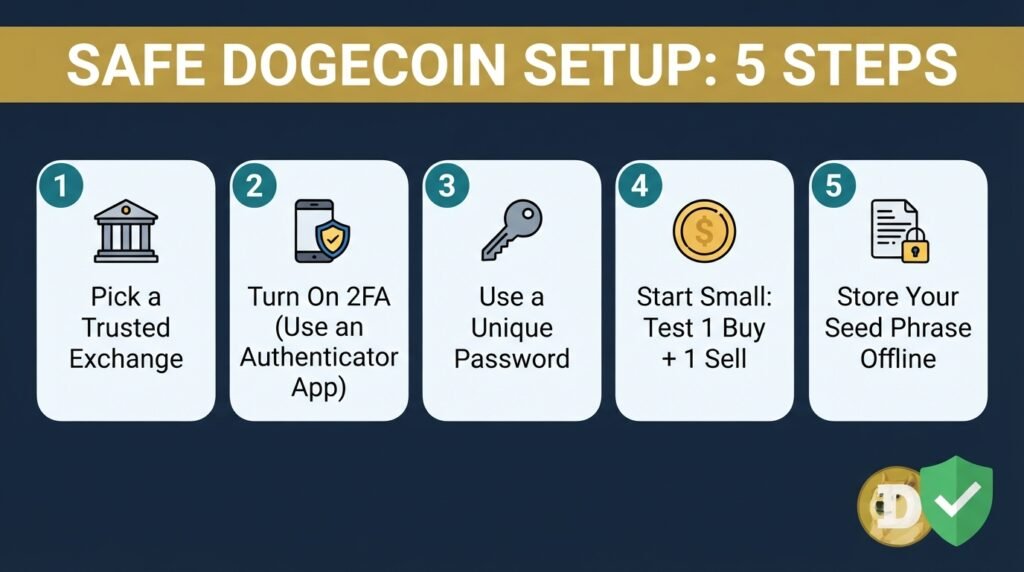
Safe setup protects you before you place any trade. Choose a reputable exchange with strong security, clear fees, and good Dogecoin liquidity. Complete the identity checks and turn on two-factor authentication right away. Use an authenticator app instead of text messages, because SIM-swap attacks target phone numbers. Create a long, unique password and store it in a password manager. Start with a small deposit, and test one buy and one sell. Confirm every withdrawal address carefully, because blockchain transfers cannot be reversed. Move coins you plan to hold for months into a personal wallet that you control. Write your seed phrase on paper and keep it offline, and never share it with anyone, including people who claim to work for support. Avoid links from random messages, because phishing sites copy popular exchanges. Bookmark the official exchange address and use only that.
Simple Dogecoin Trading Strategies for Beginners
Dollar-cost averaging offers the simplest strategy for new traders. You buy a fixed amount at regular intervals, regardless of price. This habit smooths out your entry and removes emotion from timing. Read the Investopedia guide to dollar-cost averaging to see how it works in practice. Swing trading offers another option, where you hold DOGE for days or weeks to catch larger moves. Swing traders buy near support and sell near resistance. Avoid day trading at first, because fast decisions and frequent fees punish beginners. Pick one strategy and test it with small amounts for several weeks. Record each trade, including your reason, your entry, and your exit. Review that journal to learn which decisions worked. Stick with your strategy after a loss instead of switching every time, because consistency teaches more than constant experiments.
Dogecoin Trading for Beginners: Reading Basic Charts
Charts show price history, and a few simple tools help beginners read them. Candlesticks display the open, high, low, and close for each time period. Support marks a price zone where buyers often step in, and resistance marks a zone where sellers push back. Moving averages smooth out noise and reveal the trend direction. The 50-day and 200-day averages attract many traders. The Relative Strength Index measures momentum, with readings above 70 suggesting overbought conditions and readings below 30 suggesting oversold ones. Volume confirms whether real money backs a move. Start on the daily chart, because shorter timeframes create more noise. Combine two or three signals before you act, and never trust a single indicator alone. Remember that Dogecoin often breaks technical levels during viral hype. Charts guide your plan, but they never guarantee an outcome.
Common Hype-Driven Mistakes to Avoid
Chasing green candles tops the list of beginner errors. Buyers see a coin jump and rush in near the peak. Another mistake involves investing money you need for rent, bills, or emergencies. Some beginners go all in on one trade and hope for a miracle. Others ignore fees and taxes until those costs eat the profit. Many follow influencers blindly and skip their own research. Fake giveaways and scam accounts promise to double your DOGE if you send coins first, but real giveaways never ask you to send funds. Revenge trading follows a loss, when traders double their size to win it back. That habit turns small losses into large ones. Panic selling during a dip also hurts, because prices often recover. Write your rules before you trade, and follow them when emotions run high.
Dogecoin Trading for Beginners: Risk Management Rules
Risk management keeps you in the game. Risk only a small percentage of your account on each trade, such as one or two percent. Place a stop loss every time, so a bad trade ends at a loss you planned. Decide your profit target before you enter, and respect it. Size your position by the distance to your stop, not by your excitement. Keep a cash reserve in a stablecoin, so you can buy dips without selling other assets. Diversify instead of putting everything into meme coins. Limit your total crypto exposure to an amount you can afford to lose. Avoid trading when you feel angry, tired, or euphoric, and take a break after a big win or loss. Read our crypto trading guides for more risk control basics. Protecting capital matters more than chasing profit.
Spot Trading vs Leverage: Why Beginners Should Wait
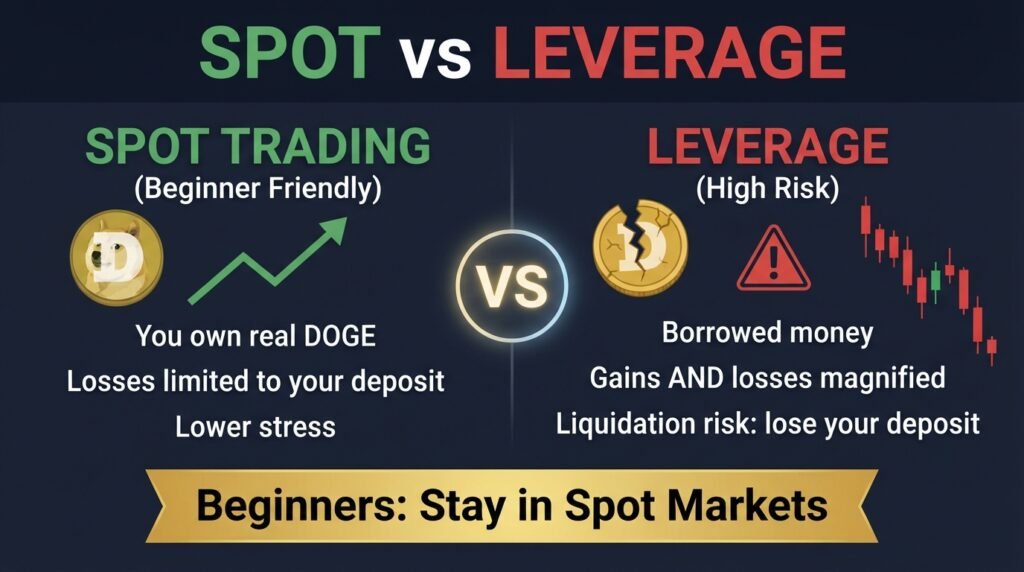
Spot trading means you buy real DOGE and own it. Leverage lets you borrow money to control a larger position. Leverage magnifies gains, but it magnifies losses just as fast. Dogecoin can move ten percent in a day, so a leveraged position can vanish quickly. Exchanges liquidate your position when losses reach a set limit, and you lose your deposit. Funding fees on futures also drain your account over time. Dogecoin trading for beginners should stay in spot markets until you master basic strategy. Prove that you can trade profitably for several months without leverage. Then test low leverage with tiny amounts if you still want to. Treat futures as a separate skill, not a shortcut. Many experienced traders avoid high leverage altogether, because slow and steady growth beats a blown account.
Build a Dogecoin Trading Plan for Beginners
A written plan turns random clicks into a process. Start with your goal, such as long-term holding, steady buying, or short-term swings. Set the amount you can afford to risk, and never exceed it. Choose your strategy, your timeframe, and your entry rules. Define your stop loss and your profit target before you trade. Decide how often you will check the market, because constant watching fuels stress. Track every trade in a journal, and review it every month. Note the news and social posts that influenced you, so you spot hype patterns. Update your plan slowly, based on evidence instead of mood. Follow daily updates on Crypto Fy Lab to stay informed without chasing rumors. Discipline separates lasting traders from lucky ones.
FAQs
Is Dogecoin trading for beginners safe?
Dogecoin trading carries high risk because the price swings sharply and reacts to social media hype. You can reduce that risk with small positions, stop losses, and a secure exchange account. No strategy removes risk completely, so trade only with money you can afford to lose.
How much money should a beginner start with?
Start with a small amount that does not affect your daily life. Many beginners begin with an amount they feel comfortable losing entirely. Increase your size slowly only after you prove that your plan works.
Should I buy Dogecoin after a big pump?
Buying after a sharp rally often means buying near the top. Wait for the price to cool, and look for a pullback to support. A fixed, regular buying schedule also helps you avoid chasing hype.
Is Dogecoin a good long-term investment?
Dogecoin has a large community and wide exchange support, but it also has an unlimited supply and heavy hype dependence. Its long-term value depends on real adoption and market demand. Research the coin, spread your risk, and avoid betting everything on one asset.
Final Thoughts
Dogecoin trading for beginners rewards patience, planning, and discipline far more than luck. Set up your accounts safely, choose one simple strategy, and learn basic chart tools. Avoid leverage, ignore hype, and protect your capital with stop losses and small positions. Write a plan, track your trades, and learn from every result. Visit Crypto Fy Lab for daily crypto news and analysis. This post shares educational information only, so make your own decisions and set your own risk limits.
