


Litecoin vs. Bitcoin is one of the oldest debates in crypto, and it matters more today than ever. People want to pay online without waiting long or losing money to fees. Bitcoin leads the market in value and trust, while Litecoin promises quicker confirmations and cheaper transfers. Both coins move money across borders without a bank, but each serves payment needs differently. In this guide, we compare speed, fees, security, scalability, and merchant support side by side. You will see where each coin shines and where it struggles. We also explain how second-layer tools change the picture. By the end, you will know which coin fits your daily payments, your business, or your savings plan.
What Makes a Cryptocurrency Good for Payments?
A payment coin must do three things well: confirm quickly, cost little, and work reliably every time. Speed matters because a shopper will not stand at a checkout for an hour. Low fees matter because small purchases lose their appeal when the network charges more than the item costs. Reliability matters because merchants need to trust that the network will not freeze or stall. Wide acceptance also gives a coin real value, since a fast coin that nobody accepts helps no one. Security plays a role too, because users want their funds to stay safe from double-spending attacks. Finally, a good payment coin keeps its price steady enough that buyers and sellers do not lose money between the sale and the settlement. We use these criteria throughout this article.
Litecoin vs Bitcoin: A Quick Overview
Both coins use proof-of-work, both run on open-source code, and both have no central owner. Their goals, however, differ importantly. Bitcoin positions itself as a global store of value, while Litecoin positions itself as a faster tool for everyday spending. This difference shapes every technical choice the two networks make. Bitcoin prioritizes maximum security and scarcity. Litecoin prioritizes quick confirmations and low costs. The two sections below break down each coin’s profile before we compare them directly.
Bitcoin at a Glance
Satoshi Nakamoto launched Bitcoin in 2009 as the first decentralized digital currency. The network produces a new block roughly every 10 minutes, and the total supply stops at 21 million coins. Miners secure the chain with the SHA-256 algorithm, and the network holds the largest mining power of any cryptocurrency. Many investors treat Bitcoin as digital gold, so they hold it rather than spend it. Large companies and investment funds now hold Bitcoin as well. This reputation gives Bitcoin deep liquidity and strong brand recognition. The same popularity, however, creates heavy demand for block space, which pushes fees up during busy periods. These traits shape how well Bitcoin handles everyday payments. You can read the original design on the official Bitcoin.org website.
Litecoin at a Glance
Charlie Lee, a former Google engineer, launched Litecoin in October 2011. He built it as a lighter, faster companion to Bitcoin, and people often describe it as silver to Bitcoin’s gold. The network produces a block about every 2.5 minutes, and the supply caps at 84 million coins. Litecoin uses the Scrypt mining algorithm, which originally let ordinary computers mine more easily than Bitcoin’s setup. Today miners use specialized machines for both coins. Litecoin also supports the Lightning Network and added optional confidential transactions through MWEB in 2022. Because of this payment focus, Litecoin attracts users who want a simple, quick way to send money. You can find project details at Litecoin.org.
Transaction Speed Compared
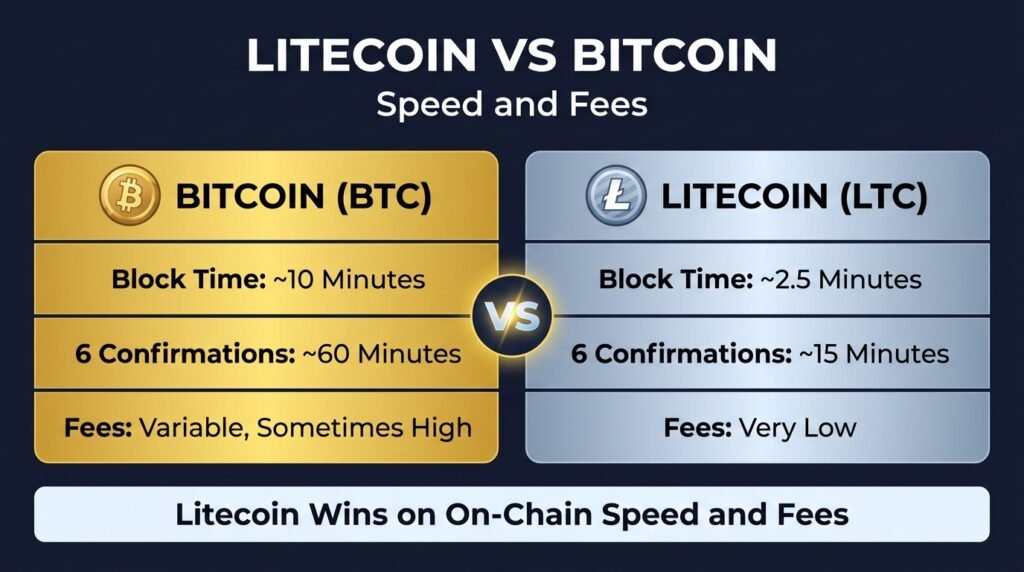
Bitcoin’s 10-minute block time means a typical on-chain transaction needs at least one block to confirm. Most merchants wait for six confirmations on large payments, which takes about an hour. Litecoin’s 2.5-minute blocks cut that wait to roughly 15 minutes for the same six confirmations. For a coffee shop, a single Litecoin confirmation arrives in minutes, while a single Bitcoin confirmation can take much longer. Network congestion can stretch these times for either coin, though Bitcoin feels the strain more often. Faster blocks also give Litecoin more room per hour for transactions. Block time sets only the average, so individual confirmations vary widely. Even so, Litecoin clearly wins the on-chain speed contest. Bitcoin narrows the gap only when users switch to the Lightning Network.
Transaction Fees Compared
Fees depend on demand for block space, not on the coin’s price. Bitcoin transactions cost more during busy periods because users compete for limited space in each block. A simple transfer sometimes costs several dollars at those moments. Litecoin transactions usually cost a fraction of a cent because the network rarely fills its blocks. This gap makes Litecoin far more attractive for small payments. Here are the main fee differences:
- Bitcoin: fees rise and fall sharply with network demand.
- Litecoin: fees stay consistently tiny, even during market rallies.
- Small payments: Litecoin keeps tips, subscriptions, and online purchases affordable.
- Frequent senders: Litecoin users save the most over time.
Bitcoin wallets let users choose a fee level, but low-fee transactions may wait hours for confirmation. Litecoin users rarely face that trade-off.
Security and Network Strength
Bitcoin holds the strongest security record in crypto. Its enormous hash rate makes a 51% attack extremely expensive, and the network has run for more than 15 years without a protocol-level breach. Litecoin also maintains a solid record since 2011, with no major protocol failure. Its hash rate stays lower than Bitcoin’s, yet Litecoin miners also merge-mine Dogecoin, which adds extra mining rewards and strengthens the network. Both coins use proof-of-work, and both rely on thousands of independent nodes to verify transactions. For payments below a few thousand dollars, Litecoin’s security level more than suffices. For very large transfers, many users still prefer Bitcoin’s extra protection. Neither coin protects you from phishing or lost keys, so careful wallet habits remain essential.
Mining Algorithms and Supply Limits
The two coins differ in how they create and limit new units. These choices influence long-term scarcity and mining behavior. Here is a quick summary:
- Bitcoin supply: 21 million coins, with a halving about every four years.
- Litecoin supply: 84 million coins, with a halving about every four years.
- Bitcoin algorithm: SHA-256, which dedicated machines dominate.
- Litecoin algorithm: Scrypt, which also relies on specialized hardware today.
A larger supply gives Litecoin smaller unit prices, so users can send whole coins more comfortably. Bitcoin’s tighter cap fuels its scarcity story. Both schedules reduce new issuance over time, and both coins reward miners with transaction fees as block rewards shrink.
Scalability and Layer-2 Solutions
Both networks scale through layered solutions. Bitcoin developers built the Lightning Network on top of the main chain, and it lets users send near-instant payments for tiny fees. Lightning adoption keeps growing, yet setup still requires channel management, which confuses new users. Litecoin also supports Lightning, but it needs less help because its base layer already moves quickly and cheaply. Bitcoin’s block size and slow block time push it to lean on these add-ons. Litecoin’s design lets users pay directly on-chain with no extra tools. A beginner can therefore start sending Litecoin in minutes, while Bitcoin Lightning demands more learning. Experienced users, however, enjoy excellent speed on Lightning. Learn more about the technology at Lightning. network.
Merchant Adoption and Real-World Use
Bitcoin enjoys the widest acceptance of any cryptocurrency. Payment processors, online retailers, and crypto debit cards support it almost everywhere crypto works. Litecoin ranks among the most widely accepted altcoins, and processors such as BitPay list it alongside Bitcoin. Many exchanges also list Litecoin with deep liquidity, so converting it to cash is easy. Merchants who want quick settlements often favor Litecoin, while merchants who want maximum customer reach often accept both. Acceptance changes quickly, so check each platform’s current coin list before you commit. For online shops, enabling both coins through a processor costs little and widens the customer base. You can find practical tutorials in the crypto guides on CryptoFyLab.
Privacy Features
Neither coin offers full anonymity by default. Bitcoin and Litecoin both record transactions on public ledgers, and analysts can trace wallet activity. Litecoin added the MimbleWimble Extension Block (MWEB) in 2022, which lets users send confidential transactions when they choose. Bitcoin lacks a native equivalent, so users rely on third-party tools. Regulators and exchanges watch privacy features closely, and some platforms have restricted MWEB deposits. Users who value privacy should therefore check platform rules before they send funds. Everyday shoppers rarely need these features, yet business owners may appreciate extra confidentiality for payroll or supplier payments. Both coins still demand good security habits, such as using fresh addresses and trusted wallets.
Price Volatility and Value Storage
Both coins swing sharply in price, which complicates payments. Bitcoin’s larger market makes it somewhat steadier, while Litecoin often moves more in percentage terms. A merchant who accepts either coin can lose value within hours of a sale, so many businesses convert payments to cash immediately. Payment processors handle this conversion automatically. Buyers who hold coins for spending should keep only what they need and store long-term savings separately. Bitcoin suits holding better because of its scarcity story and institutional demand. Litecoin suits spending better because its speed and fees favor frequent transfers. Treat each coin according to its role instead of expecting one coin to do everything.
Litecoin vs Bitcoin: Which Is Better for Fast, Low-Fee Payments?
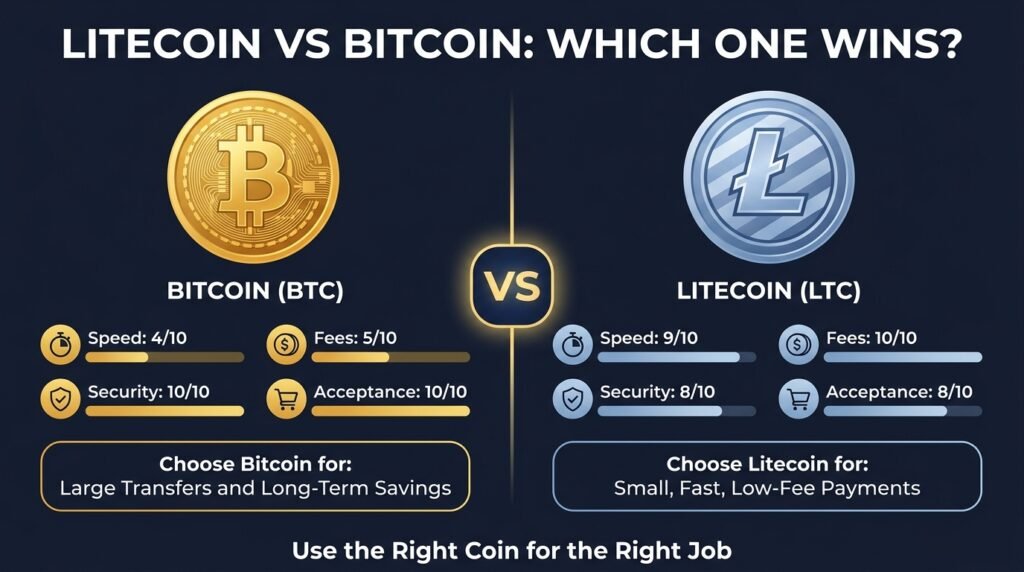
For fast, low-fee payments, Litecoin wins on the base layer. Its 2.5-minute blocks confirm transactions sooner, and its fees stay tiny even in busy markets. Bitcoin wins on security, brand strength, and global liquidity, and its Lightning Network closes much of the speed gap for advanced users. Your best choice depends on your situation:
- Choose Litecoin if you send small, frequent payments and want simple, cheap transfers.
- Choose Bitcoin if you move large amounts, value maximum security, or want a long-term store of value.
- Choose both if you run a business and want to reach every type of customer.
| Feature | Bitcoin (BTC) | Litecoin (LTC) |
|---|---|---|
| Block time | About 10 minutes | About 2.5 minutes |
| Max supply | 21 million | 84 million |
| Typical fees | Variable, sometimes high | Very low |
| Algorithm | SHA-256 | Scrypt |
| Best use | Store of value, large transfers | Everyday payments |
FAQs About Litecoin vs Bitcoin
Is Litecoin faster than Bitcoin?
Yes. Litecoin produces a block about every 2.5 minutes, while Bitcoin produces one about every 10 minutes. Confirmations therefore arrive sooner on Litecoin. Bitcoin can match that speed only through second-layer tools such as the Lightning Network.
Which coin has lower fees?
Litecoin usually charges a fraction of a cent per transaction. Bitcoin fees change with network demand and sometimes reach several dollars. For small payments, Litecoin almost always costs less.
Is Litecoin as safe as Bitcoin?
Litecoin offers strong security for everyday payments, and it has run reliably since 2011. Bitcoin, however, has a far larger hash rate, so attacking it costs much more. Large transfers therefore favor Bitcoin.
Can I accept both coins Litecoin & Bitcoin in my online store?
Yes. Most major crypto payment processors support both Litecoin and Bitcoin. You can enable both coins in a few steps and convert payments to cash automatically if you want to avoid price swings.
Final Thoughts On Litecoin vs Bitcoin
The Litecoin vs Bitcoin question has no single winner, because each coin excels at a different job. Litecoin gives you faster confirmations and lower fees, which makes it the stronger pick for quick, small payments. Bitcoin gives you unmatched security and recognition, which makes it the stronger pick for savings and large transfers. Many users and merchants hold both and choose the right coin for each task. Whichever path you take, compare current network fees, use a trusted wallet, and never risk money you cannot afford to lose. For more explainers and market updates, explore CryptoFyLab.
