


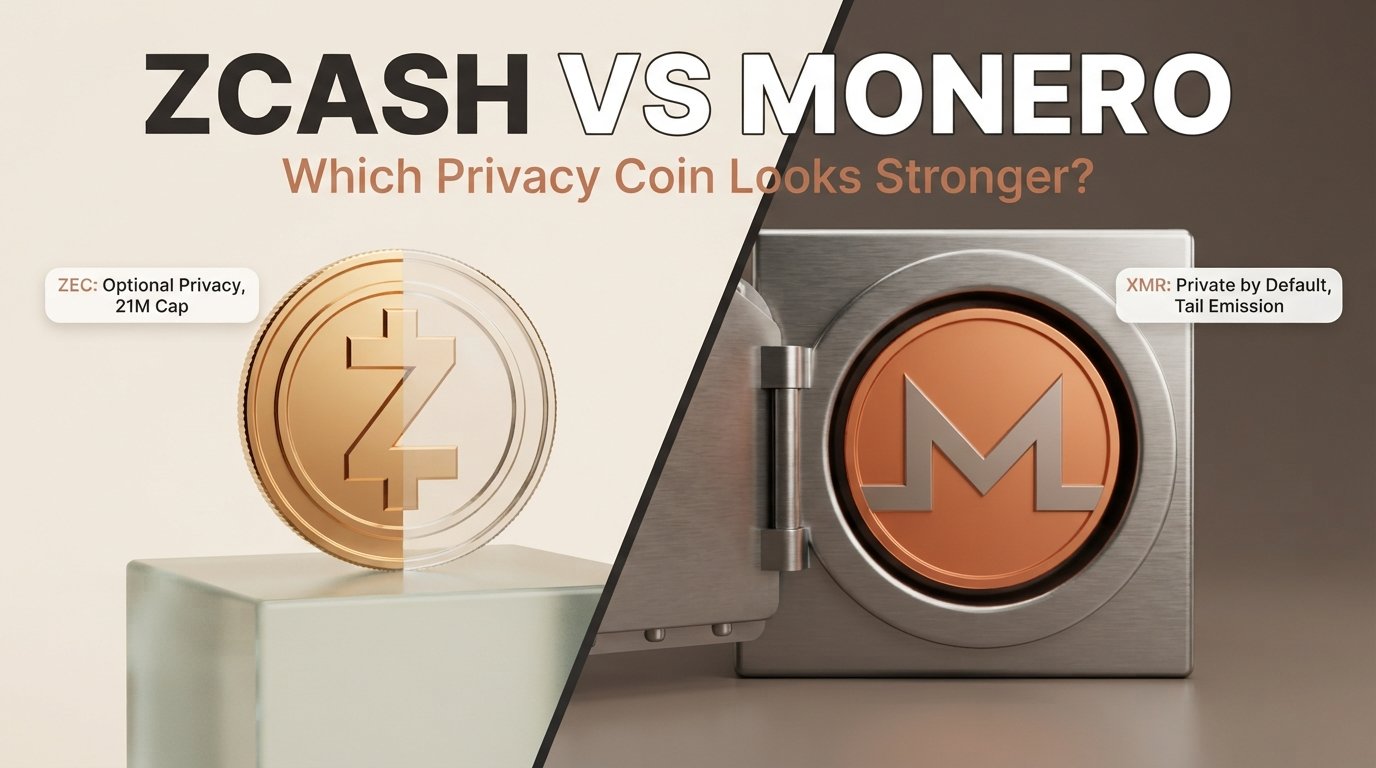
Zcash vs Monero is the central debate in the privacy coin sector. Both projects let users move value without exposing every detail on a public ledger, yet they take very different routes. Zcash offers optional shielded transactions backed by advanced cryptography, while Monero hides everything by default. Regulators, exchanges, and traders react to these choices in different ways, and those reactions shape each coin’s future. To help you evaluate which privacy coin holds a stronger position, this guide provides a comparative analysis of their technology, tokenomics, regulatory environment, and future potential.
What Are Zcash and Monero?
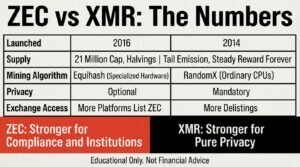
Zcash (ZEC) launched in 2016, and a team of cryptographers built it around zero-knowledge proofs. Monero (XMR) launched in 2014 and grew out of the CryptoNote protocol, which focuses on untraceable payments. Both coins use proof of work and run on open-source code. Both aim to give users financial privacy, but they define privacy differently. Zcash lets users choose between public and private transfers. Monero forces every transaction to stay private. Visit the official Zcash website and the official Monero website to explore each project directly.
Zcash vs Monero: How Their Privacy Technology Works
Zcash relies on zk-SNARKs, a type of zero-knowledge proof. This tool lets a sender prove a transaction is valid without revealing the sender, the receiver, or the amount. Monero combines three tools instead. Privacy is achieved by blending the sender’s signature with decoy inputs using ring signatures, generating a unique, one-time destination via stealth addresses, and concealing the transaction value through RingCT. In the Zcash vs Monero comparison, Monero hides data inside a crowd of decoys, while Zcash hides data behind mathematical proof. Both methods work well, and cryptographers still debate their strengths and trade-offs.

Monero’s Privacy by Default Approach
Monero makes privacy mandatory, so every transaction looks the same on the blockchain. This design protects the whole network because no user stands out. By eliminating the need for manual configuration, the platform prevents users from making costly operational mistakes. Merchants and wallets treat all XMR payments equally, which strengthens fungibility. The trade-off is that regulators and compliance teams cannot view any payment details. That reality pushes many exchanges to avoid the coin. Monero’s development team continuously refines the network, developing enhancements like FCMP++ to provide even greater anonymity for senders.
Zcash’s Optional Privacy Approach
Zcash gives users two address types: transparent addresses that work like Bitcoin and shielded addresses that hide transaction data. This flexibility helps businesses and exchanges that must show some activity for compliance. However, many users still send coins through transparent addresses, which weakens the privacy of the whole network. Wallets like Zashi now push users toward shielded transfers, and shielded usage has grown in recent years. Users can also share a viewing key with an auditor, which proves activity without giving up spending control. This balance appeals to institutions that want privacy without legal conflict.
Zcash vs Monero: Supply, Mining, and Tokenomics
Zcash caps its supply at 21 million coins, just like Bitcoin, and it halves its block rewards on a schedule. Monero takes a different path with tail emission, which pays miners a small, steady reward forever. That reward keeps the network secure without relying only on fees. Zcash miners use the Equihash algorithm, which favors specialized hardware. Monero miners use RandomX, which favors ordinary CPUs and encourages wider participation. Scarcity drives the Zcash story for many investors, while Monero’s steady security model attracts long-term believers. Check live supply and price data on CoinGecko’s privacy coin category.
Zcash vs Monero: Regulation and Exchange Access
Regulation shapes both coins more than any technical feature. Several major exchanges have delisted Monero in different regions, which reduces liquidity and access. Zcash faces pressure too, but its optional privacy gives it a stronger compliance argument, so more platforms keep it listed. Lawmakers in many regions keep tightening rules around anonymous assets. These rules can shrink trading volume quickly, so every investor should track them closely. Meanwhile, decentralized swaps and peer-to-peer markets give users alternative routes. Follow policy updates on Crypto Fy Lab to stay ahead of the news.
Does Zcash currently have the stronger market and institutional outlook?
Zcash has the stronger outlook for investors who expect regulators to accept privacy with compliance options. Its flexible design, active development, and growing wallet ecosystem give it more room to reach institutions. Monero has the stronger outlook for users who value pure, uncompromising privacy and a battle-tested network. Its loyal community and steady demand on peer-to-peer markets keep it resilient. Neither coin escapes regulatory risk, and both prices swing sharply. Weigh your own goals before you pick a side, and read our crypto market analysis for more context.
FAQs
Is Zcash or Monero more private?
Monero offers stronger privacy by default because every transaction stays hidden. While Zcash provides equivalent anonymity during shielded transactions, its transparent transfers leave transaction data fully visible. Use shielded addresses on Zcash to get the full benefit.
Can I buy Zcash and Monero on major exchanges?
Zcash trades on many major exchanges, while Monero faces more delistings. Availability depends on your region, so check each platform’s list before you deposit funds. Decentralized options also exist for both coins.
Which coin wins the Zcash vs Monero debate for beginners?
Zcash usually feels easier for beginners because more exchanges list it and modern wallets guide users toward private transfers. Monero also offers simple wallets, but fewer exchanges support it. Start with a small amount and learn how seed phrases, fees, and wallets work.
Final Thoughts
Zcash vs Monero comes down to a choice between flexible privacy and absolute privacy. Zcash offers optional shielding, a capped supply, and a stronger compliance story. Monero offers mandatory privacy, tail emission, and a loyal community. Regulation will likely decide which coin gains the most ground. Visit Crypto Fy Lab for daily crypto news and analysis. This post shares educational information only, so make your own decisions and set your own risk limits.
