



Privacy coins are back in the spotlight, and new investors want to understand them before buying. These cryptocurrencies hide sender, receiver, or amount details that Bitcoin shows on its public ledger. Supporters call them essential tools for financial freedom, while regulators call them a compliance headache. Prices swing sharply, exchanges change their listings, and rules shift across regions. This guide explains how privacy coins work, compares the leading projects, and weighs the risks. Read on to learn what new investors should know before investing in this niche sector.
What Are Privacy Coins and How Do They Work?
Privacy coins are cryptocurrencies that hide transaction details from the public. Bitcoin records every transfer on an open ledger, and anyone can follow the trail. Privacy coins break that trail by masking the sender, the receiver, the amount, or all three. Each project uses its own cryptography to reach this goal. Some coins hide everything by default, while others let users choose privacy for each transaction. Users still hold their coins in wallets and send them across a normal blockchain network. Miners or validators still verify every payment and record it on the chain. The difference lies in what outsiders can read from that record. Privacy does not mean a coin works outside the law, and many users simply want financial confidentiality. Visit the official Monero website to see how one leading project explains its mission.
Why New Investors Should Know About Privacy Coins
Privacy coins give investors exposure to a unique corner of the crypto market. Demand for financial privacy grows whenever people worry about surveillance and data leaks. Public blockchains expose spending habits, balances, and business payments to anyone with a block explorer. Companies dislike revealing supplier payments, and individuals dislike revealing their savings. Privacy coins solve this problem and attract users who value confidentiality. Their prices often rise during privacy debates and fall during regulatory crackdowns. This sensitivity to news makes them more volatile than many large coins. New investors must understand that volatility before they buy. A small allocation can add variety to a portfolio, but it should never replace core holdings. Learn the basics first, because knowledge protects your capital better than any chart.
Main Technologies Behind Privacy Coins
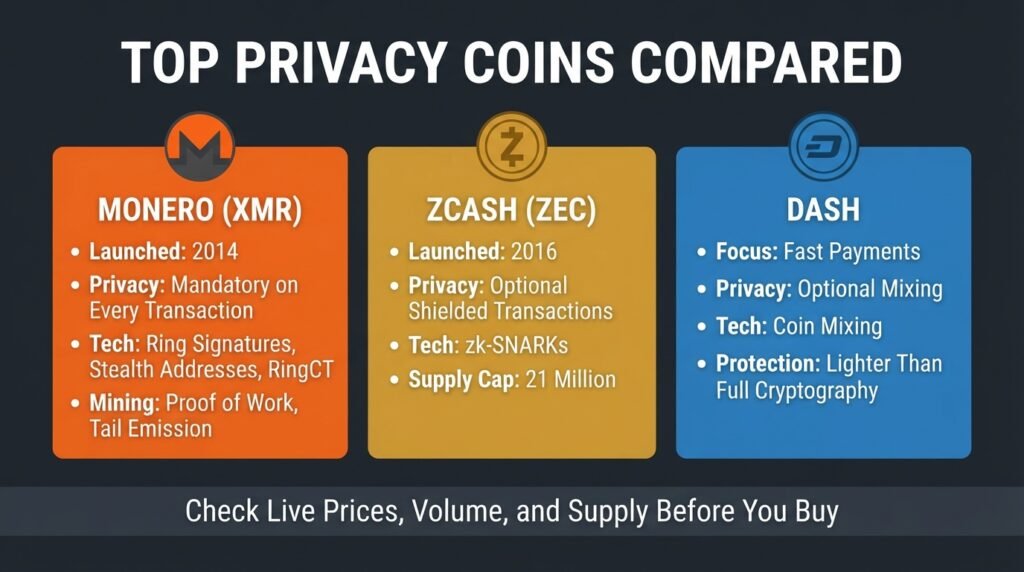
Different privacy coins use different tools, so new investors should learn the basics. Monero uses ring signatures, which mix a sender’s signature with decoy signatures from other users. Stealth addresses create a one-time address for every payment, so outsiders cannot link payments to one wallet. RingCT hides the amount that moves in each transaction. Zcash uses zk-SNARKs, a type of zero-knowledge proof. This proof lets a sender show that a payment is valid without revealing any details. Dash takes a lighter route with a mixing feature that shuffles coins among users. Mixing hides links between inputs and outputs, though it offers weaker protection than full cryptographic hiding. Each method trades privacy strength against speed, cost, and complexity. Cryptographers keep testing these designs and publishing improvements. Learn the main method behind each coin before you invest.
Top Privacy Coins Beginners Should Know
Monero (XMR) leads the sector for users who want mandatory privacy on every transaction. It launched in 2014, and it uses proof of work with a steady tail emission. Zcash (ZEC) launched in 2016 and offers optional shielded transactions through zero-knowledge proofs. Its capped supply of 21 million coins appeals to investors who like scarcity. Visit the official Zcash website to read its technical documentation. Dash started as a Bitcoin alternative and now offers fast payments with optional mixing. Other projects, such as Decred and Horizen, add privacy tools to broader platforms. Market values and rankings change often, so check live data before you decide. Compare prices, volume, and supply on CoinGecko’s privacy coin category. Never buy a coin only because its name sounds familiar or its price just jumped.
Privacy Coins vs Bitcoin: Is Bitcoin Really Anonymous?
Many beginners believe Bitcoin hides their identity, but it does not. Bitcoin uses pseudonyms, which means addresses appear instead of names. Anyone can trace those addresses across the public ledger. Analytics firms link addresses to real people through exchange records and online clues. Law enforcement uses these tools to follow funds across many wallets. Once someone connects your identity to one address, they can often see your whole history. Privacy coins aim to block this kind of tracking at the protocol level. They hide the details that analysts normally use to build a profile. However, no tool offers perfect anonymity, and careless habits still leak information. Reusing exchange accounts, sharing screenshots, or linking wallets to social profiles can expose you. Treat privacy as a practice, not a switch you flip once.
Regulation and Exchange Delistings
Regulation shapes privacy coins more than any technical feature. Many governments worry that hidden transactions help criminals move illicit funds. Exchanges therefore face pressure to follow anti-money-laundering rules. Several major exchanges have removed Monero and other privacy coins in various regions. Japan and South Korea already restrict these assets on regulated platforms. The European Union passed anti-money-laundering rules that will limit privacy coins on regulated platforms from 2027. Delistings reduce liquidity and make buying and selling harder. Prices often drop when a major exchange announces a removal. Decentralized swaps and peer-to-peer markets still offer routes, but they demand more skill. Check your local rules before you trade, because laws differ by country. Follow policy updates on Crypto Fy Lab to stay ahead of the news.
Risks of Privacy Coins New Investors Must Weigh
Privacy coins carry risks that go beyond normal crypto volatility. Regulatory risk tops the list, since a new rule can remove a coin from major exchanges overnight. Liquidity risk follows, because thin markets let large orders move the price. Technical risk matters too, because a flaw in the cryptography could weaken privacy or break the network. Reputation risk also hangs over the sector, because criminals use these tools, and headlines often highlight that. Some tax authorities scrutinize privacy coin holders more closely. Scam tokens also exploit the privacy label, so fake projects appear regularly. Prices can swing wildly during news events and hype cycles. Never invest money you need for rent, food, or emergencies. Use small positions and stop losses, and read our crypto trading guides before you use leverage. Spread your holdings across several assets instead of betting everything on one coin.
How to Buy and Store Privacy Coins Safely
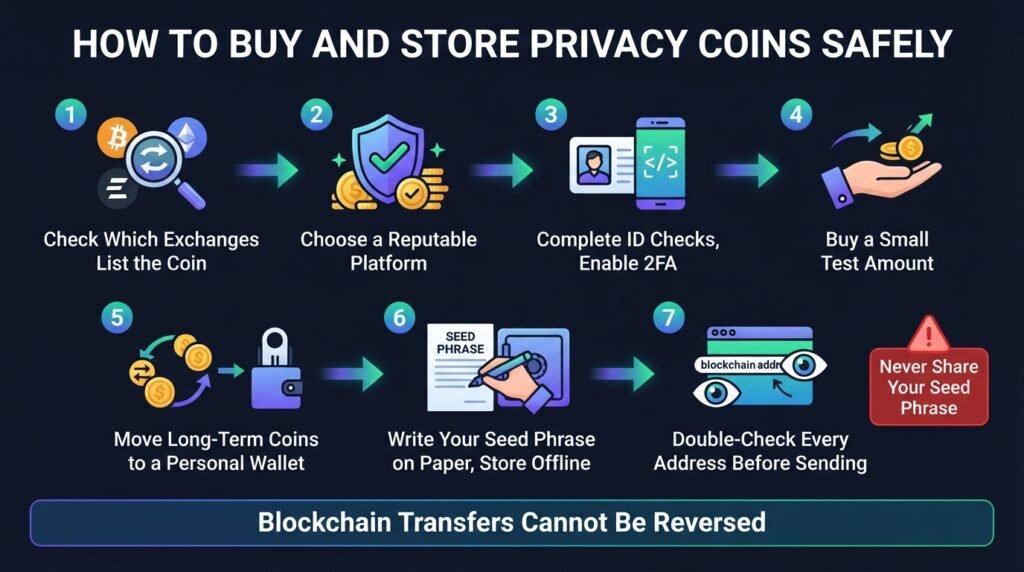
Start by checking which exchanges in your region still list the coin you want. Choose a reputable platform with strong security, clear fees, and good liquidity. Complete the required identity checks, and enable two-factor authentication immediately. Buy a small amount first to test the process. Move your coins to a personal wallet if you plan to hold them for a long time. Use the official wallet that each project recommends on its website. Write down your seed phrase on paper and store it offline in a safe place. Never share your seed phrase with anyone, including support agents. Update your wallet software regularly, because updates fix bugs and security holes. Double-check every address before you send funds, because blockchain transfers cannot be reversed. Practice with tiny transfers until you feel confident.
How to Research a Privacy Coin Before You Invest
Good research protects you from hype and scams. Read the project’s official website and documentation first. Check who builds the code, how often developers publish updates, and whether the code is open source. Look at the supply schedule, because inflation and caps affect long-term value. Examine trading volume and exchange listings to judge liquidity. Study how much privacy the coin offers by default and where it falls short. Search for independent security reviews and academic papers on its cryptography. Join community forums, but ignore price predictions and promotional posts. Compare the coin with its main rivals on speed, fees, and adoption. Write down why you want to invest and what would make you sell. A clear plan keeps emotions from driving your decisions.
Privacy Coins: Bullish and Bearish Outlook
In the bullish case, concern about data privacy grows, and demand for confidential payments rises. Clear rules that allow compliant privacy features could bring institutions into the sector. Projects like Zcash that offer optional privacy and viewing keys may benefit most. Strong developer activity and wallet improvements would also support growth. In the bearish case, regulators tighten rules and exchanges delist more coins. Falling liquidity would then hit prices hard and trap holders. The base case sits between the two, with privacy coins following Bitcoin while reacting sharply to regulatory news. Watch exchange listings, policy changes, and developer updates to track which path unfolds. Nobody can predict the winner, so plan for every scenario. Size your positions so that a bad outcome does not wreck your portfolio.
FAQs
What are privacy coins and how do they work?
Privacy coins are cryptocurrencies that hide sender, receiver, or amount details with cryptography. Tools like ring signatures and zero-knowledge proofs break the public link between transactions. Each coin uses a different method, so read its documentation before you buy.
Are privacy coins legal?
Owning privacy coins is legal in most countries, but rules differ by region. Some places restrict them on regulated exchanges or limit certain activities. Check your local laws and tax rules before you trade, and keep records of your purchases.
Which privacy coin is best for beginners?
Beginners often start with Zcash or Monero because both have long track records and strong communities. Zcash offers optional privacy, while Monero makes privacy mandatory. Pick the coin whose design you understand best, and start with a small amount.
Can I buy privacy coins on major exchanges?
Some major exchanges still list them, while others have removed them in certain regions. Availability changes often, so check each platform’s current list. Decentralized swaps offer alternatives, but they require extra care and technical knowledge.
Final Thoughts
Privacy coins offer a distinctive mix of confidentiality, innovation, and risk. New investors should learn how the main technologies work, compare the leading projects, and track regulation closely. Start small, secure your wallet, and research every coin before you buy. Treat privacy as a practice and not a guarantee, because careless habits can still expose you. Visit Crypto Fy Lab for daily crypto news and analysis. This post shares educational information only, so make your own decisions and set your own risk limits.
