


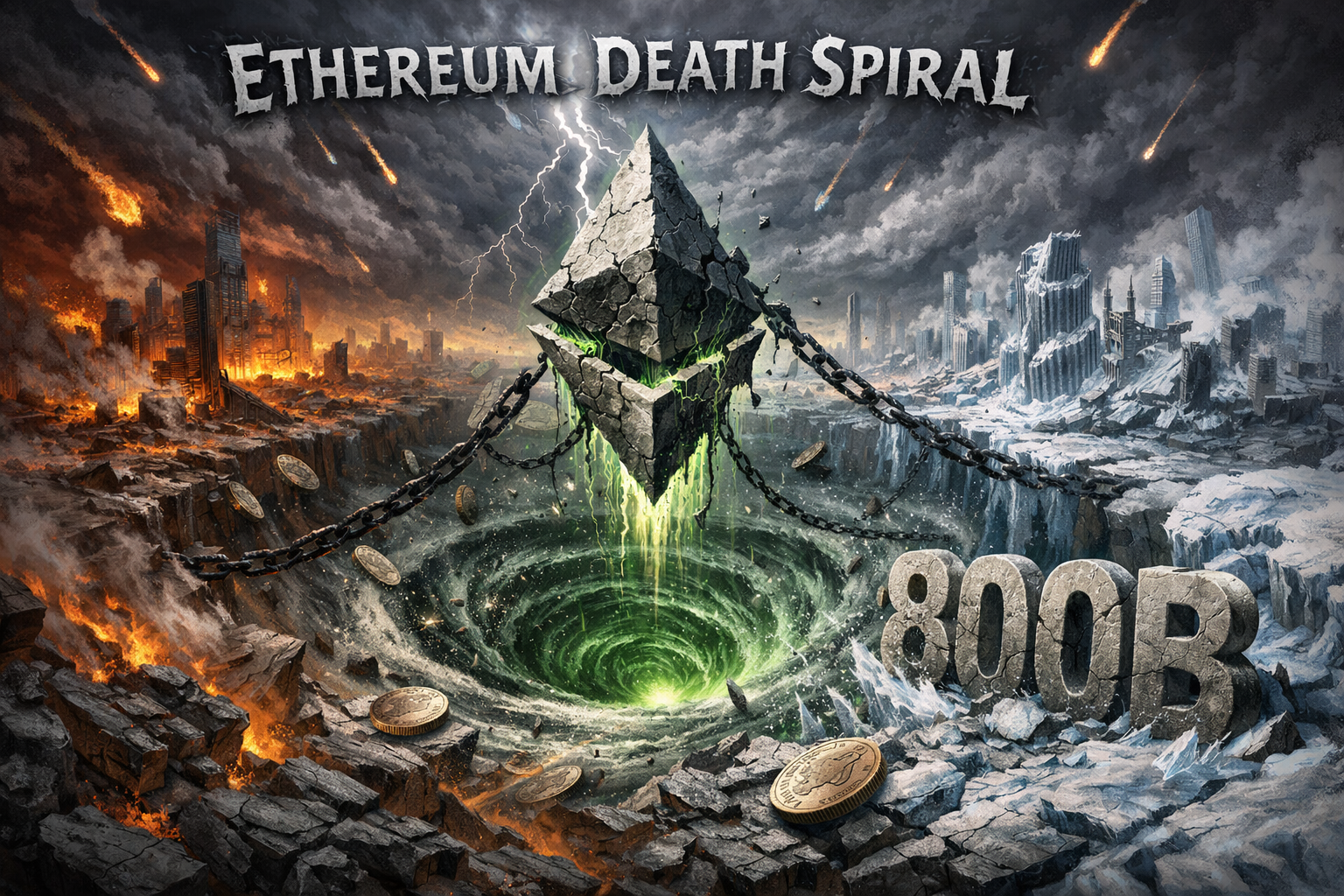
Ethereum is often described as the most battle-tested smart contract network in crypto. It has survived massive bull runs, brutal bear markets, DeFi blowups, and every kind of stress test that comes with hosting trillions of dollars in value flow over time. Yet the biggest risk to Ethereum users may not look like a hack, a rug pull, or a catastrophic bug. It can look like “everything is fine” while transfers stall, withdrawals get delayed, and otherwise “safe” assets become effectively immobile.
That’s where the idea of an Ethereum death spiral mechanic comes in: not a single vulnerability, but a feedback loop where congestion, fees, liquidity constraints, and risk controls amplify each other until markets seize up. In this scenario, the chain itself doesn’t necessarily fail. Validators keep proposing blocks. The protocol keeps ticking. But a huge portion of the ecosystem behaves as if it’s frozen—because moving assets becomes too expensive, too slow, or too risky for intermediaries to allow. And when the market is under stress, those friction points can stack quickly.
The unsettling part is that “safety ratings” don’t necessarily protect you. You can hold top-tier stablecoins, blue-chip DeFi collateral, or widely-audited wrapped assets and still be trapped if the pathways you rely on—exchanges, bridges, rollup sequencers, liquidity pools, and risk engines—start throttling. The Ethereum death spiral mechanic isn’t about one token imploding; it’s about the plumbing of the entire system tightening at the same time.
In this article, we’ll unpack how a hidden Ethereum death spiral mechanic could, in theory, freeze an enormous amount of value—think $800 billion in assets across Ethereum mainnet, Layer 2 networks, and the DeFi and CeFi rails that connect them. We’ll focus on the mechanics: what triggers the loop, why it can affect assets “regardless of their safety rating,” how it shows up in real-world behavior, and what users and builders can do to reduce the risk of becoming stuck.
The “Ethereum death spiral mechanic”
The phrase Ethereum death spiral mechanic is best understood as a cascading failure of market usability, not a protocol death. Ethereum can remain technically “alive” while financial activity becomes impaired. The spiral begins when normal stress protections—like higher fees to ration block space—interact with liquidity and risk management systems that are designed for calm markets.
During a spike in demand, the network’s limited block space becomes scarce. Gas fees rise sharply. On their own, high fees are not new. Ethereum has always priced block space via an auction-like mechanism, and after EIP-1559, base fees adjust dynamically. The hidden danger appears when fee spikes combine with external constraints: users and protocols need to rebalance collateral, manage liquidations, redeem stablecoins, bridge between networks, or withdraw from exchanges—all while costs explode and confirmation times become uncertain.
When the cost of action rises, fewer participants can react. Lower participation reduces liquidity. Reduced liquidity increases volatility. Higher volatility increases risk engine conservatism—causing exchanges, lending platforms, and market makers to tighten limits or pause operations. Those pauses push even more activity back onto fewer remaining rails, increasing congestion further. That’s the loop.
In short, the Ethereum death spiral mechanic is a situation where the rational response to risk—raising fees, widening spreads, increasing collateral requirements—creates conditions that make risk worse. It’s “hidden” because each step looks sensible locally, but collectively it produces a freeze.
Why “safety rating” doesn’t guarantee mobility
A common assumption in crypto is that “safe assets” remain safe. For example, users may believe that holding major stablecoins, ETH, or widely-used tokenized assets protects them from being locked out. But a hidden Ethereum death spiral mechanic targets mobility more than solvency.
A token can be solvent, fully backed, audited, and globally recognized—and still become difficult to move because:
- Transaction costs exceed the value of smaller transfers, pushing retail users out entirely.
- Liquidity pools thin out, making swaps punitive via slippage.
- Bridges and exchanges throttle withdrawals to manage operational risk.
- Layer 2 exits become delayed or expensive, especially if many users attempt to exit simultaneously.
- DeFi protocols increase margins or restrict certain actions, forcing users into a narrow set of allowed moves.
The result is an ecosystem where “your balance exists,” but converting, withdrawing, or repositioning it becomes practically impossible for a period. That’s why the Ethereum death spiral mechanic can freeze assets regardless of their safety rating.
The mainnet pressure cooker: gas spikes and block space scarcity
Ethereum mainnet remains the settlement layer for much of the ecosystem. Even though the user experience has shifted to Layer 2 scaling solutions, mainnet is still the place where major value is finalized: large trades, protocol governance changes, rollup proofs, bridge settlements, and emergency exits. When stress hits, everyone eventually competes for the same scarce resource: block space.
High Ethereum gas fees create a first-order freeze by raising the cost of simple actions. But the second-order effect is more dangerous: it changes the behavior of intermediaries. Market makers stop rebalancing as frequently. Arbitrage becomes less profitable. The price alignment between venues weakens. That creates uneven pricing across centralized exchanges, decentralized exchanges, and Layer 2 DEXs—feeding uncertainty and widening spreads.
At the same time, protocols that depend on keepers, bots, and automated rebalancers may fail to operate efficiently. Those systems pay gas too. When gas becomes extreme, liquidation bots may become selective. Some positions that should be liquidated quickly remain open longer. That can raise bad debt risk or create sudden liquidation clusters when conditions normalize.
In a hidden Ethereum death spiral mechanic, these symptoms reinforce each other. Congestion increases gas. High gas reduces bot activity. Reduced bot activity weakens market efficiency. Weak market efficiency increases volatility. Volatility increases demand for on-chain actions. Demand for on-chain actions increases congestion. The loop doesn’t need a protocol flaw to intensify; it only needs enough stress at once.
EIP-1559 can stabilize, but it can’t eliminate spirals
EIP-1559 improved fee predictability by introducing a base fee that adjusts with congestion. That helps users estimate costs and reduces some worst-case behavior. However, it does not create infinite capacity. When demand overwhelms available block space, prices still rise. And when high-value actors can outbid everyone else, lower-value actors get priced out. That’s where asset “freezing” begins for a large portion of users: not because they can’t transact at all, but because they can’t transact at a rational cost.
This is one reason the Ethereum death spiral mechanic is so concerning: it can happen even when the system is “working as designed.”
Layer 2 dependency: when rollups become choke points
Scaling has shifted activity to rollups and other Layer 2 solutions. This is a major win for Ethereum’s throughput and cost. Yet it introduces new chokepoints that can amplify a hidden Ethereum death spiral mechanic.
Layer 2 networks rely on mainnet for settlement and security. They post data, publish proofs, and maintain bridges that ultimately touch Ethereum. When mainnet fees spike, operating a rollup becomes more expensive. Some rollups can absorb costs for a while, but in a crisis, fees can flow through to users or to the operators’ risk decisions.
Additionally, many Layer 2 ecosystems have concentrated liquidity. If users need to migrate from one rollup to another, or from a rollup back to mainnet, they often rely on bridges and liquidity providers. During stress, bridge liquidity can dry up, and fast exits become costly or unavailable. Even if the rollup itself is functioning, the ability to move value between domains can become constrained.
That’s a crucial detail: a Ethereum death spiral mechanic can occur across domains. You might be on an L2 with low fees, but if everyone wants to leave at once, the bridge pathway can bottleneck. If the mainnet settlement path is congested, exit costs rise. If exit costs rise, fewer people exit, and prices on the rollup can decouple from mainnet markets. Decoupling increases panic, which increases exit demand. The spiral intensifies.
Sequencer and operational risk during stress
Many rollups currently have sequencers that can pause for safety or operational reasons. Even if decentralization roadmaps exist, the current reality is that L2 operations involve additional trust assumptions and operational controls. During an extreme market event, operators may prioritize network integrity over immediate liquidity flow. That can lead to temporary slowdowns, rate limits, or protective pauses.
These aren’t necessarily failures. They’re risk management choices. But in the context of an Ethereum death spiral mechanic, protective pauses can contribute to the perception—and the reality—of frozen assets. Users may technically be able to withdraw via a canonical bridge path, but the cost, time, or complexity makes it nonviable for many.
DeFi reflexivity: liquidations, collateral spirals, and stablecoin stress
DeFi is built on collateral, leverage, and automated liquidation. In calm conditions, that machinery works surprisingly well. In stressed conditions, it can become reflexive: price drops trigger liquidations, which trigger more selling, which triggers more price drops. That reflexivity doesn’t just impact one protocol. It impacts shared collateral assets and shared liquidity venues.
In a hidden Ethereum death spiral mechanic, the key risk is not just falling prices. It’s that on-chain risk controls demand more actions precisely when those actions are becoming too expensive to perform. Borrowers need to top up collateral. Liquidators need to execute transactions. Arbitrageurs need to realign prices. Stablecoin holders need to redeem or rotate exposure. Each of these actions competes for block space.
If they can’t act quickly, DeFi positions become vulnerable. That vulnerability can lead protocols to take defensive measures: raising collateral requirements, increasing interest rates, restricting borrow caps, or pausing certain markets. Each defensive measure reduces liquidity and flexibility, which increases stress elsewhere.
This is why the Ethereum death spiral mechanic is so dangerous: it isn’t a single domino. It’s a ring of dominos pushing back into the first one.
“Safe” stablecoins can still be trapped
Stablecoins are often perceived as the safety rail during volatility. Yet stablecoins rely on liquidity venues, redemption paths, and counterparties. Even if a stablecoin remains fully backed, users may struggle to swap or withdraw at par if liquidity pools thin out. On-chain prices can deviate temporarily, and centralized venues may impose delays if they face operational strain.
In this environment, LSI keywords like liquidity crunch, withdrawal delays, on-chain congestion, and bridge bottlenecks are not theoretical. They are the mechanisms that can make stable assets behave unstable in practice—again, regardless of their “safety rating.”
Staking and validator economics: the quiet amplifier
Ethereum’s proof-of-stake security is anchored by validators and staking. In normal times, staking stabilizes the system. In stressed times, the economics and incentives of validators and large stakers can become part of the feedback loop—especially when combined with market moves and liquidity needs.
If market participants need liquidity urgently, they may try to unwind positions. Staked ETH can’t always be treated like instantly available ETH in every context, even with withdrawal functionality. Some participants will sell liquid staking tokens instead. That can introduce additional price dynamics between staked derivatives and spot ETH, particularly if redemption pathways become congested or market makers widen spreads.
Validators also face operational costs and incentives. If the network is congested and MEV opportunities spike, competition among block builders and relays can intensify. Complexity increases. Risk increases. If any part of the infrastructure stack becomes unstable, it can affect transaction inclusion patterns. While Ethereum is designed to be resilient, markets are sensitive to perceived instability. Perception alone can increase demand for emergency actions, amplifying congestion.
In a hidden Ethereum death spiral mechanic, the system doesn’t need validators to fail en masse. It only needs enough friction that users and intermediaries decide it’s safer to pause, throttle, or wait—creating an economic freeze.
The $800 billion question: how assets become “frozen” in practice
When people hear “freeze $800 billion in assets,” they might imagine a literal lock: funds stuck in contracts forever. That’s not what this mechanic implies. The more realistic scenario is a temporary but severe impairment where a massive amount of value becomes illiquid, difficult to move, or practically inaccessible at reasonable cost.
Here’s how that can happen without any single catastrophic event:
- A major market shock triggers huge demand for on-chain transactions.
- Gas fees surge, pushing many users out and slowing automated keeper systems.
- Liquidity fragments across mainnet and multiple Layer 2 environments.
- Bridges and exchanges throttle withdrawals due to risk controls and operational strain.
- DeFi protocols tighten parameters, increasing margin calls and forcing expensive actions.
- Users rush to exit or rebalance, further increasing congestion.
At that point, “frozen assets” include not just tokens sitting in wallets, but also collateral locked in lending protocols, liquidity in AMMs that can’t be withdrawn cheaply, stablecoins that can’t be swapped at par without heavy slippage, and bridged assets waiting for settlement. Add centralized exchange delays and you can see how a very large notional amount—potentially hundreds of billions—can become temporarily stuck in place.
This is why the Ethereum death spiral mechanic is best viewed as a systemic liquidity freeze rather than a technical lock. And it’s why “safe rating” is not enough: the freeze targets the rails, not the asset’s backing.
The role of risk engines and throttles
Centralized exchanges, custodians, and even some DeFi frontends operate with risk engines that can throttle behavior in extreme conditions. This includes withdrawal batching, temporary limits, and additional confirmations. These systems exist to prevent operational failure. But they also contribute to a sense of paralysis.
Meanwhile, DeFi protocols may activate emergency parameters. Even if contracts are immutable, governance-controlled risk parameters can be adjusted quickly. That can be sensible, but it means your ability to act depends not only on the chain, but on the policy decisions of protocols and intermediaries during a crisis.
How to reduce exposure to an Ethereum death spiral mechanic
No one can fully eliminate systemic risk, but users and builders can reduce the chance of being trapped when the Ethereum death spiral mechanic appears.
One major factor is optionality. If your assets are all in one environment, one bridge domain, or one protocol position, your escape routes are limited. If you rely on a single on-chain action to save a position—like adding collateral during a liquidation cascade—high fees can make that impossible.
Another factor is understanding your dependencies. A token’s “safety rating” might reflect custody, backing, audits, or governance. But your practical safety depends on market depth, redemption routes, bridge liquidity, and operational policies of the platforms you use.
You also want to track stress signals. Rising base fees, volatile L2-to-mainnet spreads, widening stablecoin swap spreads, and delayed bridge finality can all be early indicators of tightening conditions. They don’t guarantee a spiral, but they can signal that the rails are becoming crowded.
Most importantly, it helps to internalize the real lesson: the Ethereum death spiral mechanic is about system-wide frictions converging. The antidote is not panic, but preparation—keeping your moves flexible before everyone tries to move at once.
Conclusion
Ethereum doesn’t need to “die” for users to feel trapped. A hidden Ethereum death spiral mechanic can emerge when congestion, gas spikes, liquidity fragmentation, bridge bottlenecks, and risk controls reinforce each other during a market shock. In that environment, enormous value—potentially $800 billion in assets across wallets, protocols, stablecoins, and settlement rails—can become practically frozen, regardless of whether the underlying assets are considered safe.
The key insight is that safety is not only about solvency; it’s about mobility. A blue-chip token can be fully backed and still be hard to move when the pipes clog. The more Ethereum scales through Layer 2s and interconnected liquidity, the more important it becomes to understand these systemic dependencies. If you want to protect yourself, focus on optionality, diversification of rails, and awareness of congestion-driven constraints—because when a spiral starts, the best time to react is often before it becomes obvious.
FAQs
Q: What exactly is an Ethereum death spiral mechanic?
An Ethereum death spiral mechanic is a feedback loop where congestion, rising fees, thinning liquidity, and tightened risk controls amplify each other, making it increasingly hard to move or manage assets even if the chain keeps running.
Q: Can “safe” assets like major stablecoins be affected?
Yes. Even highly trusted assets can be impacted because the freeze often comes from blocked pathways—like high gas fees, low liquidity, bridge bottlenecks, or withdrawal throttles—rather than the asset’s backing.
Q: Does this mean Ethereum can halt or stop producing blocks?
Not necessarily. The network can continue finalizing blocks while users experience a functional freeze due to cost, delays, or platform restrictions. The risk is usability and liquidity, not always protocol failure.
Q: Are Layer 2 networks safer during these events?
Layer 2s may remain cheaper for local transactions, but exits, bridging, and cross-domain liquidity can become chokepoints. In a spiral, the bottleneck often shifts to bridges and settlement on mainnet.
Q: What’s the best way to protect yourself from being “frozen”?
Maintain flexibility. Avoid relying on a single emergency transaction, understand bridge and exchange policies, monitor fee and liquidity stress signals, and keep multiple routes available before congestion peaks.
