


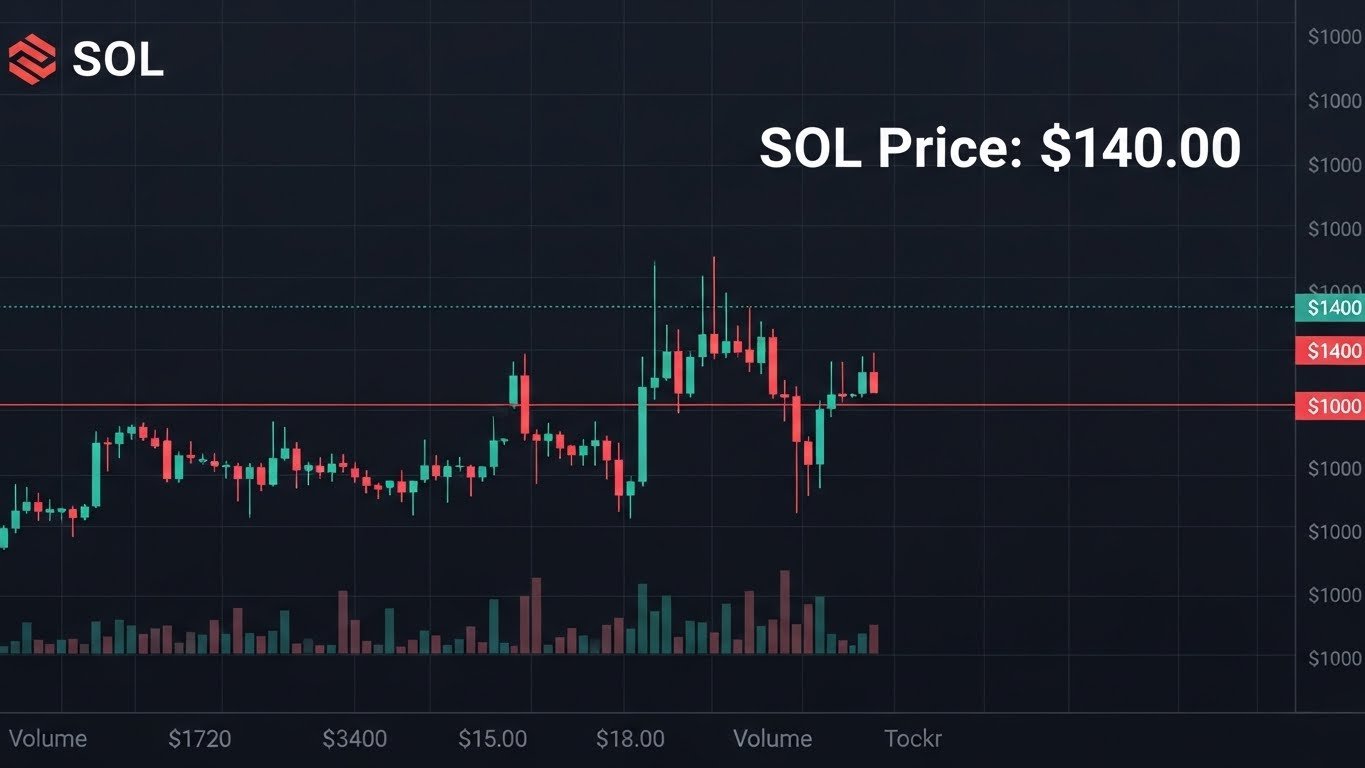
The SOL price has spent recent sessions wrestling with a stubborn ceiling around the one-hundred-forty-dollar mark, even as overall interest in alternative cryptocurrencies remains strong. At first glance, this can feel puzzling. Solana continues to attract developers, on-chain activity is elevated, and the network’s reputation as a fast, low-fee blockchain is firmly established. Yet the Solana price appears boxed in, repeatedly approaching the one-hundred-forty region before retreating.
A key part of the explanation lies outside the Solana ecosystem itself. The rapid rise of altcoin ETF products has begun to reshape how capital flows into the wider crypto market. Where retail and institutional investors once had to buy spot SOL directly from exchanges, many can now gain exposure to entire baskets of digital assets, sector-specific tokens, or rival Layer-1 networks through regulated exchange-traded funds. The emergence of these altcoin ETF rivals is redefining what “demand” looks like for SOL and for competing tokens, creating new patterns of liquidity, volatility, and price resistance.
This article takes a deep, human-centered look at why the SOL price is capped near $140, how altcoin ETFs are influencing crypto demand, and what these shifts mean for traders, long-term investors, and the Solana ecosystem itself. Rather than oversimplifying the story to a single technical level or indicator, we will explore the interplay between traditional finance, on-chain fundamentals, investor psychology, and the new generation of ETF-based crypto products.
The evolving role of SOL price in a maturing crypto market
As the crypto market evolves, the SOL price no longer lives in a vacuum driven only by retail speculation and DeFi yields. It now sits within a complex web of narratives that link multiple blockchains, institutional flows, and regulatory developments. Understanding why the Solana price struggles to break decisively above one hundred and forty dollars requires a broader view of how demand for digital assets is being packaged, marketed, and regulated.
Solana’s rise from niche project to leading altcoin
Solana’s story begins as a high-performance Layer-1 blockchain offering extremely fast transaction speeds and low fees. Over several years, this narrative attracted developers building decentralized exchanges, NFT marketplaces, gaming platforms, and DeFi protocols. As adoption grew, SOL Price Stalls at $140 evolved from a speculative bet into a proxy for the health of an entire ecosystem.
Today, Solana is widely recognized as one of the leading altcoins, often described as a rival to Ethereum in specific niches such as high-frequency trading, NFT minting, and consumer-facing applications. This recognition has pushed SOL into the portfolios of traders who seek diversification beyond Bitcoin and Ethereum. At the same time, it has placed Solana under the spotlight of institutional investors who evaluate the asset alongside a growing list of altcoins that now have ETF representation or are expected to attain it.
Despite this progress, the Solana price still faces the realities of market cycles. Every major crypto rally is eventually followed by consolidation or correction phases, during which previous resistance levels become formidable barriers. The one-hundred-forty-dollar region appears to be such a barrier, shaped not only by chart patterns but also by the shifting structure of crypto demand.
Why the SOL price is capped near $140
The phrase “SOL price capped at $140” captures more than just a number on a chart. It reflects how market participants are interpreting risk, opportunity, and competition. Traders observe that each attempt to climb convincingly above this zone encounters sell orders, profit taking, or rotation into other assets.
One reason is simple market memory. When an asset hits a particular price repeatedly and then pulls back, traders begin to treat that region as a natural sell zone. Short-term participants place limit orders there, and algorithmic strategies respond to the pattern, reinforcing the perceived ceiling. Over time, these behaviors build a psychological wall that keeps the Solana price contained unless a powerful catalyst arrives to break it.
Another reason lies in portfolio rebalancing. As SOL approaches a high-visibility level, some investors choose to lock in gains and redistribute capital into other altcoins, stablecoins, or new ETF products. If the SOL price has already delivered strong performance in recent months, risk managers within funds may see the one-hundred-forty level as a convenient point to trim exposure. This behavior keeps supply elevated just when demand would need to surge for a breakout.
The impact of previous cycles and realized profits
Historical price action also shapes how traders behave around the SOL price. Many participants entered the market at lower levels and watched Solana appreciate dramatically during bullish phases. When the asset returns to familiar resistance regions, those investors may finally see an opportunity to exit positions or reduce risk, especially if they endured a drawdown during prior corrections.
This dynamic of realized profit has a crowding effect. As multiple holders decide that one hundred and forty dollars represents “good enough” returns, sell pressure converges at the same price zone. The result is what appears to be an invisible lid on the Solana price, even if broader market sentiment remains constructive.
How altcoin ETF rivals are reshaping crypto demand
The emergence of altcoin ETFs is one of the most important structural changes in today’s crypto market. These funds allow investors to gain exposure to baskets of digital assets without directly managing private keys, navigating spot exchanges, or handling complex DeFi interfaces. While this shift can increase the total amount of capital flowing into the space, it also changes how that capital is distributed across individual tokens such as SOL.
From direct Solana purchases to diversified ETF flows
In the earlier years of Solana’s rise, the primary way for investors to bet on the ecosystem was to buy SOL directly. Whether through centralized exchanges or decentralized platforms, capital flowed straight into the token, influencing the SOL price in an immediate and visible way.
The introduction of altcoin ETFs alters this pattern. Instead of choosing a single asset, many investors now opt for diversified funds that spread risk across multiple altcoins. A person who might have allocated a fixed amount entirely to SOL could now place the same amount into an ETF that includes Solana alongside other Layer-1s, DeFi tokens, or even metaverse projects. In this structure, some of the demand that previously concentrated on the Solana price is diluted across a wider universe of cryptocurrencies.
This does not necessarily reduce overall interest in SOL, but it can change the ratio between direct spot demand and indirect ETF-based demand. Since ETF issuers typically rebalance according to predetermined rules or indices, their buying and selling behavior may not match the timing or intensity of discretionary traders. As a result, the SOL price may see less explosive upside during rallies and more measured responses when new capital enters the market.
Competition from sector-specific and rival Layer-1 ETFs
Another factor keeping the SOL price capped at $140 is competition from other ETFs that focus on rival sectors or blockchains. Some funds concentrate specifically on Layer-2 solutions, gaming ecosystems, or Ethereum-centric DeFi protocols. Others may highlight a different high-performance Layer-1 that positions itself as an alternative to Solana.
When a new ETF launches with heavy marketing and high liquidity, it can temporarily become the preferred vehicle for investors who want altcoin exposure but lack a strong bias toward a single network. In this environment, Solana is no longer competing only on speed, fees, or developer activity. It is also competing for visibility inside index methodologies and ETF marketing campaigns.
As altcoin ETF rivals reshape demand, money that might have flowed into SOL spot markets may instead be channeled into these diversified products. Although some ETFs hold Solana as part of their portfolios, the marginal flow directed specifically toward SOL can be less concentrated. This subtle shift can help explain why the Solana price repeatedly stalls near one hundred and forty dollars rather than blasting through with aggressive buying surges.
Investor psychology and shifting narratives around SOL
Crypto markets are as much about stories as they are about code. The SOL price reflects not only order books and ETF mechanics but also the evolving narratives that investors attach to Solana. These narratives influence who buys, who sells, and how much conviction they bring to their positions.
From “Ethereum killer” to multi-chain collaborator
In earlier cycles, Solana was often framed as an “Ethereum killer,” a network that could supplant Ethereum by offering faster and cheaper transactions. Over time, however, the conversation has shifted. The multi-chain reality has become evident, with numerous Layer-1 and Layer-2 networks coexisting and interacting. Cross-chain bridges, multi-chain wallets, and interoperable apps now allow users to move value and data across ecosystems with increasing ease.
This narrative evolution changes how investors perceive SOL. Instead of viewing it purely as a competitor whose success demands the failure of others, many now see Solana as one of several strong networks that can thrive simultaneously. While this view is healthier and more realistic in the long run, it can also temper the speculative extremes that once propelled the Solana price higher in parabolic surges.
As altcoin ETFs promote diversified exposure across multiple blockchains, they reinforce the multi-chain narrative. Investors who buy these funds implicitly express a belief in a broad crypto ecosystem rather than a single dominant chain. This, too, makes it more difficult for one asset, even a leading altcoin like SOL, to monopolize new inflows and break decisively above established resistance such as the one-hundred-forty-dollar level.
Balancing long-term conviction with short-term caution
Another psychological factor in the SOL price story is the balance between long-term conviction and short-term caution. Many participants believe strongly in Solana’s technical merits and potential. They point to metrics like transaction throughput, ecosystem growth, and expanding DeFi and NFT activity on the network. Yet even these believers must contend with the short-term realities of volatility, regulatory headlines, and macroeconomic uncertainty.
When SOL approaches a known resistance level such as $140, this tension is magnified. Long-term holders may hesitate to sell, but they also may refrain from aggressive new buying until there is more clarity. Short-term traders, meanwhile, may see the level as a tactical opportunity to short or to take profits. The result is a delicate equilibrium that keeps the SOL price pressing against the ceiling without decisively breaking through.
What the $140 cap means for Solana’s ecosystem
Although the SOL price capped at $140 can feel frustrating to traders seeking quick gains, it can also signal a period of consolidation that benefits the broader ecosystem. Price stability, even within a defined range, allows developers, builders, and long-term partners to plan without the distraction of extreme volatility.
A capped price zone can help projects that rely on SOL-denominated funding or collateral. When the Solana price swings wildly, it becomes difficult to manage treasuries, pay team members, or design sustainable tokenomics. By contrast, a relatively stable band near one hundred and forty dollars allows teams to operate with clearer expectations. This environment can foster more responsible growth and attract serious participants who prioritize long-term value creation over speculative frenzy.

At the same time, the SOL price ceiling serves as a visible reminder that Solana still has room to grow. It challenges the ecosystem to justify a breakout with tangible progress: more users, more innovative applications, and deeper integration with both crypto-native and traditional financial systems. If the network can deliver such milestones, it is more likely that the ceiling will eventually transform into a floor.
How traders and investors can approach SOL in the ETF era
For traders, the presence of a clear resistance zone near $140 offers both risk and opportunity. Some may use this level as a reference for short-term strategies, seeking to buy dips and sell into strength while the SOL price remains range-bound. Others may wait for a decisive breakout above the ceiling before considering new positions, viewing the level as a confirmation point that indicates renewed momentum.
Long-term investors, meanwhile, might focus less on exact price levels and more on the broader trends shaping the Solana ecosystem and the altcoin ETF landscape. They will ask whether ETF inclusion, institutional coverage, and continued developer interest make the Solana price attractive relative to its long-term potential. They may also evaluate how diversified ETF products fit alongside direct SOL holdings, balancing the convenience and regulatory clarity of funds with the flexibility and governance rights of owning the asset itself.
Regardless of strategy, one lesson stands out. The new era of altcoin ETF rivals demands a more nuanced understanding of how demand is generated and expressed. It is no longer enough to watch spot order books alone. Capital can enter the market through fund issuers, structured products, derivatives, and staking services. The SOL price, therefore, is the visible surface of a deeper current of flows and narratives.
Conclusion
The headline “SOL price capped at $140 as altcoin ETF rivals reshape crypto demand” captures a pivotal moment in Solana’s journey and in the broader evolution of the digital asset market. The one-hundred-forty-dollar level has become a focal point where market memory, investor psychology, and portfolio rebalancing converge. Each approach toward this zone triggers a tug-of-war between bulls seeking a breakout and cautious participants locking in profits.
Behind the scenes, the rise of altcoin ETFs has profoundly changed the path by which capital reaches Solana and its competitors. Investors who once had to commit directly to SOL can now access diversified baskets, spreading risk and altering the pattern of demand. This shift dilutes some of the intensity that previously drove parabolic rallies, yet it also broadens the base of participants who gain exposure to Solana, even if indirectly.
For the Solana ecosystem, a SOL price constrained near $140 is both a challenge and an opportunity. It challenges developers and community members to deliver real-world utility, robust infrastructure, and compelling user experiences that justify a sustained push beyond resistance. At the same time, it offers a period of consolidation in which the network can mature, partnerships can deepen, and long-term strategies can be refined.
In the end, the intersection of Solana price dynamics, altcoin ETF rivals, and shifting investor expectations illustrates how far the crypto market has come. Solana is no longer just a speculative token on the fringes of finance. It is a core component of a multi-chain, institutionally connected ecosystem whose future will be shaped as much by regulatory frameworks and ETF flows as by block times and throughput metrics. How the SOL price behaves around $140 in the coming months will offer valuable clues about where that future is headed.
FAQs
Q: Why does the SOL price keep stalling near the $140 level?
The SOL price repeatedly stalls near one hundred and forty dollars because this zone has become a strong psychological and technical resistance. Many traders choose to take profits at this level, and short-term market participants often sell when SOL approaches this region. This creates consistent sell pressure, preventing a clean breakout unless a fresh catalyst or strong buying momentum appears.
Q: How are altcoin ETFs affecting demand for Solana?
Altcoin ETFs reshape Solana’s demand by diverting investor capital into diversified crypto baskets instead of single assets. Earlier, investors who wanted exposure to Solana bought SOL directly, but now many prefer ETFs that include multiple altcoins. This spreads demand across various tokens rather than concentrating it solely on SOL, making it harder for the SOL price to accelerate past key resistance levels like $140.
Q: Are altcoin ETFs good or bad for Solana in the long run?
In the long run, altcoin ETFs can be beneficial for Solana because they increase institutional exposure and bring more regulated investment channels into the crypto market. Although ETFs dilute direct demand for SOL, they also introduce Solana to a broader audience of traditional investors, potentially supporting long-term price stability and ecosystem growth.
Q: Does the price cap mean Solana’s growth is slowing down?
The price cap near one hundred and forty dollars does not indicate that Solana’s growth is slowing. Instead, it suggests that the asset is currently in a consolidation phase. Consolidation allows fundamentals to strengthen and prepares the ecosystem for future expansion. If developer activity, user adoption, and network innovation continue, Solana can eventually gather enough momentum to break through resistance.
Q: How should investors approach Solana in the ETF-driven market era?
Investors should approach Solana with an understanding that direct spot demand and ETF flows now coexist. A balanced strategy may involve combining SOL holdings with exposure to altcoin ETFs, depending on individual risk tolerance. Observing both market structure and on-chain fundamentals helps investors make informed decisions as ETF products continue shaping overall crypto demand.
See More: Solana Price Outlook, 2025 PoH PoS, and What on-chain Activity Tells?
