


If you’re searching for the best app for low bitcoin price, you’re probably trying to do one of two things: spot dips faster, or buy BTC without getting quietly overcharged by spreads and fees. The truth is, “low Bitcoin price” inside an app isn’t just the headline price you see on a chart. What matters is the all-in price you actually pay at checkout, after spreads, maker/taker fees, payment method costs, and sometimes even slippage when markets move fast.
The good news is that you can absolutely improve your entry price by choosing the right tools and using a simple workflow: track Bitcoin accurately, set alerts, then buy using fee-efficient trading options instead of expensive “instant buy” buttons. In this guide, you’ll learn how to pick the best app for low bitcoin price in a practical, beginner-friendly way.
What “low Bitcoin price” really means inside an app
When people type best app for low bitcoin price into Google, they often assume every app shows the same BTC price. In reality, the number you see can vary depending on the data source and the way the app executes buys.
A true “low price” outcome comes down to your effective purchase price, which usually includes the spot price plus any spread, plus trading fees, plus funding costs. Some apps show a clean chart price, but apply a spread or a bundled fee at checkout. For example, Cash App states it may include a spread in the conversion rate it quotes for bitcoin trades, and that spread can vary with market conditions.
This is why two people can “buy at the same time” and still pay different prices per BTC.
Another key concept is the difference between a simple buy screen and an advanced trading screen. Many platforms offer a quick-buy experience that’s convenient but not always cost-efficient. Meanwhile, advanced trading interfaces typically use an order book and a transparent maker/taker fee model (often cheaper for active traders and limit orders). Coinbase’s Advanced fees page, for instance, explains the maker/taker model and how fee tiers apply at the time of the order.
So, if your goal is the best app for low bitcoin price, your “best” choice is usually the app that helps you minimize spreads and fees while still giving you fast, reliable price tracking.
Best app for low bitcoin price strategy: use two apps the smart way
Here’s the simplest way to win at getting a lower effective BTC price without turning crypto into a full-time job: use one app to track and time, and another app to execute buys with lower costs. A dedicated tracker helps you catch dips and confirm the real market move. A low-fee buying app helps you convert that timing into a better entry price by using limit orders, lower trading fees, or fee-free recurring purchase options (where available).
This two-app approach is often more effective than trying to force one single app to do everything perfectly.
Best Bitcoin price tracker app options for spotting dips fast
A strong tracker app should give you fast updates, reliable charts, and flexible alerts. You want notifications that hit immediately when BTC reaches your target level, not 15 minutes later. CoinMarketCap’s mobile app promotes custom price alerts, watchlists, portfolio tracking, and market data tools in one place, which is useful if you want a clean, mainstream tracking experience.
CoinGecko’s mobile experience is also built around real-time tracking and alerts, and CoinGecko publishes guidance on using its Portfolio and Price Alerts features to get notified about price changes and organize holdings.
If you want advanced alert logic, TradingView is hard to beat because its alerts system supports real-time triggers and can be built from price levels as well as indicator conditions, depending on how deep you want to go. TradingView’s own help documentation explains how users can create alerts that respond to market changes in real time.
If your priority is catching “low Bitcoin price moments” quickly, then bitcoin price alert app features matter just as much as charts.
Best apps to buy BTC at a lower effective price
Now let’s talk about what most people really mean by best app for low bitcoin price: an app where the buy experience doesn’t quietly inflate your cost.
A few patterns usually lead to lower all-in costs:
Using an advanced trading mode with maker/taker fees and limit orders
Avoiding “instant buy” where spreads are wider
Using recurring buys on platforms that offer reduced or zero fees for DCA
Funding via lower-cost methods (bank transfer often beats cards)
Kraken publicly describes its maker-taker fee schedule and notes that volume-based incentives apply, and it also calls out that volume generated with Instant Buy does not count toward 30-day volume incentives. (Kraken) This matters because it nudges cost-conscious buyers toward Kraken Pro style trading rather than convenience buys.
Coinbase Advanced similarly uses a maker/taker structure and explains how fee tiers work and when they apply. In general, when you use advanced trading, you’re closer to “market price + transparent fees,” instead of “market price + hidden spread + convenience fee.”
Binance provides a public spot fee schedule and also explains how trading fees are calculated in its support documentation. For many users, a clear fee schedule is a big step toward getting a better effective price because you can predict costs before you tap buy.
River markets “zero-fee recurring buys,” and River’s help center clarifies how recurring buy fees become zero after a defined period (for example, recurring buys are zero-fee starting seven days after initiation, with timing details depending on schedule). If your goal is long-term accumulation, this kind of structure can be powerful because it lowers friction on consistent buys.
Strike has also discussed moving from spread-based pricing to a fee structure for buying and selling bitcoin, aiming for simpler and more transparent pricing. Strike’s own FAQ also references how users can track their fee level in the app.
To keep your expectations realistic, it helps to remember that spreads are a real cost in many consumer-friendly apps. Bitbo’s fee comparison content explains the concept of spread with a simple example of an exchange quoting a higher buy price than the market price, and it focuses on estimating the “true cost” of a bitcoin purchase across several popular services.
The takeaway is simple: the best app for low bitcoin price is usually the one that makes your total cost visible and gives you tools to reduce it.
How to compare apps if you want a genuinely lower Bitcoin purchase price
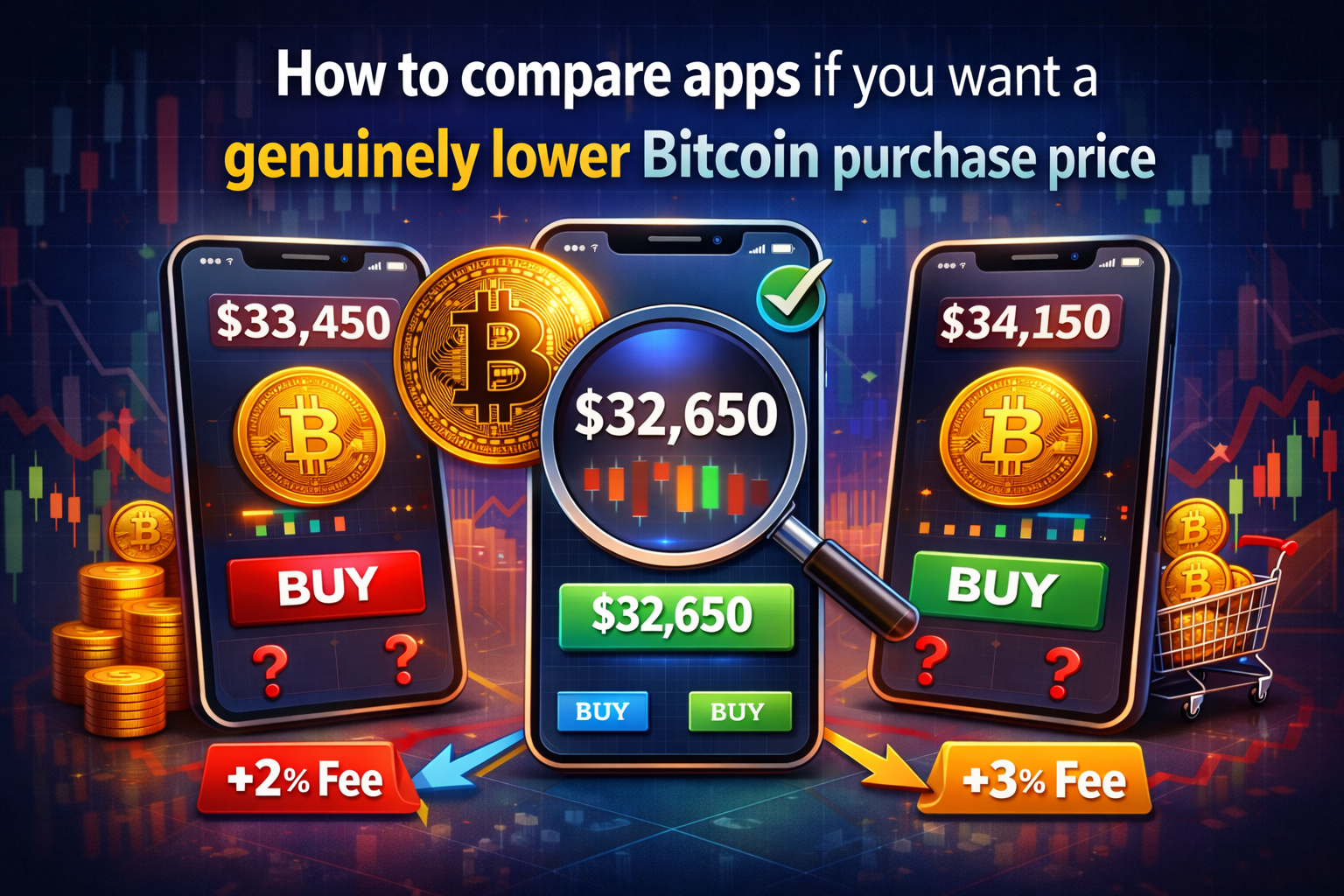
To choose the best app for low bitcoin price for your situation, focus on how the app behaves at the moment you press buy. Charts are important, but execution rules everything.
Fees that are obvious vs fees that hide inside the price
Some platforms separate fees cleanly, especially in advanced trade modes. Others bundle costs into the conversion rate. Cash App explicitly notes it may include a spread and that it is included in the price displayed on the confirmation screen.
If you care about paying less per BTC, you want the app where costs are easiest to see and easiest to reduce.
Maker/taker fees and why limit orders can save you money
Maker/taker pricing rewards adding liquidity, usually via limit orders that don’t fill instantly. Coinbase’s Advanced fees documentation lays out the idea that maker and taker orders have different fees and that your tier at the time of the order determines fees.
This matters because a limit order can help you do two things at once: target a lower entry price and potentially pay a lower fee category than a market order.
Deposit method can change the “low price” outcome
Even if the trading fee is low, funding your account with a debit card or credit card can raise your total cost. If your goal is the lowest bitcoin fees app experience, prioritize bank-based funding where possible and save cards for emergencies.
Liquidity and slippage are sneaky costs
In fast markets, the price can move between tap and execution. High-liquidity venues and limit orders help reduce slippage. If you’re buying a meaningful amount of BTC, execution quality can matter as much as headline fees.
A simple workflow to get a lower BTC price without staring at charts all day
This is the practical routine that helps most people get results with the best app for low bitcoin price approach.
Set alerts on a tracker first, not on the exchange
Start by setting a clear price alert on a tracker you trust. CoinMarketCap promotes custom alerts in its app ecosystem, which is useful for straightforward threshold notifications. CoinGecko also supports price alerts and publishes guidance on setting them up.
If you want to get more advanced, TradingView’s alert system is designed for real-time responses to market changes and can trigger alerts based on price levels and more complex conditions.
This alert-first mindset is how you stop missing dips, even when you’re busy.
Confirm the move on at least two data sources
Before buying, open your tracker and your buying app and compare the quoted prices. If the buy app is meaningfully higher than your tracker’s spot reference, you’re likely looking at a spread or a convenience markup. That’s not automatically “bad,” but it tells you you’re not getting the lowest effective price.
Use advanced trade or recurring buys instead of instant buy when possible
If your platform offers an advanced trade mode, it’s often the fastest route to a better effective price because costs are more transparent and you can place limit orders.
If you’re doing long-term accumulation, recurring buys can be a strong option. River’s recurring buy structure is specifically marketed as zero-fee after a defined initial period, which can reduce ongoing friction for DCA buyers.
Consider limit orders for “buy the dip” execution.
A limit order lets you define your price. If BTC never hits it, you don’t buy. If it does, you potentially get the dip you wanted. This is one of the most practical tools for anyone serious about the best app for a low bitcoin price goal.
Which “best app” choice fits your style
Because the keyword is best app for low bitcoin price, it’s worth being honest: “best” depends on how you buy.
If you’re a beginner who wants simplicity, a tracker like CoinMarketCap or CoinGecko plus a reputable exchange app with an advanced mode, is usually a strong start. CoinMarketCap’s app positioning emphasizes market data, watchlists, and alerts, which covers the tracking side well. CoinGecko’s ecosystem also focuses heavily on real-time tracking and alerting.
If you’re cost-focused and comfortable learning basic order types, prioritize platforms that support maker/taker fees and limit orders. Coinbase Advanced and Kraken Pro-style trading are built around that structure, and both platforms document the maker/taker concept and fee scheduling.
If you’re a long-term accumulator, look closely at recurring buy economics. River explicitly frames recurring buys as zero-fee after specific timing rules, which can be meaningful over months and years.
If you care about payments and moving BTC efficiently, apps that emphasize Bitcoin-native flows and fee transparency can be attractive. Strike has published about shifting from spread to fee-based pricing for buying and selling bitcoin and offers tools to check your fee level in-app.
Security matters when hunting for low Bitcoin prices
People chasing the best app for low bitcoin price sometimes fall into a dangerous trap: downloading lookalike apps, clicking sponsored links, or installing “cracked premium” versions of charting tools. This is one of the fastest ways to lose funds.
There have been real-world malware campaigns that specifically target crypto traders by impersonating popular trading tools. For example, reporting highlighted malicious ads promoting a fake “Premium” version of TradingView that led users to malware.
If you want to safely use the best app for low bitcoin price, keep it simple: download apps only from official app stores, avoid “free premium” offers, enable strong authentication, and double-check the publisher name before installing. The cheapest BTC in the world isn’t worth it if the app is fake.
Conclusion
If your real goal is to pay less per BTC, the best app for low bitcoin price is the one that helps you do two things consistently: spot the right moment with reliable alerts, and execute your buy with minimal spread and transparent fees. Use a tracker like CoinMarketCap, CoinGecko, or TradingView for fast alerts and clean charts, then buy through an app that supports advanced trading or fee-efficient recurring buys, depending on your style. Now take action: set one BTC dip alert today, choose your buying method, and commit to a smarter workflow that actually earns the title best app for low bitcoin price for your needs.
FAQs
Q: Is there really one best app for low bitcoin price?
Not in a universal way. The “best” outcome usually comes from combining a tracker for timing with an exchange or broker that offers lower all-in costs through transparent fees, advanced trading modes, or low-fee recurring buys. This is why the two-app strategy is so effective.
Q: Why is the Bitcoin price different between apps?
Apps can pull prices from different sources, update at different speeds, or apply spreads and fees in different ways. Some apps include a spread in the quoted conversion rate, which can change with market conditions.
Q: What’s the fastest way to lower my Bitcoin buying cost?
Avoid expensive “instant buy” flows when you can. Use advanced trading modes with maker/taker fees and consider limit orders. Coinbase and Kraken both document maker/taker fee structures and how fees are determined.
Q: Are recurring buys good for getting a low effective price?
Recurring buys can be great for long-term accumulation because they reduce the need to time entries. If the platform offers fee advantages for recurring purchases, it can significantly reduce total cost over time. River’s documentation explains how recurring buys can become zero-fee after a defined timing window.
Also Read: Bitcoin Price Live Chart Trading Watch BTC Live Prices & Trade Like a Pro
