


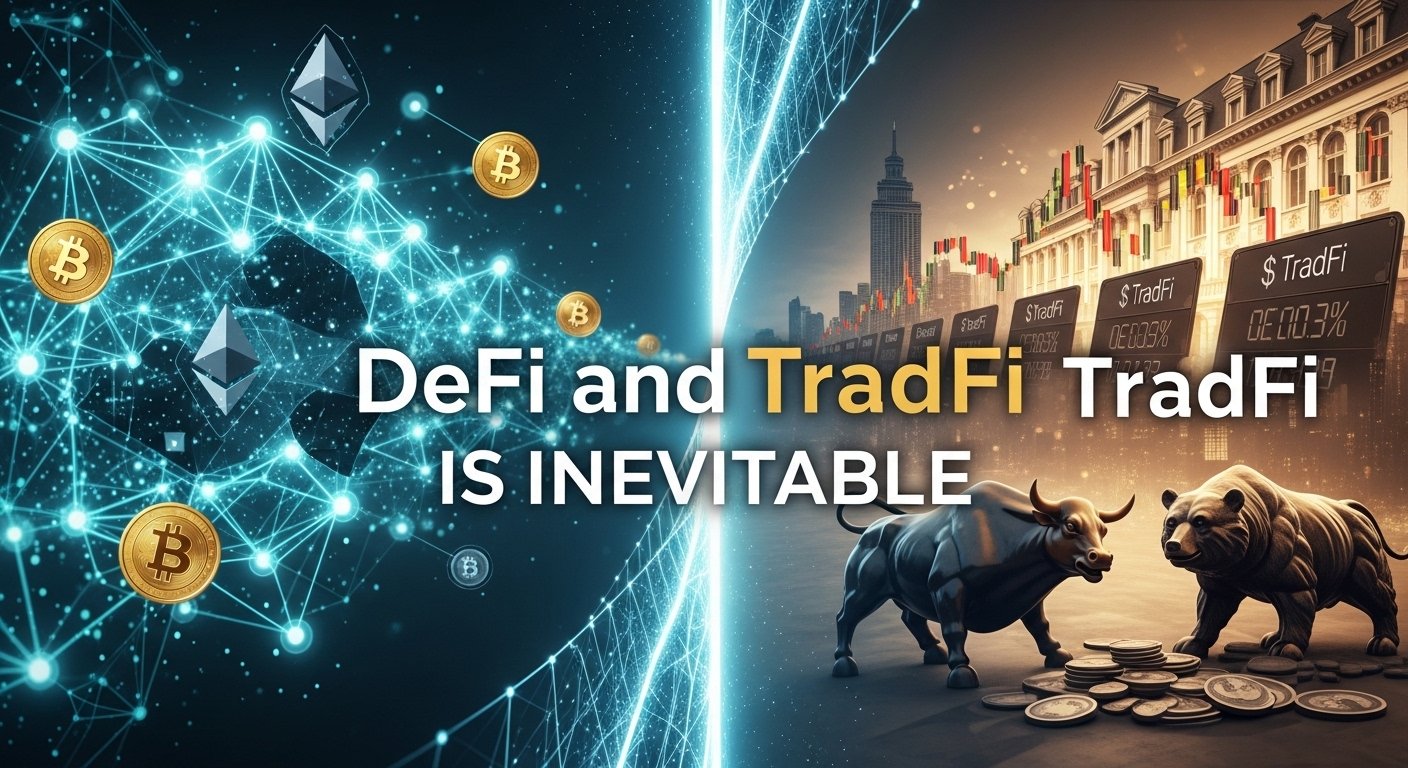
Finance has always evolved alongside technology. From paper money to digital banking, every major upgrade reshaped how people move, store, and grow wealth. Today, the industry is facing another major shift—one driven by blockchain and decentralized systems. Traditional finance, often called TradFi, includes banks, exchanges, insurers, and payment networks. These institutions are trusted, regulated, and deeply embedded in the global economy. They manage trillions of dollars every day and serve billions of people.
Decentralized finance, or DeFi, emerged as an alternative. It uses blockchain technology to offer financial services without relying on centralized intermediaries. Through smart contracts, DeFi enables lending, trading, and payments in a more open and automated way. At first, DeFi and TradFi appeared to be competing systems. Supporters of DeFi criticized traditional finance for being slow and expensive. Traditional institutions viewed DeFi as risky and unstable.
Over time, however, something important became clear. These two systems are not destined to fight forever. Instead, they are moving toward each other. The convergence of DeFi and TradFi is happening because both sides need what the other offers. TradFi needs better technology. DeFi needs trust and scale. Together, they form a more efficient financial future.
Why Traditional Finance Can No Longer Stay the Same
Traditional finance was built for stability, not speed. Many of its systems were designed decades ago. While they work well, they often rely on multiple intermediaries, manual processes, and delayed settlement. For example, a stock trade can execute instantly, but final settlement may take days. Cross-border payments can involve several banks, each charging fees and adding delays. These inefficiencies increase costs for both institutions and customers.
In a world where people expect instant digital services, these delays feel outdated. Businesses want faster capital movement. Consumers want transparency. Regulators want clearer records. DeFi demonstrated that financial transactions can be faster and more transparent. Blockchain networks allow value to move on shared ledgers, with settlement happening almost immediately.
Traditional finance does not need to abandon regulation to adopt these benefits. It can use blockchain-based infrastructure while keeping compliance and oversight in place. This pressure to modernize is a major reason the convergence of DeFi and TradFi is inevitable.
Why DeFi Cannot Succeed Alone
DeFi has proven that decentralized systems work. But it has also shown its limits. For many users, DeFi is difficult to use. Managing wallets, private keys, and transaction fees can be confusing. Risks are not always clear, and when something goes wrong, there is often no customer support. Security is another challenge. Smart contract bugs and protocol exploits have caused large losses. While transparency helps, it does not replace consumer protection.
Traditional finance excels in these areas. It offers legal accountability, insurance, customer service, and structured risk management. These elements build trust, especially for large investors and everyday users. For DeFi to grow beyond early adopters, it needs these safeguards. That does not mean giving up decentralization completely. It means integrating with systems that provide reliability and protection. This dependency makes the convergence of DeFi and TradFi unavoidable. DeFi brings innovation. TradFi brings trust.
Tokenization Connects the Old System to the New
One of the most important forces driving convergence is tokenization. Tokenization means representing real-world assets as digital tokens on a blockchain. These assets can include bonds, stocks, real estate exposure, commodities, or private credit. This process does not change the asset itself. It changes how the asset is recorded, transferred, and settled. Tokenized assets can move faster.
Ownership changes are easier to track. Settlement can happen in near real time. For traditional institutions, tokenization reduces operational complexity. For DeFi, it brings real-world value onto blockchain rails. This is why real-world assets are becoming central to the convergence of DeFi and TradFi. DeFi needs access to real economic value. TradFi needs more efficient infrastructure. Tokenization provides both.
Smart Contracts Simplify Financial Operations
Traditional finance relies heavily on contracts. These contracts define loans, derivatives, insurance policies, and investment agreements. In most cases, execution still depends on manual processes and back-office systems. This adds cost and increases the risk of errors. DeFi introduced smart contracts, which automatically execute predefined rules when conditions are met. Payments, interest calculations, and collateral management can all be handled by code.
In the future, smart contracts will not replace legal agreements. Instead, they will support them. Legal contracts will define rights. Smart contracts will handle execution. This approach improves efficiency while maintaining accountability. It also strengthens the convergence of DeFi and TradFi, as institutions adopt automation without sacrificing compliance.
Stablecoins Show Convergence in Real Life
Stablecoins are one of the clearest examples of convergence already in action. A stablecoin is a digital asset designed to maintain a stable value, usually tied to a fiat currency like the US dollar. Stablecoins are widely used in DeFi for trading and lending. At the same time, they are increasingly used for payments, remittances, and treasury management in traditional business settings.
Stablecoins allow money to move quickly and globally, without waiting for banking hours or clearing processes. For DeFi, stablecoins provide stability. For TradFi, they offer faster settlement and lower costs. This dual use makes stablecoins a powerful driver of the convergence of DeFi and TradFi.
Regulation Is Guiding the Merge, Not Stopping It
Regulation often appears to be an obstacle, but it is actually a pathway to growth. Large institutions cannot operate without clear rules. They need guidance on identity verification, custody, reporting, and consumer protection. As regulators create frameworks for digital assets, they enable compliant participation. This allows banks and financial firms to use blockchain technology responsibly. At the same time, DeFi projects are adapting. Many now explore compliance-friendly designs, such as permissioned access or identity layers. This regulatory clarity accelerates the convergence of DeFi and TradFi by allowing both systems to meet in the middle.
Institutional Adoption Changes Everything on-chain
Institutions move slowly, but when they adopt new technology, they bring scale. Institutional players demand security, transparency, and reliability. Their involvement raises standards across the ecosystem. As institutions explore tokenization, stablecoins, and on-chain settlement, DeFi infrastructure matures. Governance improves. Risk management becomes more robust. This institutional participation makes convergence permanent. Once large financial systems are built on blockchain rails, reverting becomes impractical.
On-Chain Settlement Improves Market Efficiency
Traditional markets rely on separate systems to track ownership and payments. This requires reconciliation and creates delays. On-chain settlement uses a shared ledger to record transactions. All parties see the same data at the same time. This reduces settlement risk and operational complexity. It also increases transparency. As more assets become tokenized, on-chain settlement will play a larger role in the convergence of DeFi and TradFi.
What This Means for Everyday Users
Most users will not think about DeFi or TradFi. They will notice results. Payments will be faster. Fees will be clearer. Investment products may become more accessible. Settlement delays will shrink. Behind the scenes, blockchain technology will handle more of the work. Front-end experiences will remain familiar. This quiet improvement is the true outcome of the convergence of DeFi and TradFi.
Conclusion
The convergence of DeFi and TradFi is driven by necessity, not ideology. Traditional finance needs efficiency and automation. DeFi needs trust, regulation, and real-world integration. Tokenization, smart contracts, stablecoins, and on-chain settlement are bringing both systems together. Regulation and institutional adoption are shaping how this merge happens. The future of finance will not be purely decentralized or purely traditional. It will be a hybrid system that combines the strengths of both. That future is already taking shape.
FAQs
Q: Why is the convergence of DeFi and TradFi inevitable?
Because both systems solve different problems. DeFi offers efficiency and automation. TradFi offers trust and scale. Together, they create better finance.
Q: Is tokenization important for this convergence?
Yes. Tokenization connects real-world assets to blockchain infrastructure, making integration possible.
Q: Will regulation slow down DeFi growth?
Regulation may limit risky behavior, but it also enables mainstream adoption and institutional participation.
Q: Are stablecoins part of traditional finance?
Stablecoins bridge both systems. They are used in DeFi and real-world payments, making them a key convergence tool.
Q: How will users benefit from this shift?
Users will experience faster transactions, lower friction, and more accessible financial products—often without realizing blockchain is involved.
