



The word blockchain has been around long enough to move from buzzword to backbone. It powers cryptocurrencies, secures digital assets, anchors supply chain transparency, and is quietly reshaping identity, payments, and data sharing. Yet many people still ask a simple question: what exactly is blockchain, and how does it work today? In 2025, the picture is clearer than ever. A blockchain is a shared, append-only ledger maintained by a network of computers, designed so that no single party can secretly rewrite history. It stitches together cryptography, distributed consensus, and economic incentives to create records that are tamper-evident and verifiable by anyone with access.
This complete guide breaks the topic into plain language. What is Blockchain and How Does it Work? You will learn how blocks link into chains, why consensus mechanisms matter, what public and private blockchains are, where smart contracts fit, and how enterprises and startups are using the technology. You will also see the limitations—scalability, privacy, regulation, and energy—and how the industry is addressing them. By the end, you will be able to read the news about blockchain with confidence, explain it to a colleague, and decide where it fits in your business or career.
What is a blockchain? The big idea in simple terms
A blockchain is a database that is not controlled by one company or server. Instead, it is distributed across many nodes that all hold a synchronised copy of the data. New entries are grouped into blocks. Each block contains a batch of transactions, a time marker, and a cryptographic fingerprint (a hash) of the previous block. Because each block depends on the previous one, they form a chain. If someone tries to alter an older record, the hash would change, breaking the link and alerting the network.
The system is append-only. Rather than editing past entries, the network adds a new block that reflects the updated state. This design makes history transparent and tamper-evident. Combined with a consensus algorithm—the agreed-upon way the network decides which block is valid—participants can trust the data without trusting each other personally. That is why people call blockchain trustless: trust is moved from institutions to mathematics, open rules, and cryptography.
How does blockchain work? The step-by-step journey of a transaction

Step 1: A transaction is proposed
Imagine you send a digital asset to a friend. Your wallet forms a transaction, signs it with your private key, and broadcasts it to the network. The signature proves you authorised the action and that the message has not been altered. Other nodes use your public key to verify that signature without learning your private key.
Step 2: validation by the network
Nodes check whether the input assets are real and unspent, whether the transaction follows protocol rules, and whether you have enough balance. Invalid transactions are rejected outright. Valid ones enter a pool of pending records waiting to be included in the next block.
Step 3: block creation and consensus
A designated participant—called a miner, validator, or block producer, depending on the network—gathers pending transactions into a block. The network then uses a consensus mechanism to agree on the block’s legitimacy and order. Once consensus is reached, the block is appended to the chain. Each node updates its copy, and your transaction becomes part of a shared, time-ordered ledger.
Step 4: finality and confirmations
On some networks, your transaction is considered final after a certain number of blocks are added on top of it, reducing the chance of reordering. Other systems offer economic finality in a single block via Proof of Stake or specialised protocols that minimise the risk of reversal.
The core building blocks: hashes, keys, and Merkle trees
Cryptographic hash functions
A hash takes any input and returns a fixed-length digital fingerprint. Good hash functions are one-way and collision-resistant. If a single character in the input changes, the hash changes completely. In a blockchain, the block header contains the previous block’s hash, cementing the order and making tampering obvious.
Public-key cryptography
Users control addresses with a public/private key pair. The private key signs transactions; the public key (or its derived address) verifies them. This model allows self-custody, where you control your assets without a bank, and enables permissionless participation in many public blockchains.
Merkle trees for efficient verification
Large blocks can contain thousands of transactions. A Merkle tree compresses these into a single root hash. Light clients can verify individual transactions by checking a small path of hashes rather than downloading the entire block, enabling secure, lightweight wallets and mobile usage.
Consensus mechanisms: how networks agree without a boss
Proof of Work (PoW)
In Proof of Work, miners compete to solve a mathematical puzzle. The first to solve it proposes a block; others verify and accept it. PoW is simple and battle-tested, offering strong security at the cost of significant energy consumption. Its main strength is that attacking the network requires immense computing power, making fraud economically irrational.
Proof of Stake (PoS)
Proof of Stake replaces energy with economic stake. Validators lock up tokens as collateral and are randomly selected to propose and attest to blocks. If they misbehave, they can be slashed, losing part of their stake. PoS offers improved energy efficiency and faster finality. Many modern networks prioritise PoS to balance security, decentralisation, and performance.
Delegated and hybrid models
Some networks use Delegated Proof of Stake, where token holders vote for a small set of validators, improving throughput but concentrating power. Others combine methods—PoW for block creation and PoS for finality, or Byzantine Fault Tolerance (BFT) variants—to tune the trade-offs among security, decentralisation, and speed.
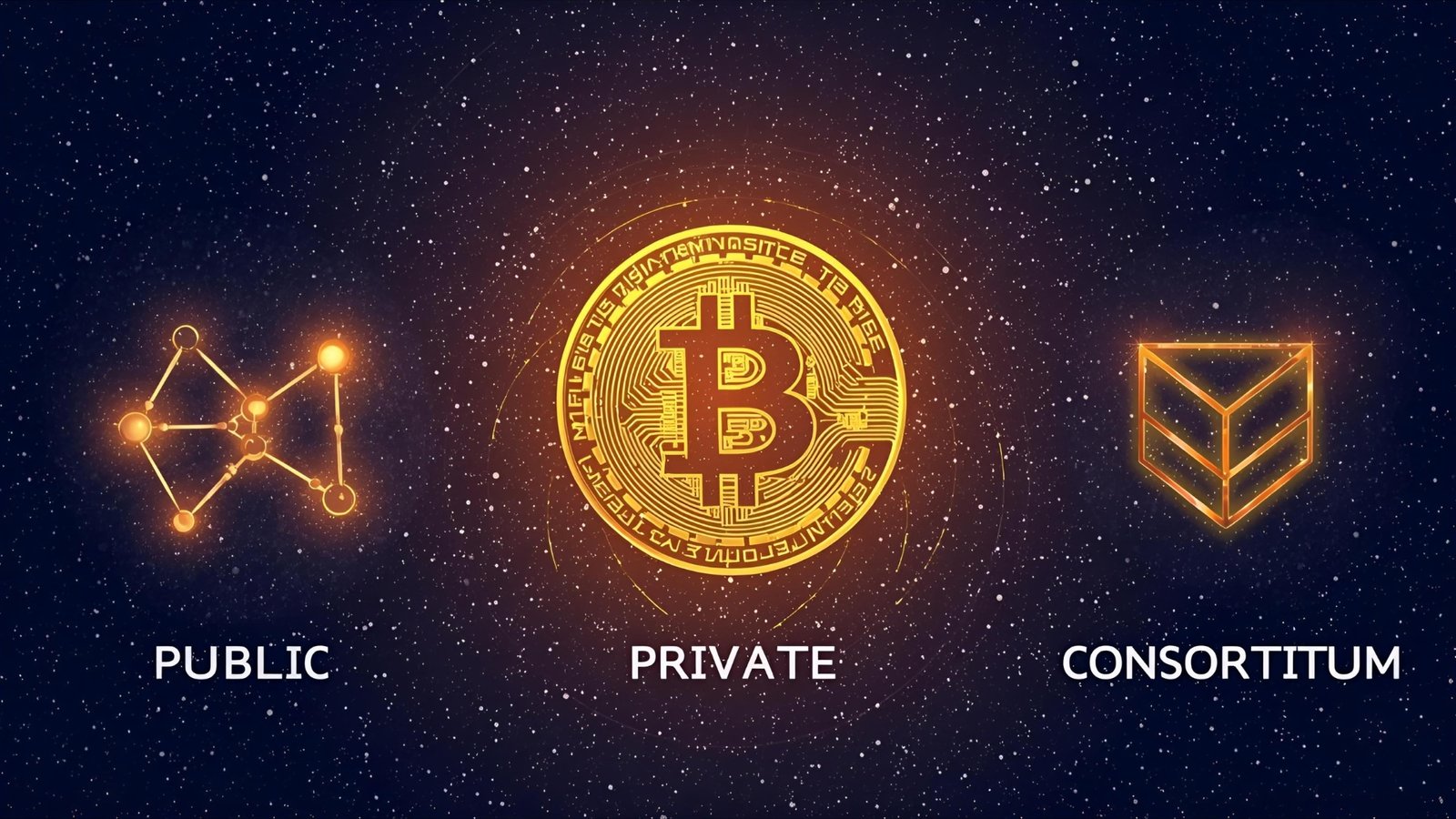
Public vs private vs consortium blockchains
Public blockchains
A public blockchain is open to anyone. You can read, write, and verify data without permission. They power cryptocurrencies, DeFi, NFTs, and open smart contract platforms. Their strength is censorship resistance and global composability; their challenges are throughput, transaction fees, and regulatory scrutiny.
Private blockchains
A private blockchain restricts participation to an organisation or a defined group. Access control, privacy features, and compliance tooling make them attractive for internal audit, document notarization, and data integrity. They trade off some decentralisation to gain performance and governance clarity.
Consortium or permissioned networks
A consortium blockchain sits between the two extremes. Multiple organisations share a network and jointly govern rules. This model is popular in trade finance, logistics, healthcare data exchange, and cross-border payments, where competitors need a shared source of truth but cannot expose all data publicly.
Smart contracts: code that executes agreements
Smart contracts are programs stored on a blockchain that run when conditions are met. They encapsulate business logic—escrow releases, token issuance, royalty splits, or access control—and execute automatically. Because their state and code are recorded on a shared ledger, results are transparent and auditable. Developers write these contracts in languages such as Solidity, Rust, Move, or JavaScript-like dialects, depending on the chain.
The power of smart contracts lies in composability. A lending app can use a decentralised price feed; a marketplace can plug into a settlement layer; an identity credential can gate access to services. This open, interoperable design encourages rapid innovation in decentralised finance (DeFi), gaming, tokenisation, and digital identity.
Tokenisation: representing value on the chain
Tokens turn rights into programmable objects. A fungible token represents interchangeable units (like stablecoins or loyalty points). A non-fungible token (NFT) represents unique items—art, tickets, academic credentials, or property records. In 2025, a major trend is real-world asset (RWA) tokenisation, where bonds, invoices, commodities, and even carbon credits are mirrored on the chain. The benefits are faster settlement, fractional ownership, improved transparency, and global market access, with risks tied to legal enforcement and custody bridges between physical and digital worlds.
Scalability and performance: L1s, L2s, and beyond
Layer 1 foundations
A Layer 1 (L1) blockchain provides the base consensus and data availability. Classic examples prioritise decentralisation and security, which caps raw throughput. Upgrades have improved performance, but consumer-app scale often requires more.
Layer 2 rollups and sidechains
Layer 2 (L2) solutions move computation off the base layer while storing proofs or summaries back on L1. Optimistic rollups assume transactions are valid by default but allow fraud proofs. Zero-knowledge rollups post cryptographic proofs that attest to correct execution. Sidechains run in parallel with their own validators and bridge assets to the main chain. Together, these techniques cut fees and raise throughput while inheriting L1 security to varying degrees.
Sharding and parallelisation
Some networks employ sharding, splitting the state across multiple partitions processed in parallel. Others use parallel execution and advanced virtual machines that optimise transaction ordering. The goal is the same: scale the number of users and applications without sacrificing trust guarantees.
Privacy on blockchain: transparency with confidentiality
Blockchains are often transparent by design, which is great for auditability but problematic for sensitive data. A wave of privacy tools balances openness with confidentiality. Zero-knowledge proofs (ZK) let you prove something is true without revealing the underlying data. Confidential transactions, secure multi-party computation, encrypted mempools, and permissioned channels protect details while keeping the system verifiable. In healthcare, for example, a lab result can be verified against a chain-anchored credential without exposing a patient’s identity or the raw data.
Security model: where the trust actually lives
What is Blockchain and How Does it Work? A blockchain’s security comes from multiple layers. Cryptography ensures signatures cannot be forged. Consensus makes it expensive to rewrite history. Economic incentives reward honest behaviour and punish attacks. Yet end users are only as secure as their key management. Losing a seed phrase can mean losing access to assets. That is why 2025 features more smart-account wallets, social recovery, and hardware security modules that lower the risk of human error while preserving self-custody.
Applications also rely on audited smart contracts and responsible governance. Vulnerabilities in contract code can be exploited, and poorly designed bridges between networks have been prime targets. Professional audits, bug bounties, and modular, minimal designs reduce the attack surface and strengthen trust.
Governance: who makes the rules?
Public blockchains evolve through community proposals, client-team coordination, and validator voting. On-chain governance mechanisms let token holders signal preferences; off-chain discussions and core developer calls handle technical specifics. In permissioned or consortium networks, governance is defined by legal agreements, voting rules, and technical access controls. The key is clarity: network participants need to understand upgrade paths, emergency procedures, and how disputes are resolved.
Regulation and compliance: the 2025 landscape
In 2025, most regions recognise that not all tokens are alike. Payment tokens, utility tokens, and asset-backed tokens face different rules. KYC/AML requirements affect fiat on-ramps, stablecoin issuers, and many DeFi gateways. Data protection laws influence how identity and credentials are stored and shared. For businesses, the best practice is building with compliance in mind: adopt travel-rule messaging where required, use attested identities for institutional access, and segregate consumer and enterprise flows per jurisdiction.
Real-world use cases that matter now

Cross-border payments and remittances
Traditional international transfers can be slow and expensive. Blockchain enables near-real-time settlement and lower fees, especially with stablecoins that minimise volatility. For small businesses, this means faster cash flow; for families, more money arrives at home.
Supply chain traceability
From coffee beans to aircraft parts, supply chains span many intermediaries. A shared ledger improves provenance, recall precision, and compliance with environmental or labour standards. When multiple parties record events on a common chain, audits become quicker and disputes easier to resolve.
Identity, credentials, and access
Decentralised identifiers (DIDs) and verifiable credentials give people control over their data while letting services verify claims. A university can issue a credential that a student stores privately but presents anywhere; an employer verifies it instantly without contacting the school. This lowers fraud and paperwork while enhancing privacy.
Capital markets and asset tokenisation
Tokenised treasuries, fund shares, or invoices can settle faster and enable fractional ownership. Programmable settlement reduces back-office costs and operational risk. Institutional adoption is growing as custodians, auditors, and compliance frameworks mature.
Gaming, media, and loyalty
Games benefit from portable in-game assets and verifiable scarcity. Media companies use NFTs for ticketing, fan access, and digital collectibles with programmable royalties. Brands build loyalty tokens that travel across partners, exchanging value in real time.
Benefits of blockchain: why organisations adopt it
Businesses choose blockchain for transparency, auditability, resilience, and automation. A shared ledger eliminates reconciliation between parties who do not fully trust each other. Smart contracts trigger payouts, compliance checks, and asset movements automatically, reducing delays and human error. Open standards and interoperability can lower vendor lock-in. For public networks, open access expands markets and developer ecosystems; for permissioned networks, full-stack control and privacy aid compliance.
Risks and limitations: what to watch out for
No technology is a cure-all. Blockchains face scalability limits, though L2S and optimised L1S help. User experience can be confusing, especially around key recovery and fees. Bridge security and contract bugs remain high-impact risks. Regulatory uncertainty varies by country and use case. Data immutability is a double-edged sword: it prevents hidden edits but requires careful design when sensitive information or the right to be forgotten is involved. Finally, projects must consider governance capture—how token concentration or validator cartels could sway decisions.
Choosing the right blockchain approach in 2025
Clarify your trust assumptions
If all parties fully trust a central administrator, a conventional database may be enough. If multiple parties require a shared, tamper-evident history without a single owner, a permissioned blockchain can fit. If you need global access, composability, and developer ecosystems, a public blockchain may be the best match.
Map requirements to platform features
List the non-negotiables: throughput, finality time, privacy, costs, compliance, and developer tooling. Compare candidate platforms and L2S on these axes, including the maturity of wallets, custody, and monitoring.
Plan for security and compliance from day one
Adopt key management best practices, contract audits, formal verification for critical logic, and clear governance. If you handle regulated assets or personal data, engage counsel early and build in KYC/AML and data-protection controls where needed.
The future of blockchain: trends to watch
By 2025, What is Blockchain and How does it Work, several shifts are shaping the road ahead. Zero-knowledge technology is moving from research to production, enabling private yet verifiable computations. Intent-based transaction systems and account abstraction are improving onboarding by hiding complexity. Interoperability standards reduce fragmentation between chains, and data availability layers and modular stacks let builders mix and match components. Enterprises are focusing on real-world asset pipelines, while user-facing apps emphasise stablecoins, simple wallets, and clear value—speed, savings, and access—over jargon.
Glossary of essential blockchain terms
Block
A batch of validated transactions plus metadata, linked to the prior block with a cryptographic hash.
Node
A computer that stores and validates the blockchain ledger, enforcing protocol rules.
Wallet
Software or hardware that manages private keys and signs transactions, enabling control over on-chain assets.
Gas/Fees
A payment to compensate validators for processing and storing transactions, preventing spam and allocating scarce compute.
Finality
The point after which a transaction is effectively irreversible, economically or technically.
Putting it all together: a mental model that sticks
Think of a blockchain as a shared spreadsheet that anyone can verify, but no single party can secretly alter. Rows are transactions; pages are blocks; page numbers are hashes; the librarians are validators. The spreadsheet never deletes rows; it only adds more. Rules for adding pages are public and enforced by many librarians at once. If one librarian tries to slip in a fake page, the others will not accept it because the numbers will not match. This metaphor captures the elegant balance of openness, security, and automation that makes blockchain valuable beyond the hype.
Conclusion
Blockchain is not magic; it is an engineering system for coordinating strangers around a single, tamper-evident record. In 2025, it powers payment rails, credentials, markets, and cross-company data sharing. The fundamentals—distributed ledgers, cryptographic hashes, keys, and consensus—create a bedrock of integrity. Smart contracts turn that bedrock into programmable workflows. Layer 2 scaling, privacy tech, and tokenisation are making it cheaper, faster, and more practical. Success still depends on thoughtful choices: pick the right network model, build with security and compliance from day one, and focus on real user value instead of buzzwords. With that mindset, you can evaluate opportunities, avoid common pitfalls, and deploy blockchain where it truly fits.
FAQs
Q: What is the simplest definition of blockchain?
A blockchain is a shared, append-only ledger maintained by many computers. Each block references the previous one with a hash, making changes to history obvious. Consensus rules decide which block is valid so that participants can trust the data without trusting a single administrator.
Q: How is blockchain different from a traditional database?
Traditional databases are usually controlled by one organisation and allow edits and deletions. A blockchain distributes control across many nodes and is append-only, favouring transparency and tamper-evidence over raw write flexibility. The trade-off brings shared integrity in multi-party environments.
Q: Do I need cryptocurrency to use blockchain?
Not always. Public blockchains generally require paying fees in a native token, but private and consortium networks can abstract fees or use internal accounting. Many enterprise use cases—supply chain, identity, document notarization—use blockchain without speculative tokens.
Q: Are blockchains secure and private?
They are secure when designed and used properly, relying on cryptography, consensus, and economic incentives. Privacy varies by system. Public chains are transparent, but techniques like zero-knowledge proofs and permissioned channels can protect sensitive data while preserving verifiability.
Q: What should a business evaluate before adopting blockchain?
Clarify the problem: do multiple parties need a single source of truth without a central owner? Map requirements—throughput, finality, privacy, compliance, and cost—to candidate platforms. Plan for key management, smart-contract audits, and clear governance. Success depends on solving a real customer or operational pain point, not on using blockchain for its own sake.
Read More: 4 Types of Blockchain Technology Explained for Business
