


XRP Ledger (XRPL) is entering a new phase of development that could redefine its role in the broader crypto ecosystem. For years, XRPL has been known for its speed, low transaction costs, and efficiency in cross-border payments. Now, the focus is expanding beyond payments toward something more ambitious: institutional DeFi.
Institutional DeFi refers to decentralized finance infrastructure designed specifically for regulated financial entities such as banks, asset managers, payment providers, and fintech firms. Unlike retail DeFi, which prioritizes permissionless access and experimentation, institutional DeFi emphasizes compliance, risk management, privacy, and operational reliability. This strategic shift positions XRPL not as a competitor to every smart-contract blockchain, but as a specialized financial ledger built for real-world adoption.
As XRPL prepares to introduce lending protocols, permissioned environments, and advanced compliance features, market participants are asking an important question: will institutional DeFi boost XRP price? The answer depends on how adoption unfolds, how value flows through the network, and whether XRP remains central to that activity. Understanding the implications requires a closer look at what institutional DeFi on XRPL actually involves.
Understanding institutional DeFi on the XRP Ledger
Institutional DeFi is fundamentally different from the DeFi most crypto users are familiar with. While traditional DeFi emphasizes open access and composability, institutional DeFi prioritizes controlled participation and regulatory alignment without sacrificing blockchain efficiency.
On XRPL, institutional DeFi is about enabling financial activity that institutions are already comfortable with—such as lending, asset issuance, and liquidity provision—but doing so on a decentralized ledger. This approach allows institutions to benefit from faster settlement, reduced counterparty risk, and transparent infrastructure while still meeting legal and compliance obligations.
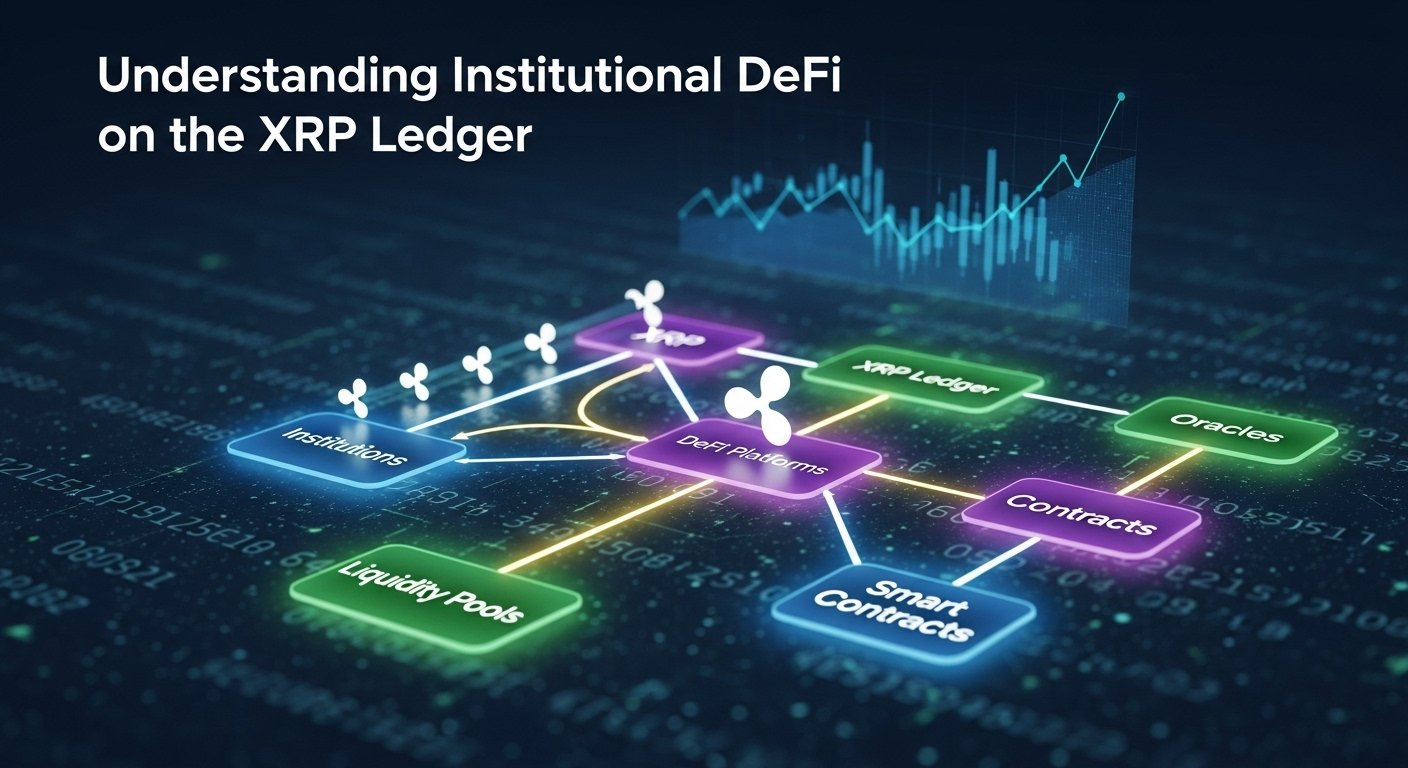
The XRP Ledger is well-suited for this evolution due to its deterministic transaction finality, low fees, and built-in decentralized exchange. Rather than layering complexity on top of the network, XRPL aims to integrate institutional requirements directly into the protocol and ecosystem. This design philosophy could make institutional DeFi more practical and scalable than purely experimental DeFi models.
Why XRPL’s institutional DeFi strategy is different
Many blockchains are attempting to attract institutions, but XRPL’s approach stands out because it focuses on specialization rather than generalization. Instead of trying to be everything at once, XRPL concentrates on being a financial-grade ledger optimized for settlement, liquidity, and regulated activity.
A key differentiator is XRPL’s emphasis on optional permissioning. Institutions can participate in environments where counterparties are verified and rules are enforced, while the base ledger remains decentralized. This balance allows XRPL to support both open innovation and regulated use cases without forcing institutions into uncomfortable operational models.
Another difference is XRPL’s conservative approach to upgrades. Changes to the ledger require broad validator consensus, which reduces the risk of sudden protocol shifts. While this can slow development, it also increases predictability—an important factor for institutions managing large amounts of capital.
Key components of XRPL’s institutional DeFi roadmap
Native lending and credit markets
One of the most anticipated developments in XRPL’s institutional DeFi roadmap is the introduction of native lending functionality. Credit markets are central to institutional finance, enabling capital efficiency, yield generation, and structured risk exposure.
Unlike many retail-focused lending protocols, XRPL’s lending vision emphasizes predictable terms, transparent risk management, and compatibility with regulated entities. If implemented successfully, lending on XRPL could unlock significant on-chain liquidity while attracting participants who previously avoided DeFi due to risk concerns.
For XRP, the relevance lies in how lending markets use the token. If XRP plays a role as collateral, settlement currency, or liquidity bridge, demand for the asset could increase alongside lending activity.
Compliance-first infrastructure
Compliance is often the biggest barrier preventing institutions from participating in DeFi. XRPL’s institutional DeFi strategy directly addresses this challenge by introducing tools that make on-chain activity safer and more controllable.
Features such as identity credentials, asset freezing mechanisms, and transaction simulation allow institutions to test and manage risk before executing live transactions. These tools help reduce operational errors and provide assurances that compliance requirements can be met consistently.
By embedding compliance awareness into the ecosystem, XRPL lowers the friction for institutions entering decentralized finance. This approach increases the likelihood of long-term adoption rather than short-lived pilot programs.
Permissioned markets and controlled liquidity
Permissioned environments are a cornerstone of institutional DeFi on XRPL. These environments allow issuers and market operators to restrict participation to verified entities, enabling compliant trading of tokenized assets.
This structure is especially important for real-world assets such as bonds, equities, and funds. Institutions are far more likely to tokenize and trade these assets on-chain if they can control who participates and how assets behave.
If permissioned liquidity grows on XRPL, the network could become a hub for regulated on-chain markets. That, in turn, could increase transaction volumes and strengthen XRPL’s position as institutional infrastructure.
Privacy with accountability
Privacy is often misunderstood in crypto discussions. For institutions, privacy is not about hiding activity but about protecting sensitive financial information while remaining compliant with audits and regulations. XRPL’s exploration of privacy-preserving technologies aims to strike this balance. Confidential transactions can allow institutions to operate without exposing proprietary strategies or client positions to the public, while still enabling verification when required. This capability could unlock higher-value activity that would otherwise remain off-chain, increasing overall network usage and relevance.
XRPL’s existing DeFi foundation
While institutional DeFi represents the next phase, XRPL already has important DeFi components in place. The ledger includes a native decentralized exchange and automated market maker functionality, providing a foundation for liquidity and price discovery.
Recent enhancements allow token issuers to apply compliance-related controls within liquidity pools. These features make it easier for regulated assets to participate in DeFi without violating legal obligations.
The presence of this infrastructure means institutional DeFi on XRPL is not starting from zero. Instead, it builds on a mature base that has been operating reliably for years.
How institutional DeFi could boost XRP price
Increased utility demand for XRP
XRP’s value proposition has always been tied to liquidity and settlement efficiency. If institutional DeFi expands on XRPL, settlement flows could increase significantly. More on-chain activity can translate into greater demand for XRP if the token remains integral to those processes.
Utility-driven demand tends to be more sustainable than speculative demand. If XRP is consistently used in lending, trading, and settlement workflows, price support can strengthen over time.
Improved liquidity and market efficiency
Institutional participation often leads to deeper liquidity and more stable markets. Larger participants bring capital, professional market-making, and longer-term strategies.

As liquidity improves, XRP markets may experience tighter spreads and reduced volatility. These conditions can make the asset more attractive to both institutional and retail investors, potentially supporting higher valuations.
Narrative shift and investor perception
Markets are driven not only by fundamentals but also by perception. If XRPL successfully positions itself as a leading platform for institutional DeFi, investor sentiment around XRP could change. A shift from viewing XRP as primarily a payments token to seeing it as part of a broader institutional finance ecosystem could attract new capital. Narrative-driven inflows often amplify price movements, especially during favorable market cycles.
Risks and limitations to consider
Despite the potential upside, institutional DeFi on XRPL is not guaranteed to boost XRP price quickly or dramatically. Institutional adoption is slow and cautious, often taking years rather than months. Competition is also intense. Many blockchains are targeting tokenization and institutional finance, and XRPL must demonstrate clear advantages to stand out.
Most importantly, XRP must capture value from increased activity. If institutional DeFi growth primarily benefits stablecoins or tokenized assets without significant XRP usage, price impact could be limited.
Conclusion
XRPL’s preparation for institutional DeFi represents a meaningful evolution of the network. By focusing on lending, compliance, permissioned markets, and privacy, XRPL is positioning itself as a serious contender for regulated on-chain finance.
Whether this shift boosts XRP price depends on execution and adoption. If institutional DeFi drives sustained network activity and keeps XRP central to liquidity and settlement, the long-term outlook could be positive. However, success will require patience, real usage, and clear value capture.
Institutional DeFi is not a short-term hype cycle. It is a structural bet on how finance may operate on-chain in the future—and XRPL is making its move early.
FAQs
Q: What is institutional DeFi on XRPL?
Institutional DeFi on XRPL refers to decentralized finance infrastructure designed for regulated entities, emphasizing compliance, controlled participation, and financial-grade reliability.
Q: How could institutional DeFi affect XRP price?
XRP price could benefit if institutional DeFi increases network activity and uses XRP for settlement, liquidity, or collateral, creating sustained demand.
Q: Why do institutions prefer permissioned DeFi environments?
Permissioned environments allow institutions to meet regulatory requirements by restricting access to verified participants and enforcing asset controls.
Q: Is XRPL competing with Ethereum and other DeFi chains?
XRPL is not trying to replace general-purpose DeFi platforms. Instead, it focuses on specialized institutional finance use cases where compliance and efficiency are critical.
Q: Is institutional DeFi a short-term catalyst for XRP?
Institutional DeFi is a long-term strategy. While it can influence market sentiment, meaningful price impact depends on gradual adoption and real-world usage.
