


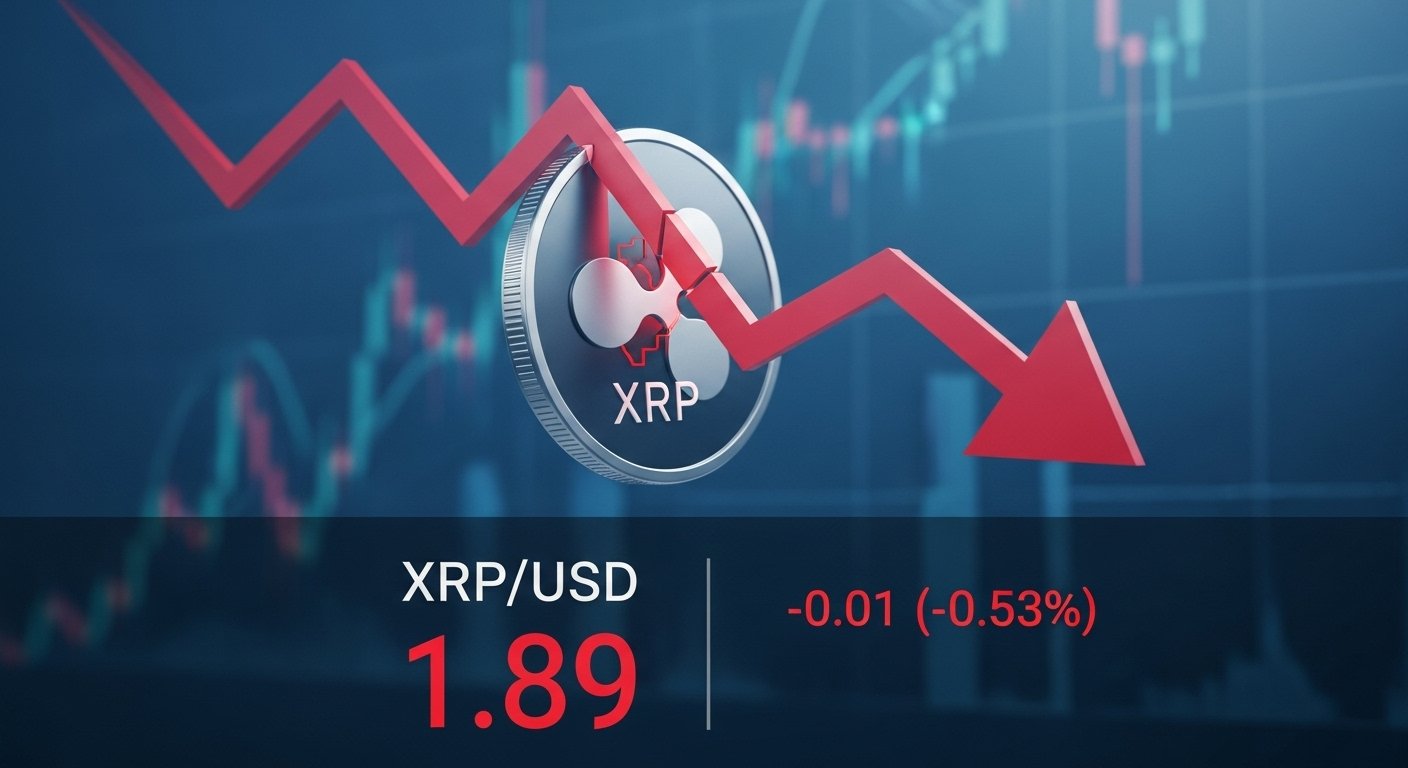
XRP has once again found itself at the center of a familiar crypto dilemma: strong long-term fundamentals colliding with short-term macroeconomic fear. The digital asset slipped below the psychologically important $1.90 level as broader market anxiety surrounding the U.S. Federal Reserve overshadowed what would normally be considered a highly bullish development—a major enterprise partnership between Ripple and DXC Technology.
Under typical market conditions, news of a global IT services leader integrating Ripple’s blockchain infrastructure into core banking systems would dominate headlines and sentiment. Instead, traders largely ignored the announcement, choosing caution over optimism as uncertainty around interest rates, inflation, and monetary policy direction weighed heavily on risk assets.
This divergence between price action and fundamentals highlights the ongoing tension in crypto markets. While XRP’s adoption narrative continues to strengthen, short-term price movement remains tightly linked to macroeconomic signals. Understanding why XRP dropped below $1.90 requires examining both sides of this equation—Federal Reserve anxiety and the deeper implications of the DXC partnership.
Why XRP Fell Below $1.90 Despite Positive News
The move below $1.90 was not driven by a breakdown in XRP’s ecosystem or a loss of confidence in Ripple’s strategy. Instead, it reflected a broader market reaction to uncertainty. When traders anticipate potential shifts in monetary policy, they tend to reduce exposure to volatile assets, including cryptocurrencies.
XRP, often viewed as a high-beta digital asset, is particularly sensitive to changes in risk sentiment. As expectations around interest rates fluctuate, capital temporarily flows away from speculative markets, regardless of individual project developments.
The Federal Reserve Effect on Crypto Markets
The Federal Reserve plays an outsized role in shaping liquidity conditions. Even the anticipation of a policy decision can influence markets as traders attempt to position ahead of potential outcomes. When uncertainty rises, fear of tighter financial conditions often outweighs optimism about technological progress.
This environment creates short-term selling pressure that can drag prices lower, even when long-term fundamentals remain intact.
Psychological Pressure Around Key Price Levels
The $2.00 level has become a major psychological barrier for XRP. Repeated failures to sustain price action above this area have conditioned traders to expect selling pressure near that range. When XRP failed to reclaim $2.00, momentum weakened, making the $1.90 support level vulnerable.
Once price dips below such a widely watched threshold, it can trigger short-term stop losses and algorithmic selling, accelerating downside movement.
Understanding the DXC–Ripple Partnership
While price action grabbed attention, the partnership between Ripple and DXC Technology is strategically significant. DXC is a global enterprise technology provider with deep roots in financial services. Its decision to integrate Ripple’s blockchain solutions into the Hogan core banking platform represents a meaningful step toward mainstream institutional adoption.

The collaboration is designed to allow banks to adopt digital asset custody and blockchain-based payment solutions without overhauling existing infrastructure—a critical factor for conservative financial institutions.
Integration Into Core Banking Systems Matters
Core banking platforms serve as the operational backbone of financial institutions. Any technology that integrates at this level gains credibility and accessibility. By embedding Ripple’s capabilities into Hogan, DXC is effectively lowering the barrier for banks to explore blockchain solutions within a familiar framework.
This approach aligns with how institutions prefer to adopt innovation: incrementally, securely, and without operational disruption.
Custody and Payments as Adoption Gateways
Digital asset custody is often the first step for institutional involvement in crypto. Banks must be able to securely hold and manage assets before expanding into transaction services. The partnership’s focus on both custody and payments suggests a long-term roadmap rather than a short-lived experiment.
For XRP, this creates potential future demand through institutional usage, even if that demand is not immediately reflected in market price.
Why Markets Didn’t React Immediately
Enterprise adoption moves slowly. Announcements signal intent, but markets typically wait for execution—pilot programs, live deployments, and measurable transaction volume. Until tangible results emerge, traders tend to discount long-term potential in favor of near-term risk considerations.
XRP Price Today: Key Technical Levels to Watch
Technical analysis plays a crucial role in short-term market behavior. As XRP slipped below $1.90, traders began assessing whether buyers would defend this zone or allow price to explore lower levels.
Support Zones and Downside Risk
The $1.90 region has acted as a short-term support area. A sustained break below it could open the door to a deeper retracement toward the mid-$1.80 range. However, brief dips below support are not uncommon in crypto markets and can sometimes signal a liquidity sweep before a rebound.
Resistance Near $2.00
On the upside, $2.00 remains the most important resistance level. A decisive move above it would likely restore bullish momentum and shift market sentiment. Until then, XRP may continue to trade cautiously within a tight range.
Volume and Market Structure
Volume trends provide insight into conviction. High-volume selloffs may indicate panic, but they can also mark temporary exhaustion points. Low-volume declines, on the other hand, suggest hesitation rather than strong bearish conviction.
Why Fed Anxiety Continues to Dominate Crypto Sentiment
Macroeconomic uncertainty has a way of overwhelming sector-specific narratives. Crypto markets, despite their decentralized ethos, remain deeply connected to global liquidity cycles.
Liquidity and Risk Correlation
When financial conditions tighten, speculative assets often suffer. Investors prioritize capital preservation over growth, reducing exposure to assets perceived as risky. This dynamic explains why crypto prices often react sharply to macroeconomic signals.
Timing Mismatch Between Adoption and Price
Real-world adoption unfolds over months or years. Market pricing reacts in minutes. This mismatch can create frustration for long-term holders but is a natural feature of speculative markets.
Enterprise partnerships like DXC and Ripple’s collaboration build foundational value, even if price action lags.
The Bigger Picture for XRP and Institutional Adoption
The DXC partnership reinforces Ripple’s strategy of targeting institutional infrastructure rather than retail hype. By focusing on compliance-ready, scalable solutions for banks, Ripple positions XRP within a growing narrative of tokenized finance and blockchain-enabled payments.
Why Institutions Care About Seamless Integration
Financial institutions prioritize stability. Solutions that work within existing systems are far more attractive than disruptive overhauls. This partnership aligns with that reality, increasing the likelihood of gradual but sustained adoption.
Long-Term Implications for XRP
If banks begin offering digital asset services powered by Ripple’s infrastructure, XRP could benefit from increased utility and relevance within the financial system. While this won’t happen overnight, it strengthens the asset’s long-term value proposition.
Conclusion
XRP’s drop below $1.90 highlights the ongoing struggle between short-term macro pressure and long-term adoption progress. Federal Reserve uncertainty has dampened risk appetite, pushing price lower despite a strategically important partnership between Ripple and DXC Technology.
While the market focuses on interest rates and liquidity conditions, the groundwork for institutional adoption continues to expand quietly. For XRP holders, the key takeaway is balance: near-term volatility driven by macro forces does not negate the long-term significance of enterprise integration and real-world use cases.
As macro uncertainty fades, the market may once again turn its attention to fundamentals—and when it does, partnerships like DXC could play a central role in shaping XRP’s future.
FAQs
Q: Why did XRP fall below $1.90?
XRP declined due to broader market uncertainty linked to Federal Reserve policy expectations, which reduced risk appetite across crypto markets.
Q: What is the DXC and Ripple partnership about?
The partnership focuses on integrating Ripple’s blockchain solutions into DXC’s core banking platform to help banks adopt digital asset custody and payment services.
Q: Is the DXC partnership bullish for XRP?
From a long-term perspective, yes. It strengthens institutional adoption potential, though it may not immediately impact price.
Q: What price levels should XRP traders watch?
Key levels include support near $1.90 and resistance around $2.00, which currently define short-term market structure.
Q: Can macroeconomic factors override crypto fundamentals?
Yes. Short-term price movements are often driven by liquidity and sentiment, even when long-term fundamentals remain strong.
Also Read: Crypto Price Prediction Today Bitcoin Ethereum & XRP
